guide
Small wine cellar cooling units: closets, under-stairs nooks and rooms up to 500 ft³
How to cool a wine closet or small room of about 100 to 500 ft³: when you need a unit at all, the entry models makers publish for small rooms, why oversizing hurts most here, and where the heat goes.
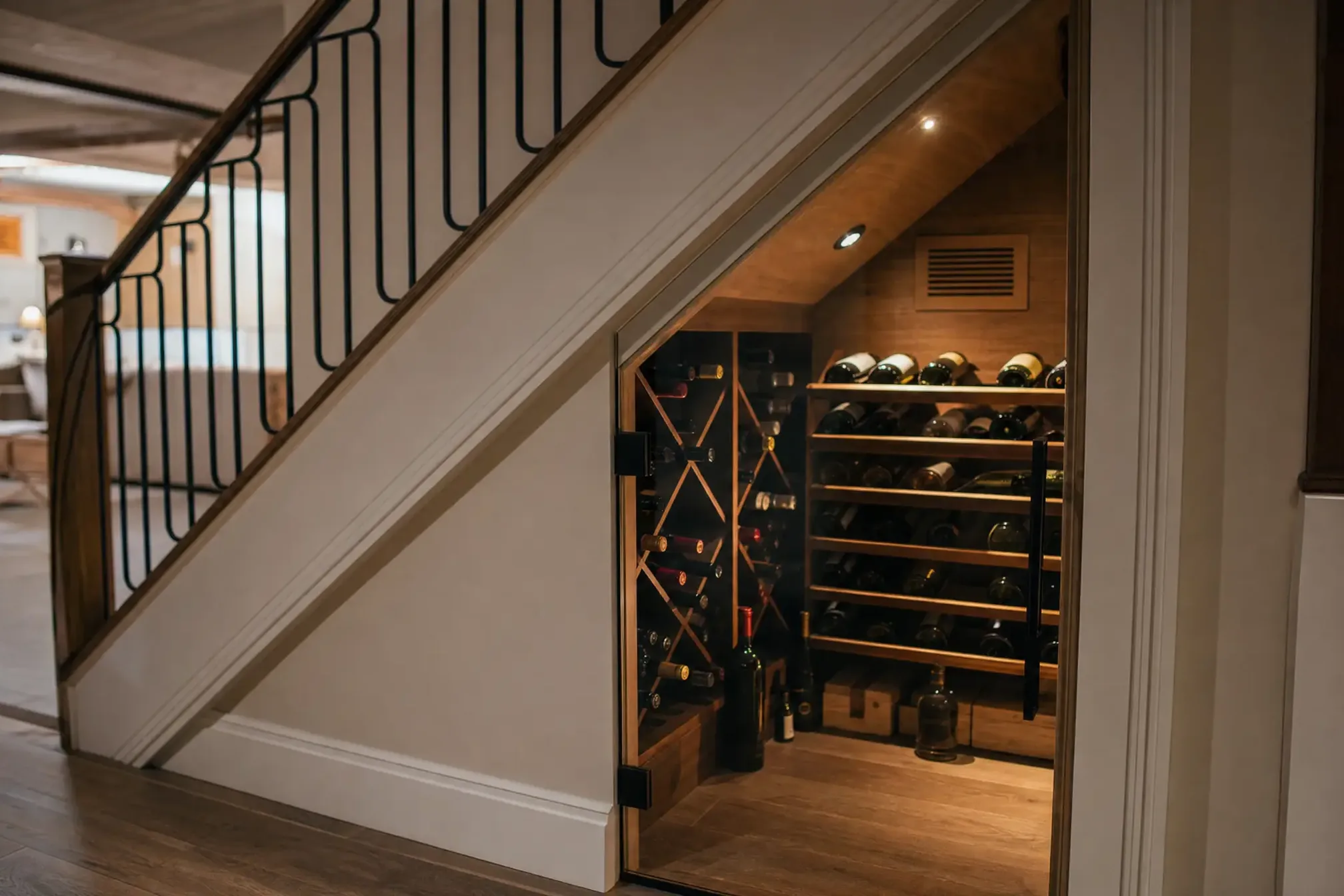
A wine closet is easy to build and surprisingly hard to cool well. Almost everything about a closet works against the unit: a tiny air volume that swings fast, a door opening into a hallway, often a glass panel, and usually nowhere sensible for the hot exhaust to go.
This guide covers small rooms of roughly 100 to 500 ft³ (3 to 14 m³): reach-in closets, under-stairs nooks, and small walk-ins. It covers when a small wine cellar cooling unit is worth it, which entry models makers publish for small rooms, and the installation details that decide whether the unit works. For the broader picture, start with our guide to wine cellar cooling units.
Does a small wine closet need a cooling unit at all?
Not always. Our target across this site is a steady 55°F (13°C) at 50–70% relative humidity, with about 60% as a comfortable middle. Our guide to ideal cellar temperature and humidity explains why a steady 60°F is still safe and why swings matter more than the exact number.
A closet can work without a unit when:
- It sits in a cool basement that already logs in the 50s °F most of the year and changes slowly between seasons.
- It has no exterior wall in the sun and no HVAC supply or return inside it.
- The wine turns over quickly. A space that holds the low 60s °F steadily is fine for bottles you will drink within two or three years.
Our guide to designing a small passive cellar covers the conditions in detail. Before you buy anything, log temperature and humidity in the space for a full year, or at least through one summer.
A small room needs active cooling when:
- It is on a main or upper floor. A hallway closet tracks the house, which is typically set for people, not wine.
- It regularly passes about 70°F (21°C) in summer. Above that, aging speeds up noticeably.
- You plan to age wine for a decade or more and want 55°F, not whatever the house happens to be.
- It has a glass front or glass door. Glass couples the closet to the room outside it.
Under-stairs cellars are a special case: the stairwell collects warm air, so they usually need cooling even in a basement.
Why is oversizing worse in a small room?
Every cooling guide on this site says the same thing: size to the calculated load, not the biggest unit you can afford. Our BTU sizing guide explains short cycling in full. In a closet the effect is sharper, for three reasons.
There is very little air to cool. A 200 ft³ (5.7 m³) closet holds a small mass of air. An oversized unit brings that air down to the setpoint in a few minutes, shuts off, and starts again soon after. The bottles, which hold most of the thermal mass, barely see the cycle; the air and the sensor see all of it.
Humidity never settles. A cooling coil removes moisture only while it runs long enough to get cold and drain. Short cycles leave the coil wet when the compressor stops, and some of that water goes back into the room. The result is humidity that runs high or swings, which is the opposite of what most closet owners expect from an oversized unit. Our guide to wine cellar humidity and mold covers what high readings do to labels and racking.
Short cycles wear the compressor. Frequent starts are hard on it, and a small unit in a small room can rack up a lot of them.
Size from a load calculation, not from the largest volume a spec sheet allows. And if the unit offers a bottle probe that controls from the temperature of liquid in a bottle rather than air, consider it. Several small units list one as standard or as an option, including the WhisperKOOL SC PRO 2000, the Vinotemp Wine-Mate 1500HZD and the Breezaire WKL series. Controlling from the wine rather than the air tends to lengthen cycles.
Which cooling units are made for small rooms?
Most makers offer an entry through-the-wall model aimed at wine closets and small rooms. The table lists the smaller models from several makers, ordered by the room size each maker publishes. The figures come from each maker's product page or spec sheet as we read them in November 2026.
| Model | Maker's room size | Published capacity (rating conditions) | Published noise | List price seen, Nov 2026 |
|---|---|---|---|---|
| Vinotemp Wine-Mate 1500HZD | 90 ft³ (2.5 m³) | 1,500 BTU/h (conditions not stated) | 50 dBA unit, 47 dBA cabinet (distance not stated on page) | $1,899 (vinotemp.com) |
| Breezaire WKL 1060 | Up to 140 ft³ (4.0 m³) | Not published | 41 dBA (maker's estimate) | Not listed on maker site |
| Vinotemp Wine-Mate 2500HZD | 200 ft³ (5.7 m³) | 2,500 BTU/h (conditions not stated) | 57 dBA unit, 53 dBA cabinet | $2,099 (vinotemp.com) |
| Breezaire WKL 2200 | Up to 265 ft³ (7.5 m³) | Not published | 56 dBA (maker's estimate) | Not listed on maker site |
| CellarPro 1800XT-HE | 1800 series sizing table covers 100–400 ft³ (2.8–11.3 m³) | 1,642 total / 1,473 sensible BTU/h at 55°F cellar | 47 dBA (rear) | $2,095 (cellarprocoolingsystems.com) |
| WhisperKOOL SC PRO 2000 | 300 ft³ (8.5 m³), R-19 minimum | 1,453 BTU/h at 85°F condenser intake | Not published | $3,165 (whisperkool.com) |
| CellarCool CX2200 | 300 ft³ (8.5 m³) | 1,453 BTU/h at 85°F air entering the condenser | 63 dBA evaporator, 63 dBA condenser | Not listed on maker site (sold through dealers) |
| Wine Guardian TTW01B Classic | Not published | 1,440 BTU/h total at 55°F cellar, 75°F condenser air (1,070 at 90°F) | 51.9 dBA evaporator, 55.7 dBA condenser, at 6 in | $3,039 (wineguardian.com) |
| Wine-R WR2500 | Up to 700 ft³ (19.8 m³) at R-20; 900 ft³ (25.5 m³) fully enclosed; no minimum published | 2,337 BTU/h (conditions not published) | Not published | $2,450 (wine-r.com) |
On the makers' own sites, these small through-the-wall units listed between roughly $1,900 and $3,200 in November 2026. Those are list prices for the equipment alone. Installed cost varies with the wall work, electrical and drain, and our guide to wine cellar cooling unit cost covers the full picture.
Where does the heat go from a closet cooling unit?
This is where most closet projects fail. A through-the-wall unit moves the cellar's heat, plus its own compressor heat, into the space on the other side of the wall, all year. The makers are direct about it:
- Breezaire's WKL instructions ask for at least 3 feet (0.9 m) of unobstructed airflow from the warm-air exhaust, say the exhaust area must be well ventilated, and list unventilated laundry rooms, closets, bathrooms, garages, crawl spaces, attics and humid basements as inappropriate exhaust locations (installation instructions, PDF).
- WhisperKOOL's Slimline LS owner's manual asks for at least 3 feet of horizontal clearance around the unit and warns against venting to closets, bathrooms, attics or small rooms.
- Wine Guardian's through-the-wall manual notes that condenser exhaust air can be 20°F above the air entering it (manual, PDF). In a small space, the unit ends up breathing its own exhaust.
Each maker also publishes a limit for the hot side. WhisperKOOL says the SC PRO 2000 should exhaust into an interior space that does not exceed 85°F (29°C). Vinotemp lists a 78°F (26°C) maximum ambient for the Wine-Mate 1500HZD and 95°F (35°C) for the 2500HZD. CellarPro lists 40°F to 95°F (4°C to 35°C) condenser air for the 1800XT-HE. Breezaire says a WKL unit produces less than its stated capacity once the surrounding temperature is more than 25°F above the cellar setpoint.
So in practice:
- A closet that opens onto a large hallway or living area is usually workable, as long as that room stays inside the unit's range in summer and you accept fan noise there.
- A closet backed by another closet, a pantry or a laundry room is not a good exhaust space without ducting.
- Under stairs, the best case is a storage room behind the cellar; the worst is a main-floor living room.
What if there is no good exhaust space?
You have three routes, in rising order of cost and complexity.
- Duct the hot side. Some small units accept exhaust ducting. The SC PRO 2000 spec sheet lists an optional ducting kit, Wine Guardian offers a duct collar kit, and CellarPro's rear duct kit lets an 1800 series unit sit inside the cellar with its hot-side air ducted up to 100 equivalent feet (50 feet per duct). Breezaire states its WKL units are not designed for ductwork on either side. Check the maker's limits before planning a duct run.
- Move to a ducted self-contained unit in a mechanical room or attic. These start at larger capacities than the closet units above. For example, Panthaire lists its APEX 3500 at 3,353 BTU/h for rooms up to about 900 ft³ (25.5 m³), and WhisperKOOL lists the Phantom 3500 at 4,060 BTU/h. In a 150 ft³ closet, that capacity is a sizing problem to check, not a free upgrade. See ducted wine cellar cooling units compared.
- Use a split system with the condenser outdoors. It solves both heat and noise, at a much higher installed cost. Our self-contained vs ducted-split comparison covers the trade-off.
Where should the unit go in a closet?
Closet walls are usually racking, so wall space is scarce.
- Above the door is the usual answer. The WhisperKOOL Slimline LS and the Wine-R WR2500 are both designed to mount above a door; Wine-R's product sheet lists a 15 5/8 × 9 1/4 in (397 × 235 mm) cutout in a wall 5.5 to 14 in (140 to 355 mm) thick.
- Between standard studs works for units sized for it. WhisperKOOL says the SC PRO 2000 fits between standard wall studs with a one-piece bracket.
- Check how far it projects. CellarPro notes that the front 8 inches of an 1800 series unit must be inside the cellar, which matters in a shallow reach-in.
What about glass doors and glass fronts?
Glass is the fastest way to double a closet's load. Insulated glass rates around R-2, while an insulated wall is R-19 or better. In a small room with only about 160 ft² (15 m²) of wall, a full-lite door is a large share of the envelope.
Several makers' published room sizes assume no glass. Breezaire says glass doors and windows are not included in its calculations and should not be used in a wine enclosure. CellarPro's sizing assumptions for the 1800XT-HE include no glass walls. WhisperKOOL's ratings assume a sealed room with at least R-19 insulation and note that glass reduces the insulation value. Wine-R gives a lower room size for glass-walled rooms than for fully enclosed ones.
If you want glass, use a double-pane insulated unit, keep it to the door if you can, and enter it in the load calculation as its own surface. Our guides to glass wine cellars and wine cellar doors cover the details.
What electrical and drain work does a small unit need?
Small units plug in, but most makers still ask for more than a spare outlet:
- WhisperKOOL SC PRO 2000 and CellarCool CX2200: 115V, 20 amp dedicated circuit, per their spec sheets.
- CellarPro 1800XT-HE: 115V, dedicated 15 amp circuit recommended, with a listed startup draw of 20.5 amps.
- Wine-R WR2500: dedicated 15 amp, 120V circuit.
- Breezaire WKL: GFCI outlet on its own circuit.
- Wine Guardian TTW Classic: outlet within 5 feet of the unit and, for the Classic and Sentinel, outside the cellar; no extension cords.
A hallway closet often shares a circuit, so budget for an electrician.
For condensate, some small units evaporate it (WhisperKOOL lists up to 3 oz per hour for the SC PRO series), and Vinotemp says the 1500HZD needs no drain line. Others require one: Wine-R calls its drain mandatory. Our practice is the same as in our cooling units guide: plan a drain route anyway. An overflowing pan in a closet runs straight into the racks.
Worked example: sizing a 4×6×8 ft wine closet
Take a reach-in closet 4 ft wide, 6 ft long and 8 ft high (1.2 × 1.8 × 2.4 m). That is 192 ft³ (about 5.4 m³), with about 160 ft² (15 m²) of wall and a 24 ft² (2.2 m²) ceiling. Here is how we would run it through our BTU calculator, input by input.
- Dimensions. Length 6, width 4, height 8 (or switch to metric).
- Wall insulation. Enter what the walls actually have. A closet framed in 2×4 studs usually holds R-13 in the cavity; getting to R-19 takes deeper framing or added rigid foam. See our guide to insulation and vapor barriers.
- Ceiling insulation. Often the hardest surface to insulate in a closet with a finished floor above. Enter what fits.
- Floor. "Concrete slab on the ground" in a basement; "Uninsulated floor over a heated space" for a main-floor closet over a finished basement, unless you insulate it.
- Glass. If the door has a glass panel, choose the glazing type and enter its area. A full-lite door 24 × 80 in (0.6 × 2.0 m) is about 13 ft² (1.2 m²).
- Warm side temperature. Use the hallway or room temperature on a hot summer day, not the thermostat setting.
- Cellar set point. 55°F (13°C).
- Door openings per day. Be honest. A closet off the kitchen gets opened more than a cellar in the basement.
- Lighting and equipment. The wattage of any lights left on inside.
The calculator returns a rating to look for and a range of ratings that fit. It also warns that a unit rated more than about 1.5 times its recommendation will short-cycle. We aren't printing a number here, because the answer moves a lot with the inputs. Run it twice: once with a solid door and once with the glass you want, and once more with your hottest summer hallway temperature. The spread between those runs tells you how much the design choices cost in capacity.
Then compare with the table. A 192 ft³ closet sits above the 90 and 140 ft³ ratings, close to the 200 and 265 ft³ ratings, and inside CellarPro's 100–400 ft³ table. Check whether the unit's published capacity was rated at a hot-side temperature near yours, and whether its room size assumes the insulation and glass you actually have. Last, check the exhaust: a closet off a large, cool hallway is a reasonable through-the-wall candidate; one backed by a laundry room is not.
If the numbers and the exhaust space point in different directions, which is common in small rooms, our experts can look at the plan with you before you buy.
FAQ
Small wine cellar cooling questions
- What size cooling unit do I need for a wine closet?
- Run a load calculation with your closet's dimensions, insulation, glass, warm-side temperature and door use, then choose a unit inside the recommended range. A 4 by 6 by 8 ft closet is 192 cubic feet, but insulation and glass can change its load a lot, so volume alone is not enough.
- Can a wine closet cooling unit exhaust into another closet?
- Generally not. Breezaire and WhisperKOOL both warn against exhausting into closets or small rooms, because the space heats up and the unit loses capacity. Exhaust into a large, ventilated room that stays within the unit's rated temperature, or duct the exhaust where the maker allows it.
- Is a bigger cooling unit safer for a small wine cellar?
- No. An oversized unit cools the small volume of air quickly, shuts off, and starts again. It never runs long enough to manage humidity, and frequent starts wear the compressor. Stay inside the range a load calculation gives you.
- Do I need a cooling unit for a closet wine cellar?
- Only if the closet runs warm or swings. A closet in a basement that logs in the 50s °F most of the year can work passively. A main-floor closet that follows the house, or any space that passes about 70°F in summer, needs active cooling for long-term storage.
- Can I put a glass door on a cooled wine closet?
- Yes, with a double-pane insulated glass door that seals on all four sides, entered as its own surface in the load calculation. Several makers' published room sizes assume no glass, so a glass door usually means a larger load than the spec sheet's room size suggests.
New guides from people who build cellars, sent to your inbox.
Planning a cellar? Ask the people who build them.
Contact our expertsKeep reading