guide
Through-the-wall wine cellar cooling units compared: capacity, noise, drains and warranties
A sourced spec comparison of self-contained through-the-wall cellar cooling units from WhisperKOOL, CellarPro, Wine Guardian, Breezaire, CellarCool and Wine-R, with how to read the numbers and which unit type suits which room.
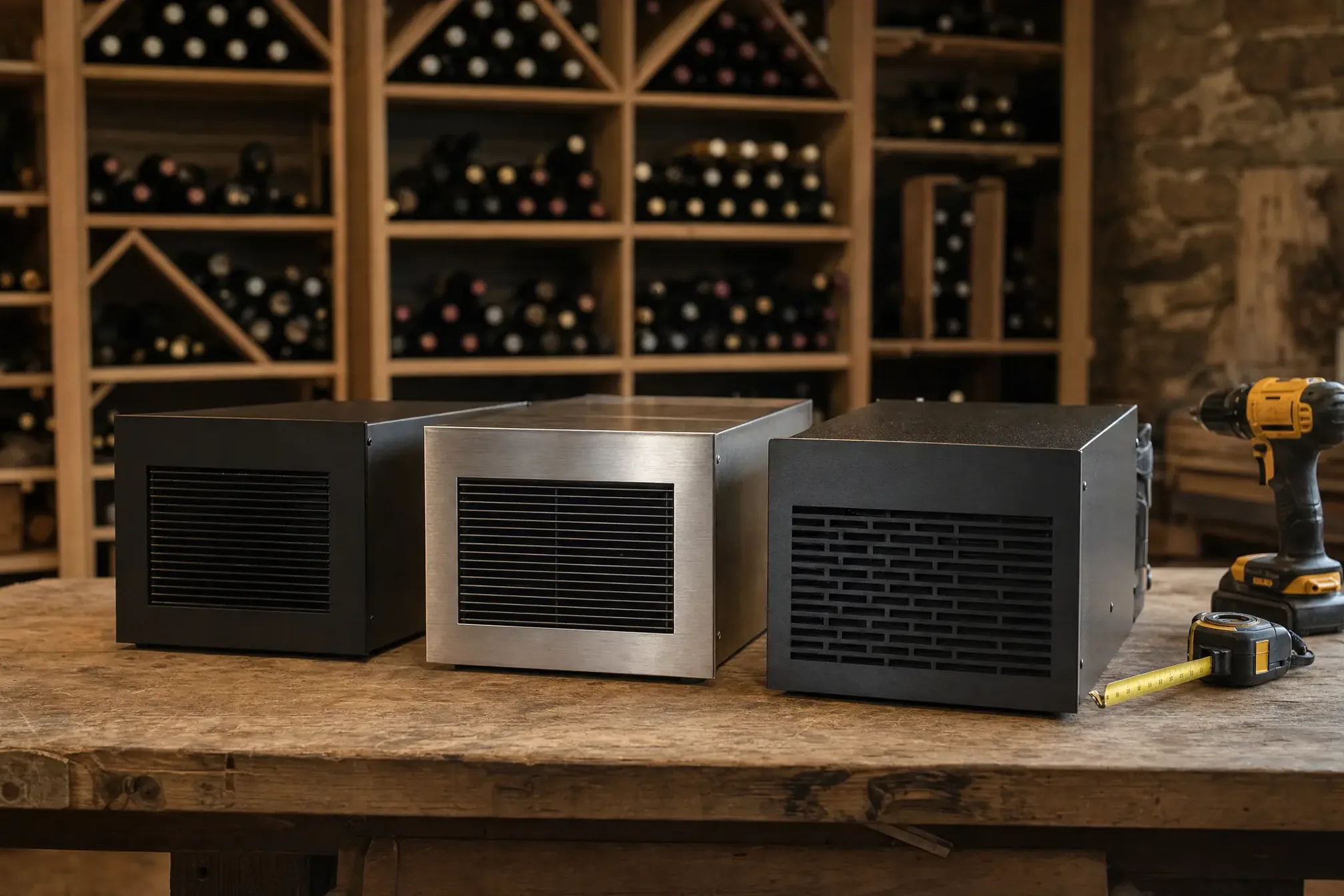
Once you've decided a through-the-wall unit suits your cellar, the next question is which one. Most makers in this class sell a family of units from about 1,500 to 4,000 BTU/h, and their spec sheets look similar until you read the small print.
This page lines up what each maker publishes, explains why the numbers can't be compared at face value, and sorts the units by the kind of room they suit. It doesn't crown a winner, because the right unit depends on your room, your exhaust space, and how much noise you can live with.
If you're still choosing between system types, start with our overview of wine cellar cooling units and self-contained vs ducted-split cooling. For what we look for in any through-the-wall unit, see choosing a through-the-wall cellar cooling unit.
What do the main through-the-wall units publish?
Every figure below comes from the maker's own product page, spec sheet, manual or warranty page, read in November 2026. Where a maker doesn't publish a figure, the cell says so. Capacity cells include the test conditions the maker states, because those conditions change the number.
| Model | Rated capacity (maker's conditions) | Rated room volume | Noise | Condensate | Refrigerant | Warranty |
|---|---|---|---|---|---|---|
| WhisperKOOL SC PRO 2000 | 1,453 BTU/h at 85°F (29°C) condenser intake | About 300 ft³ (8.5 m³), R-19 minimum, sealed | Not published | Evaporates up to 3 oz/hr; drain line required as backup | R-134a/R-513a | 2 years product (plus up to 6 months install grace), 5 years compressor |
| WhisperKOOL SC PRO 3000 | 2,049 BTU/h at 85°F (29°C) condenser intake | About 650 ft³ (18.4 m³) | Not published | As SC PRO 2000 | R-134a/R-513a | As SC PRO 2000 |
| WhisperKOOL SC PRO 4000 | 2,253 BTU/h at 85°F (29°C) condenser intake | About 1,000 ft³ (28.3 m³) | Not published | As SC PRO 2000 | R-134a/R-513a | As SC PRO 2000 |
| CellarPro 1800XT-HE | 1,642 total / 1,473 sensible BTU/h at 55°F (13°C) cellar, 85°F (29°C) ambient | No single figure; the 1800 Series sizing table covers 100–400 ft³ (2.8–11.3 m³) | 47 dBA, measured behind the cellar wall | Drain line strongly recommended for cellars (accessory); optional 100 W heater | R-290 | 5 years parts and labor (115V models) |
| CellarPro 1800XTS-HE | 1,925 total / 1,602 sensible BTU/h, same conditions | Up to 400 ft³ (11.3 m³) at R-19, 85°F, no glass | 54 dBA, measured behind the cellar wall | As 1800XT-HE | R-290 | 5 years parts and labor (115V models) |
| CellarPro 3200VSi-ECX | 3,040 sensible BTU/h at 55°F (13°C) cellar on high fan (2,487 on low) | Up to 800 ft³ (22.7 m³) at R-19, 85°F ambient | 54 / 58 / 66 dBA on low / medium / high fan | Stainless pan, ½ in drain line, 200 W heater | Not stated on product page | 2 years entire system, 5 years compressor |
| Wine Guardian TTW02B Classic / Defender | 2,650 BTU/h total at 75°F (24°C) condenser air; 2,040 total / 1,760 sensible at 90°F (32°C) | Not published (maker sizes by calculation) | Classic 58 dBA cellar side, 63.2 warm side; Defender 54 / 53.2 (at 6 ft) | Classic: drain line. Defender: internal re-evaporation | R-513A | 2 years parts, 1 year labor; paid Platinum upgrade |
| Wine Guardian TTW04B Classic / Defender | 3,760 BTU/h total at 75°F (24°C); 3,400 total / 3,200 sensible at 90°F (32°C) | Not published | Classic 59.3 / 60.2 dBA; Defender 56.9 / 57.7 (at 6 ft) | As TTW02B | R-513A | As TTW02B |
| Breezaire WKL 3000 | Not published as BTU/h | 650 ft³ (18.4 m³) maximum, built to the maker's spec | 60 dB-A (maker's estimate, complete unit) | Pull-down drain tube in the base for excess condensate; rear drain fitting is a factory option | Not published | 5 years parts, 1 year labor (factory repair) |
| Breezaire WKL 4000 | Not published as BTU/h | 1,000 ft³ (28.3 m³) maximum | 61 dB-A (estimate) | As WKL 3000 | Not published | As WKL 3000 |
| CellarCool CX3300 | 2,049 BTU/h at 85°F (29°C) condenser intake | About 650 ft³ (18.4 m³), insulated and sealed | 63 dBA cellar side, 64 warm side | Drain line required (rear port) | R-134a/R-513a | 2 years parts (plus up to 6 months install grace), 5 years compressor |
| CellarCool CX4400 | 2,962 BTU/h at 85°F (29°C) condenser intake | About 1,000 ft³ (28.3 m³) | 63 / 64 dBA | As CX3300 | R-134a/R-513a | As CX3300 |
| Wine-R WR2500 | 2,337 BTU/h (test conditions not stated) | Up to 900 ft³ (25.5 m³) fully enclosed, or 700 ft³ (19.8 m³) with glass walls, at R-20 | Not published as a number | Drain required, ⅜ in, continuous fall | R-290 | 2 years parts only; register within 30 days |
Each family has smaller and larger siblings. WhisperKOOL adds an SC PRO 8000 (4,241 BTU/h, about 2,000 ft³), CellarCool a CX2200 and CX8800, Breezaire a WKL 1060, 2200, 6000 and 8000, and Wine Guardian a TTW01 and a mid-range Sentinel series. Vinotemp lists a through-the-wall category on its site, but we couldn't load model specs from it when we checked, so it isn't in the table.
How should you read this table?
Carefully, and never as a ranking. Three things make the columns less comparable than they look.
Capacity is measured at different warm-side temperatures. WhisperKOOL and CellarCool rate at 85°F (29°C) air entering the condenser. Wine Guardian's headline figure is at 75°F (24°C), and its own spec sheet shows the TTW02 dropping from 2,650 to 2,040 BTU/h total when that air is 90°F (32°C). CellarPro rates its 1800 Series at 85°F ambient and its larger units at 95°F (35°C). Wine-R doesn't state conditions. A unit rated at a cooler warm side looks bigger on paper than it is in a warm room.
Total and sensible aren't the same number. Total capacity includes the heat spent condensing moisture out of the air. Sensible capacity is the part that lowers temperature. CellarPro and Wine Guardian publish both; the others publish one figure. Comparing one maker's sensible figure with another's total flatters the second.
Room volumes assume a well-built room. Every volume rating assumes insulation (R-19 for WhisperKOOL and CellarPro, R-20 for Wine-R), a vapor barrier, a sealed door, and usually no glass. Breezaire's installation instructions say glass isn't included in its sizing at all. Treat the volume column as the most each unit can do in an ideal room, then run your own numbers in the BTU calculator. Our BTU sizing guide explains each input.
Noise figures are measured in different places. CellarPro measured 3 ft (0.9 m) behind the cellar wall at 5 ft (1.5 m) high, per its sound page. Wine Guardian measures 6 ft (1.8 m) from the grille. Breezaire calls its figures estimates. CellarCool lists cellar-side and warm-side figures without stating distance. A 3 dB difference is a doubling of sound energy, so a few points matter, but only when the method matches.
What actually separates these units?
How hot the exhaust side can get
This is the spec that decides most installations, and it varies more than capacity does.
- 85°F (29°C) intake: WhisperKOOL SC PRO and CellarCool CX both state they hold 55°F (13°C) in the cellar only while the air they draw in stays at or below 85°F. WhisperKOOL's manual warns that long runs in hotter air shorten the unit's life and void the warranty.
- About 80°F (27°C) at a 55°F setpoint: Breezaire says output falls below the rating once the space around the cellar runs more than 25°F (14°C) above the cellar temperature.
- 95°F (35°C): CellarPro's 1800 units are specified for condenser air from 40°F to 95°F (4°C to 35°C).
- 110°F (43°C) and beyond: CellarPro's 3200VSi-ECX is built for warm rooms up to 110°F and can be configured for -20°F to 110°F (-29°C to 43°C). Wine Guardian's Defender is rated for exterior walls from 0°F to 125°F (-18°C to 52°C).
Wine Guardian's manual notes that exhaust air can leave 20°F (11°C) warmer than it went in. In a small room, that recirculates and the intake temperature climbs.
Noise
None of these units is silent; the compressor sits in your wall. Where makers publish dBA, the figures run from the 40s to the 60s across their ranges, but the measurement differences above make direct comparison unreliable. WhisperKOOL and Wine-R describe their units as quiet without a published figure. Our guide to quiet wine cellar cooling units covers when noise should push you toward a ducted or split system.
Drain or evaporate
Every unit makes condensate. The makers handle it three ways:
- Drain required: CellarCool CX, Wine-R WR2500, and Wine Guardian's Classic series need a drain line.
- Evaporates, drain still required or recommended: WhisperKOOL's SC PRO evaporates up to 3 oz (about 90 mL) an hour, but its manual makes the drain line mandatory as a backup. CellarPro strongly recommends a drain in cellars and offers a heater that burns off some condensate first.
- Re-evaporates, drain may not be needed: Wine Guardian's Sentinel and Defender series re-evaporate internally, though the maker says a drain may still be needed when the unit exhausts to an unconditioned space or the vapor barrier is inadequate.
We plan a drain or a condensate pump on every through-the-wall installation, whatever the spec sheet allows.
Where the warm air goes
Most of these units take in and exhaust warm air at the rear, into the room behind the cellar. CellarPro's 1800 Series offers top or rear exhaust. Breezaire's rear exhaust is standard, with top exhaust as a special order. If the space behind the wall is tight, check whether a maker offers exhaust ducting: WhisperKOOL, CellarPro and Wine Guardian sell exhaust duct kits with length limits. Breezaire says the WKL isn't designed for ductwork on either side.
Warranty terms
The headline years hide different coverage:
- CellarPro 1800 (115V): five years, parts and labor.
- Breezaire: five years on parts, one year on labor, with repairs at the factory.
- WhisperKOOL and CellarCool: two years on the product, five on the compressor, plus up to six months' grace for installation.
- Wine Guardian: two years parts, one year labor, with a paid Platinum upgrade.
- Wine-R: two years, parts only, activated by registering within 30 days.
Read the conditions too. Several makers void coverage if the drain isn't installed, the exhaust space runs too hot, or the unit is boxed in.
Which type of unit suits your room?
A small, sealed room under about 400 ft³ (11.3 m³) with a cool space behind it. Look at the compact end: CellarPro's 1800 Series, WhisperKOOL's SC PRO 2000, CellarCool's CX2200, or Breezaire's smaller WKL models. Low-profile units such as the CellarPro 1800 (10½ in tall) and the Wine-R WR2500 (a 9¼ in high cutout, which Wine-R says typically goes above the cellar door) fit where a taller unit won't. Our guide to small wine cellar cooling units goes further.
A mid-size room, roughly 500 to 1,000 ft³ (14 to 28 m³), next to conditioned space. This is where most of the table competes: SC PRO 3000 and 4000, CX3300 and CX4400, WKL 3000 and 4000, Wine Guardian TTW02 and TTW04, Wine-R WR2500, and CellarPro's 3200VSi-ECX. Choose on your calculated load at your real warm-side temperature, the opening you can frame, and the warranty terms.
An exhaust space that runs warm. If the room behind the cellar passes 85°F (29°C) in summer, look at units with a published higher limit, such as CellarPro's 1800 and 3200VSi-ECX or Wine Guardian's Defender. If it's an exterior wall, only exterior-rated units qualify; WhisperKOOL, for example, says the SC PRO shouldn't go on an exterior wall.
A cellar beside a dining room, bedroom, or theater. Every unit here puts a compressor in that wall. If quiet matters most, compare ducted units and split systems before settling on through-the-wall.
Replacing an old unit in an existing opening. Several makers design around older openings: CellarCool calls the CX a direct replacement for Breezaire and Wine-Mate units, Wine Guardian says its TTW fits legacy and competitor wall sleeves, WhisperKOOL positions the SC PRO as a replacement for its XLT series, and Wine-R says the WR2500 fits the KoolR Magnum opening. A matching opening doesn't confirm capacity, drain, or circuit, so check those too. If you're unsure whether to repair or replace, see repair or replace a cellar cooling unit.
What goes wrong at installation?
- The exhaust room is too small. WhisperKOOL and CellarCool ask for about 3 ft (0.9 m) of clearance in every direction around the unit, 5 ft (1.5 m) being ideal. Breezaire asks for 3 ft of unobstructed exhaust airflow and lists unventilated closets, laundry rooms, bathrooms, garages, attics and humid basements as poor exhaust locations.
- The unit is boxed in. WhisperKOOL's manual says not to recess the unit or cover it with an aftermarket grille, and doing so can void the warranty. Racking or trim in front of either face cuts airflow.
- The circuit is wrong. WhisperKOOL's product page says the SC PRO plugs into a standard outlet, but its spec sheet calls for a 20 A dedicated circuit. CellarCool requires a 20 A dedicated circuit, CellarPro recommends or requires a dedicated 15 A circuit, Wine-R requires one, and Breezaire asks for a GFCI outlet on its own circuit. Check the spec sheet, not the marketing copy.
- The drain can't fall. Drains need a continuous downward slope. Breezaire specifies an air break within 2 to 10 in (5 to 25 cm) of the unit and a condensate pump if the line rises at all.
- The unit is mounted low. Warm air collects near the ceiling; WhisperKOOL recommends mounting high.
- A humidifier is added later. Wine Guardian says its Classic series isn't compatible with humidifiers, and Breezaire's instructions say not to use one. Check before you buy; our guide to wine cellar humidifiers covers when you need one at all.
- The room isn't ready. No unit in this table is rated for a leaky room. Insulation, a warm-side vapor barrier, and a sealed cellar door come first.
What do these units cost?
List prices on the makers' own sites in November 2026, for the unit alone:
| Model | List price (maker's site, Nov 2026) |
|---|---|
| WhisperKOOL SC PRO 2000 / 3000 / 4000 | $3,165 / $3,425 / $3,665 |
| CellarPro 1800XT-HE / 1800XTS-HE | $2,095 / $2,295 |
| CellarPro 3200VSi-ECX | $4,495 |
| Wine Guardian TTW02B Classic / Defender | $4,069 / $6,129 |
| Wine Guardian TTW04B Classic / Defender | $5,099 / $7,159 |
| Wine-R WR2500 | $2,450 |
| Breezaire WKL, CellarCool CX | Not listed on the maker's site; sold through dealers |
Dealer prices vary, and installed cost depends on framing, electrical, drain routing, and finishing. Our guide to wine cellar cooling unit cost breaks that down. If you'd like a builder to check your room, exhaust space, and shortlist before you order, talk to our experts.
FAQ
Frequently asked questions
- Can I compare through-the-wall units by BTU/h?
- Only roughly. Makers rate capacity at different warm-side temperatures (for example 75°F, 85°F or 95°F), and some publish total capacity while others publish sensible. Check the stated conditions on each spec sheet, then size from your own load calculation at your real exhaust-side temperature.
- How hot can the room behind a through-the-wall unit get?
- It depends on the unit. WhisperKOOL SC PRO and CellarCool CX are rated to hold a 55°F cellar with intake air up to 85°F. CellarPro's 1800 Series is specified for condenser air from 40°F to 95°F, and some units, such as CellarPro's 3200VSi-ECX and Wine Guardian's Defender, are rated for much warmer conditions. Check the limit before choosing the wall.
- Do through-the-wall cooling units need a drain?
- Most makers require or recommend one. CellarCool, Wine-R and Wine Guardian's Classic series need a drain, WhisperKOOL requires one as a backup to its evaporator, and CellarPro strongly recommends one in cellars. Wine Guardian's Sentinel and Defender series re-evaporate condensate and may not need one. We plan a drain or condensate pump on every installation.
- Can a through-the-wall unit go on an exterior wall?
- Only if the maker rates it for that. Wine Guardian's Defender series is rated for exterior walls, while its Classic and Sentinel series and WhisperKOOL's SC PRO are for interior walls. Check the installation manual before cutting an opening in an outside wall.
- Will a new through-the-wall unit fit my old unit's opening?
- Sometimes. Several makers design replacements around common older openings, but sizes differ between brands. Measure the framed opening and wall thickness, then confirm the new unit's capacity, drain and electrical needs as well as its dimensions.
New guides from people who build cellars, sent to your inbox.
Planning a cellar? Ask the people who build them.
Contact our expertsKeep reading