guide
How to size cellar cooling: BTU, explained
A practical guide to figuring out how much cooling capacity (in BTU/h) your wine cellar actually needs, without paying for capacity you'll never use.
The single most common mistake we see in residential wine cellars is buying a cooling unit by bottle count alone. Bottle count is a rough proxy for volume, but it ignores the four things that actually determine cooling load: volume, insulation, ambient temperature on the hot side, and how often the door opens.
This guide walks through what BTU/h actually means for a cellar, what a realistic load calculation looks like, and how to use our calculator to get an answer in about a minute.
What "BTU/h" actually measures
A BTU (British Thermal Unit) is the energy needed to raise one pound of water by one degree Fahrenheit. BTU/h is the rate: how much heat your cooling unit needs to remove per hour to hold your target temperature.
For a wine cellar, the heat coming in is the sum of:
- Conductive load: heat passing through your walls, floor, and ceiling
- Air infiltration: heat carried in by every door opening
- Latent load: heat tied up in the humidity you're trying to maintain
- Internal loads: lights, electronics, anything plugged in inside
A properly-sized cellar cooling unit handles all four with margin to spare, but not so much margin that it short-cycles.
Why oversizing is bad
It feels intuitive: more capacity = more safety. In reality, oversizing short-cycles the compressor: the unit cools the air quickly, shuts off, the air warms back up, and it cools again. Three problems:
- The unit never runs long enough to pull humidity down, so you can end up too humid
- Short cycles wear compressors out faster than long ones
- Energy consumption goes up because startup current is the most expensive part of the cycle
Right-sized, not maximum-sized, is the goal.
A realistic example
Take a 12 × 8 × 8 cellar (768 cubic feet) in a southern climate, well-insulated walls (R-19) and ceiling (R-30), opening the door 4 times a day for 30 seconds each. A reasonable estimate lands around 1,800–2,300 BTU/h, well within the range of a properly-sized through-the-wall unit.
Halve the insulation and the load roughly doubles. Move the cellar to a basement where the adjacent room runs at 65°F instead of 78°F, and the load drops by close to a third. These swings matter enormously and bottle count captures none of them.
Use the calculator
Plug your numbers into our BTU calculator. It takes the same four inputs (volume, insulation, ambient delta-T, door activity) and gives you a sized-with-margin estimate in BTU/h.
FAQ
Frequently asked questions
- What does BTU/h mean for a wine cellar?
- A BTU is the energy needed to raise one pound of water by one degree Fahrenheit. BTU/h is the rate at which a cooling unit must remove heat to hold your cellar's target temperature against the heat load coming in through walls, doors, humidity, and internal sources.
- Can I size a wine cellar cooling unit by bottle count alone?
- No. Bottle count is a rough proxy for volume, but it ignores the four factors that actually drive the cooling load: insulation, ambient temperature on the hot side, door activity, and humidity. Two cellars with the same bottle count can have wildly different BTU/h requirements.
- What four factors determine a cellar's cooling load?
- Conductive load (heat passing through walls, floor, and ceiling), air infiltration (heat carried in by every door opening), latent load (heat tied up in maintaining humidity), and internal loads (lights, electronics, anything plugged in inside the cellar).
- Why is oversizing a cellar cooling unit a problem?
- Oversized units short-cycle: they cool the air quickly, shut off, the air warms back up, and they cycle again. Short cycles prevent the unit from pulling humidity down, wear out compressors faster than long cycles, and increase energy use because startup current is the most expensive part of the cycle.
- What's a realistic BTU/h estimate for a small residential cellar?
- For a well-insulated 12 by 8 by 8 cellar (768 cubic feet) in a southern climate with moderate door activity, expect roughly 1,800 to 2,300 BTU/h. Halving the insulation roughly doubles the load. A cooler adjacent space (65°F instead of 78°F) cuts the load by close to a third.
- Do glass walls or a glass door change the BTU calculation?
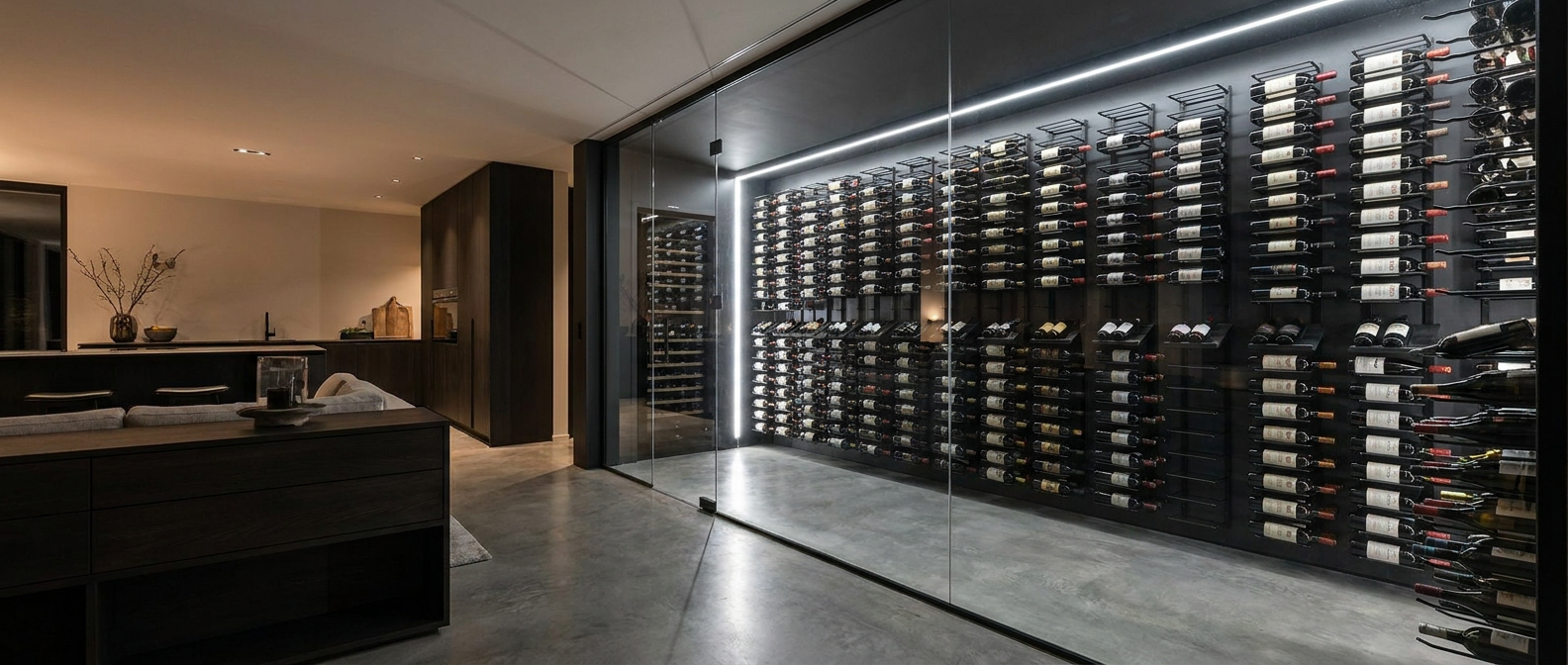
- Yes, significantly. Insulated glazing rates around R-2 while an insulated solid wall is R-19 to R-30. A single full-height glass partition can add the heat load of roughly ten times its area in solid wall, so glass needs to be entered as a separate component in any honest load calculation.
Disclosure
We're independent. We don't get paid when you click links to specific cooling units. The calculator outputs the same number regardless of which brand you end up buying.
Keep reading