guide
Wine cellar humidity and mold: how to diagnose and fix a damp or dry cellar
Mold on wine bottles, a musty smell, sweating walls, a dripping cooling unit or dry corks. How to measure cellar humidity, trace each symptom to its cause, fix it from cheap to structural, and clean mold safely.
Most humidity problems we get called about show up as something you can see or smell: white fuzz on labels, a musty room, a wall that sweats, a puddle under the cooling unit. The fix is rarely a new machine. It is usually a leak, a blocked airflow path, or a moisture source nobody noticed. Here is how we troubleshoot a cellar that is too humid or too dry, in the order we do it on site.
The range you are aiming for
We build cellars to hold 55°F (13°C) and about 60% relative humidity. Anything from about 50 to 70% is sound; our guide to ideal cellar temperature and humidity explains why. What happens at the edges:
- Below about 50% for weeks at a time, the exposed end of the cork slowly loses moisture, which means more evaporation and brittle, curling labels. Under 40% it becomes a real concern for long holds.
- Above about 75 to 80%, mold gets going on paper labels, cardboard cases and wood racking. The wine itself is rarely the casualty.
Measure before you fix anything
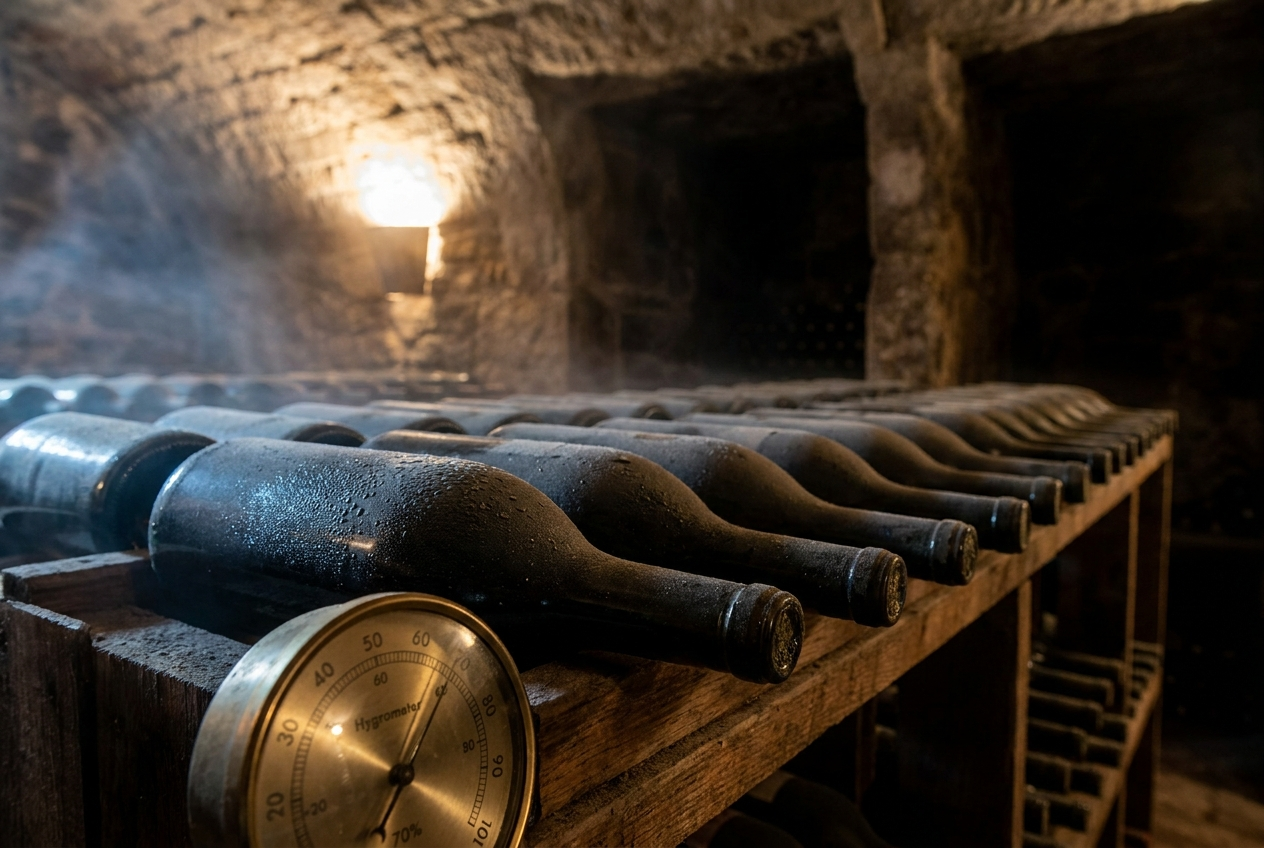
A single reading from a wall dial tells you very little. Use a digital hygrometer that logs, and leave it for at least a week so you see the daily cycle and how the room reacts when the cooling unit runs.
Mount it at mid-height inside the racking, away from the cooling unit's supply air, the door and exterior walls. If you suspect one spot, such as a back corner behind a rack, put a second logger there. The difference between the two readings is often the diagnosis.
Check the hygrometer with a salt test
Cheap hygrometers can be off by several points, and they drift. Mix a few tablespoons of table salt with just enough water to make a damp paste (wet salt, not salt water), put it in a small dish, and seal it in a zip-top bag with the hygrometer for 8 to 12 hours at a steady temperature. Saturated salt holds the air near 75% RH, so a reading of 70 means your hygrometer reads about 5 points low. Write the offset on the back and correct every reading.
Diagnose by symptom
| Symptom | Usual cause | First thing to check |
|---|---|---|
| Mold on labels or cork tops | RH above 75% for weeks, still air | Logged RH; cardboard or wood on the floor |
| Musty smell | Hidden moisture source or rotting material | Cardboard cases, behind racks, base of walls |
| Condensation on walls or glass | Cold surface below the dew point, or a vapor barrier problem | Which surface sweats, and when |
| Condensation on bottles | Room near saturation, or cold supply air hitting them | Bottles near the cooling unit's outlet |
| Dripping from the cooling unit | Blocked drain, bad slope, or an iced coil | Drain line, unit level, coil frost |
| Dry corks, curling labels, seepage | Air leaks to the house, or an undersized unit running nonstop | Door seal; winter RH; unit run time |
Mold on labels or corks
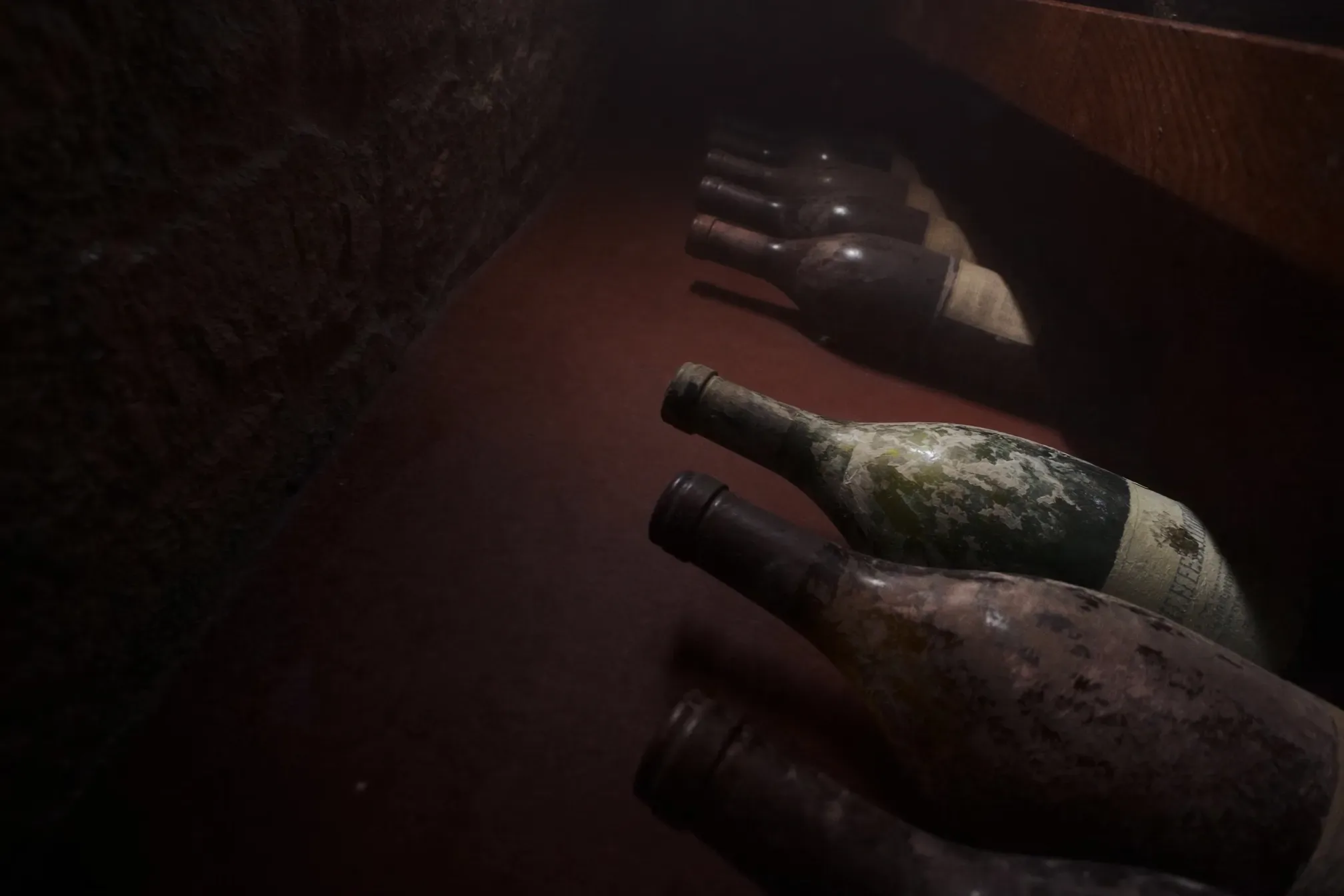
White or gray bloom on labels, and sometimes on the cork top under the capsule, is what people most often send us photos of. The good news: if the capsule is intact and the cork is sound, the wine is almost certainly fine. Mold on the outside of a bottle does not get through a healthy cork.
Look harder at a bottle with a sticky capsule, wine stains down the neck, a cork that has pushed up or sunk, or a fill level lower than its neighbors. Those point to a leaking cork, which is a problem with or without mold. When you open a moldy bottle, cut the capsule below the lip and wipe the cork top and glass before pulling the cork.
The labels are what you lose. Mold stains and lifts them, which hurts resale value.
Musty smell
Something in the room is staying wet. The usual suspects are cardboard cases, wooden crates on the floor, carpet, and the back of racking pushed tight against a cold foundation wall. Pull a few racks out and look. If the smell outlasts the cardboard, the moisture is likely inside a wall or under the floor.
Condensation on walls, glass or bottles
Condensation tells you a surface is below the dew point of the air touching it. Cellar air at 55°F and 70% RH has a dew point around 45°F (7°C), so anything in the room colder than that will sweat.
- Inside the cellar, on a foundation wall: the concrete is running colder than the room, common in winter where the top of the wall is near or above grade. The wall needs insulation bonded to it.
- Inside the cellar, near the cooling unit: supply air leaves the coil well below 55°F. If it blows across a wall, glass or a row of bottles, those surfaces sweat. Redirect the airflow.
- On the house side of a glass wall: humid room air meeting cold glass. See glass wine cellars.
- Stains at the base of interior walls, peeling paint, soft drywall: condensation inside the wall cavity, which usually means the vapor barrier is missing or on the wrong side.
Dripping from the cooling unit
Every cellar cooling unit pulls water out of the air. When it ends up on the floor, the cause is usually one of these:
- The drain path is blocked or wrong. A clogged line, a kinked hose, a missing trap, or a condensate pump that has failed.
- The unit is not sloped as the manufacturer specifies. Through-the-wall units rely on a set pitch to move water to the right side.
- The coil is icing. Racking or cases blocking the unit's intake, a dirty coil, or a set point below the unit's range lets frost build up. When it melts, it overflows the pan.
Humidity too low
Signs include curling labels, lifting capsules and, on bottles held for years, dropping fill levels. In cold climates this is mostly a winter problem: heated indoor air can fall to 20 to 30% RH, and a cellar that leaks air to the house follows it down. An undersized unit running almost nonstop also dries the room.
Root causes
A missing or wrong-side vapor barrier. The vapor barrier belongs on the warm side of the insulation, which for most cellars means the outside of the cellar walls and the top of the ceiling. Put it on the cellar side and warm, humid house air gets into the wall, hits the cold back of the barrier and condenses where you cannot see it. Basement walls have their own rules, covered in our basement wine cellar guide and in wine cellar insulation and vapor barriers.
An oversized cooling unit. It cools the air fast, shuts off and starts again, so it never runs long enough to pull moisture out. Humidity stays high and swings with every cycle.
An undersized cooling unit. It runs almost all the time and strips moisture from the air, so the room trends dry, and in a heat wave it may lose the temperature too. Our BTU calculator and the guide to sizing cellar cooling will tell you which side of the line your unit is on.
Poor air circulation. Still air lets moisture settle in corners and behind racking. Racks pushed hard against exterior walls are the classic case, and mold starts there first.
A wet slab. Concrete laid without a vapor retarder under it keeps moving ground moisture into the room for its whole life. To check, tape a 2-foot (60 cm) square of clear plastic sheet tight to the bare slab and leave it at least 16 hours. Moisture under the plastic or a darker patch of concrete means the slab is feeding the room.
Something to rot. Cardboard cases, wooden crates, carpet and untreated softwood on a damp floor hold water and feed mold long after the room itself is dry.
Fixes, from cheap to structural
Work down this list and re-log humidity after each step. Most cellars are fixed in the first half.
- Calibrate and log. Know the real number before you buy anything.
- Get rid of cardboard and crates. Nothing absorbent on the floor.
- Open up airflow. Leave about an inch (2 to 3 cm) between racking and any exterior wall, keep the cooling unit's intake and outlet clear, and add a small fan in a cellar with dead corners.
- Seal the door and penetrations. Weatherstripping on all four sides of the door, plus caulk or foam around lights, outlets and pipes. A worn door seal is the most common reason humidity won't hold.
- Service the cooling unit. Clear the drain, check the slope, clean the coil, and confirm the set point is within the unit's rated range.
- Add a humidifier or dehumidifier. Use one only once the room is tight, and size it to the room. Many household dehumidifiers lose capacity or frost up at cellar temperatures, so check the rated operating range. For the dry side, see wine cellar humidifiers.
- Resize the cooling. If the logs show short-cycling or nonstop running after the leaks are fixed, the unit is the wrong size. See wine cellar cooling units.
- Fix the envelope. Correct the vapor barrier, insulate cold walls, treat or cover a wet slab, and fix outside drainage.
Cleaning mold safely
Fix the moisture first. Cleaning a cellar that is still at 85% buys you a few weeks.
Protect yourself. Wear gloves and an N95 respirator, and run a fan with the door open while you work.
Bottles. Wipe the glass and capsule with a cloth dampened with water and a drop of dish soap, then dry it. For labels, let them dry out after the room is fixed, then brush the bloom off gently with a soft, dry brush. Do not scrub or soak a label; you will take the paper with the mold.
Racking. Vacuum loose growth with a HEPA vacuum, then wipe with dish detergent and water or plain white vinegar, and dry the wood with a fan. Wood that is stained deep, soft, or crumbles under a screwdriver should be replaced.
Skip the bleach. Chlorine fumes build up fast in a closed cellar. On porous wood, bleach whitens the surface without reaching the roots, so the mold comes back. Chlorine on wood can also contribute to TCA, the compound behind cork taint, which is why wineries largely moved away from chlorine cleaners. Never mix bleach with ammonia or vinegar.
When it is a building envelope problem
Some signs mean the problem is in the walls, ceiling or slab, and a dehumidifier will only hide it: stains or soft drywall at the base of walls, mold that returns within weeks of cleaning, a musty smell that outlasts every absorbent item, efflorescence (white mineral deposits) on foundation walls, or humidity that won't respond to a sealed door and a correctly sized unit.
At that point you need someone who can open a wall and read what is inside it, such as a building envelope specialist or a mold remediation contractor. If you want a second opinion on what you are seeing, contact our experts with your logged readings and a few photos. For a full rebuild, our guide on how to build a wine cellar covers the assembly from the studs out.
FAQ
Frequently asked questions
- Is wine with mold on the bottle safe to drink?
- Usually, yes. Mold on the label, capsule or top of the cork does not get through a sound cork. Check that the capsule is not sticky, the cork has not moved, and the fill level is normal, then wipe the cork top before opening.
- What humidity should a wine cellar be?
- We aim for about 60% relative humidity at 55°F (13°C). Anything from about 50 to 70% is fine. Below 50% for long stretches, corks and labels start to dry; above about 75 to 80%, mold becomes likely on labels, cardboard and wood.
- Why is my wine cellar too humid?
- Common causes are an oversized cooling unit that short-cycles, a leaky door letting humid house air in, poor air circulation, a damp slab, and cardboard or wood holding moisture. A missing or wrong-side vapor barrier is the most serious and hardest to fix.
- Should I use bleach to clean mold in a wine cellar?
- We don't. The fumes build up in a closed cellar, it doesn't reach mold roots in porous wood, and chlorine has been linked to TCA, the compound behind cork taint. Use dish detergent and water or white vinegar instead.
- Why is my wine cooling unit dripping water?
- Usually a blocked or kinked drain line, a failed condensate pump, a unit not sloped as the manufacturer specifies, or a coil that is icing and then melting. Check the drain first, then look for anything blocking the unit's intake.