guide
Glass wine cellars: glass types, condensation, cooling, and cost
A builder's brand-neutral guide to glass wine cellar walls and enclosures: which glass to specify, how to stop fogging, how glass changes cooling size, and what drives the cost.
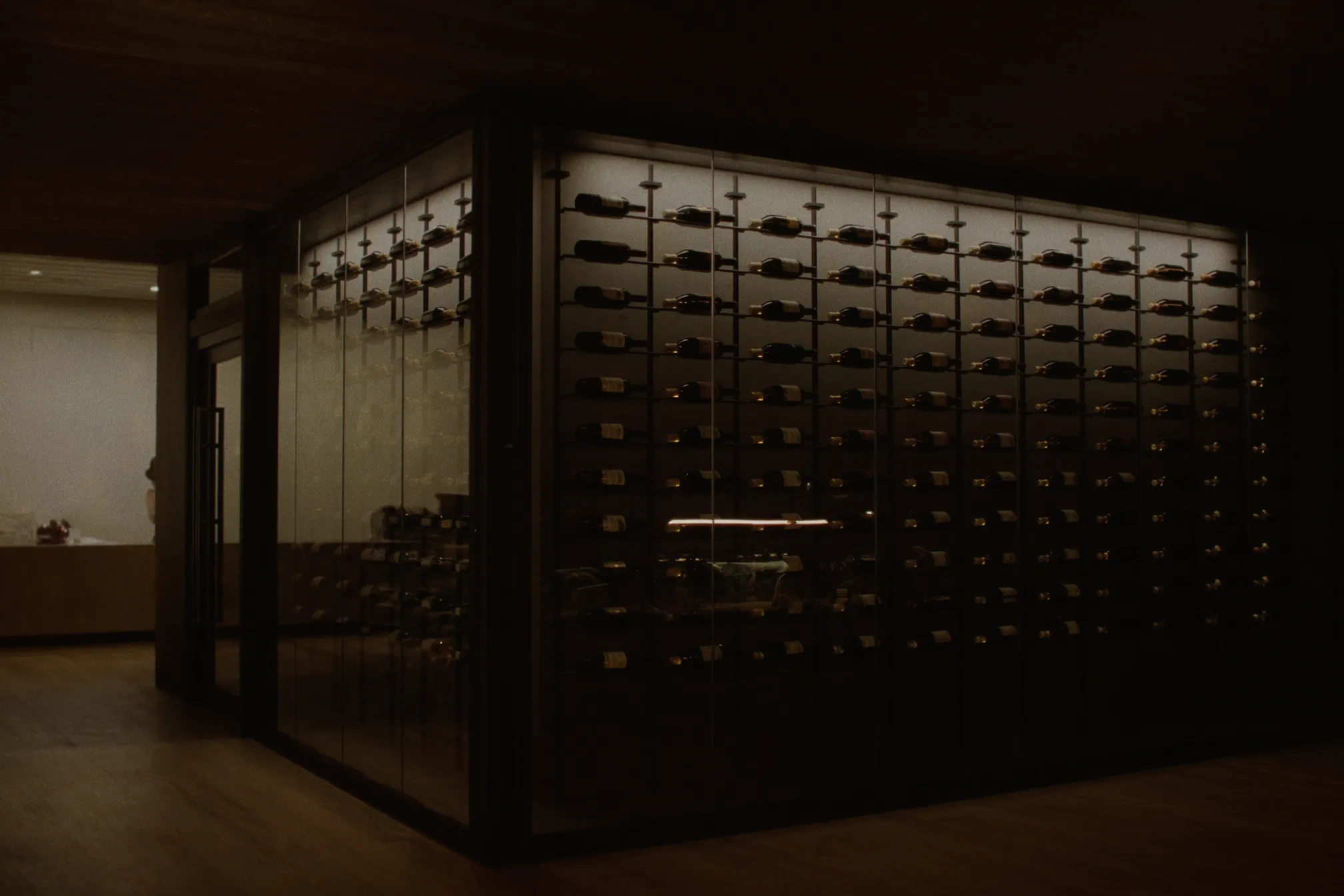
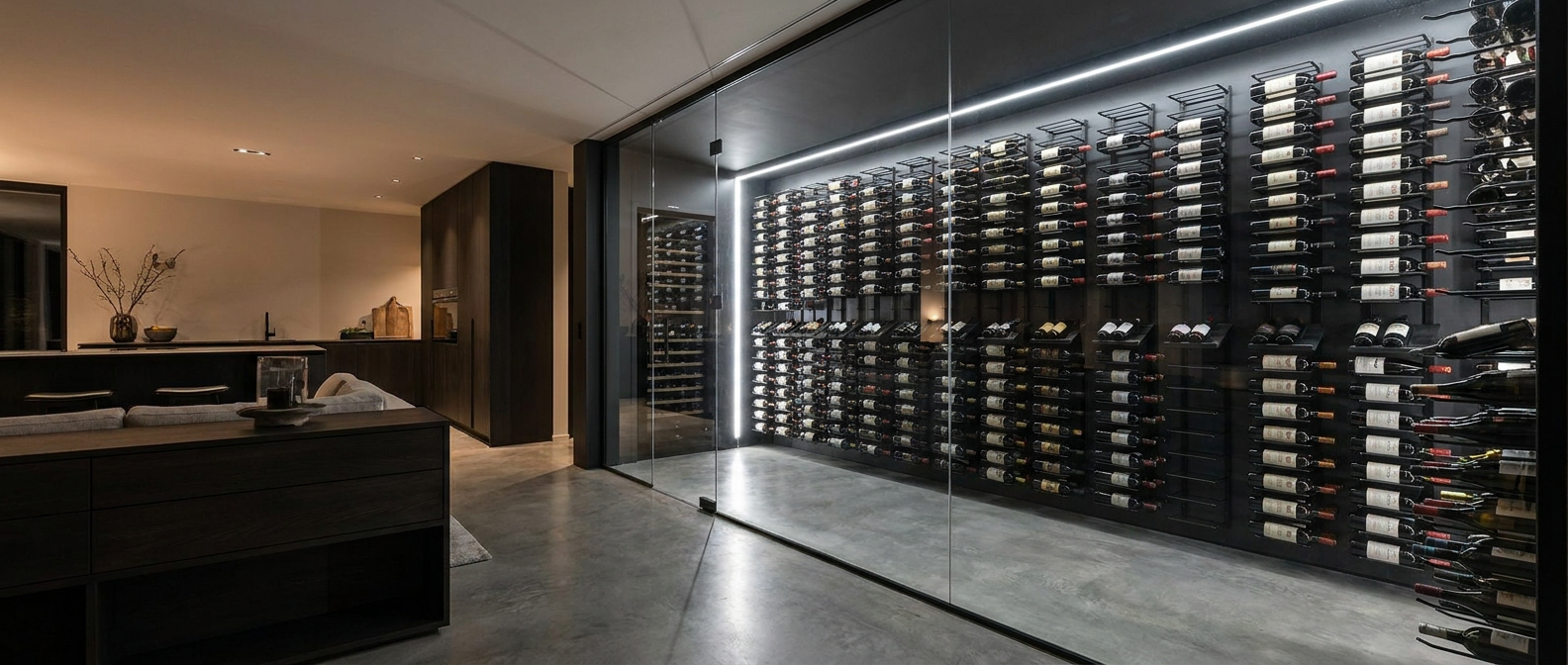
A glass wine cellar puts the collection on view, and we understand why so many clients ask for one. It is also the hardest kind of cellar to get right. Glass is a poor insulator, a cold surface, and a large target for sunlight.
None of that rules glass out. It means the glass, the frame, the cooling, and the room around the cellar have to be designed together. Here is how we work through it.
Start with the honest number
We cover the basic thermal problem in designing a modern wine cellar: a good insulated glass unit is around R-2, and an insulated cellar wall is R-19 to R-30. Every square foot of glass costs you insulation. This guide picks up from there.
Glass types, from weakest to strongest
| Glass | Approx. R-value | Where it fits |
|---|---|---|
| Single-pane tempered (3/8 in or 1/2 in) | about R-1 | Display walls, or a partition between the cellar and a room held near cellar temperature |
| Single-pane laminated | about R-1 | Same as tempered, where you want the panel to hold together if broken, or more UV blocking |
| Double-pane insulated glass unit (IGU), clear | about R-2 | The minimum for a wall between a cellar and normal living space |
| Double-pane IGU, low-e coating, argon fill | about R-3 to R-4 | Our default for a glass wall facing a conditioned room |
| Triple-pane IGU | about R-5 and up | Large glass areas, humid rooms, or warm climates |
The terms, briefly:
- Tempered glass is heat-treated to be several times stronger than ordinary glass and breaks into small, blunt pieces. It cannot be cut after tempering, so every panel is made to measure.
- Laminated glass is two sheets bonded to a plastic interlayer that holds the pieces in place if it breaks. The interlayer also blocks most UV light.
- An IGU is two or three panes sealed around a spacer. Low-e is a thin metallic coating that reflects radiant heat, and argon is an inert gas fill that insulates better than air. Together they lift a double-pane unit from about R-2 to R-3 or better.
Single-pane glass belongs in two situations only. One is display, where the glass is not the barrier between the wine and warm air, such as a wine wall inside an already-cooled room. The other is a partition between the cellar and a space that is also held cool, such as a tasting room on the same climate system. Between a 55°F (13°C) cellar and a 72°F (22°C) living room, single-pane glass doubles the glass load compared with a clear IGU and can fog on the room side in humid weather.
Frame systems
The frame sets the look, and it also decides how well the envelope seals.
- Frameless. Large tempered panels held in a low channel at floor and ceiling, with clear seals between panels. Most frameless walls are single-pane, because IGUs are thick, heavy, and hard to join without a visible frame. Frameless IGU walls exist but cost more and need careful detailing at every joint.
- Steel-framed. Slim profiles, often black, with a divided-light look. Plain steel conducts heat, so the frame becomes a cold bridge. With an IGU, ask for a thermally broken system: a non-conductive break inside the profile.
- Aluminum. Storefront-style framing, lighter and usually cheaper than steel, with thermally broken versions widely available. The look is more commercial.
Whatever the frame, the edges are where glass walls leak:
- Head and sill. The ceiling and floor channels need a continuous seal to the structure, not just a bead of caulk on the visible face.
- Vapor barrier tie-in. The vapor barrier in the solid walls and ceiling has to connect to the glass frame. The glass is a vapor barrier. The gap around it is not.
- Panel joints. Butt joints between frameless panels need a proper seal or gasket. An open gap is a constant air leak.
- The door. The hardest part of the envelope to seal. More below.
Condensation: why glass fogs, and when
Glass fogs when its surface drops below the dew point of the air touching it, the temperature at which that air can no longer hold its moisture.
In a glass wine cellar, the room side is the one at risk. On the cellar side, the glass is warmer than the cellar air, so it stays clear. On the room side, warm, more humid air meets a surface the cellar is pulling down toward 55°F (13°C).
Rough numbers for a 55°F cellar next to a 72°F (22°C) room:
- Room air at 72°F and 50% relative humidity has a dew point of about 52°F (11°C).
- The room-side face of single-pane glass in still air sits in the low 60s °F (about 16 to 18°C). It usually stays clear.
- The room-side face of a clear IGU sits closer to 67°F (19°C), a much wider margin.
- Room air at 75°F (24°C) and 70% humidity, typical of a summer basement without dehumidification, has a dew point in the mid 60s °F (about 18°C). Now single-pane glass fogs and even a clear IGU gets close.
So a glass wall rarely fogs in a well-conditioned room. It fogs when something else goes wrong:
- Humid room air. Unconditioned basements, rooms near pools or kitchens, houses without summer air conditioning. Our basement wine cellar guide covers this.
- Cold air blowing on the glass. Supply air leaves the cooling coil well below 55°F. Aimed at the glass, it pulls the room side below the dew point.
- Metal frames without a thermal break. The frame runs colder than the glass and sweats first, usually along the bottom rail.
- Single-pane glass against normal living space.
Prevention is the same list in reverse: an IGU (low-e and argon where you can), thermally broken frames, cooling air kept off the glass, and a room side kept conditioned and below roughly 50 to 55% relative humidity. The cellar side holds its normal 60 to 70%; see ideal cellar temperature and humidity.
How glass changes the cooling load
Heat through any surface is its area times the temperature difference, divided by its R-value. Take an 8 ft by 8 ft glass front (64 ft²) between a 55°F (13°C) cellar and a 72°F (22°C) room, a 17°F difference:
- Single-pane, about R-1: roughly 1,090 BTU/h through the glass alone.
- Clear IGU, about R-2: roughly 540 BTU/h.
- Low-e argon IGU, about R-3: roughly 360 BTU/h.
- The same area as an R-19 wall: roughly 60 BTU/h.
For context, the well-built 768 ft³ cellar in our BTU sizing guide needs about 1,800 to 2,300 BTU/h in total. One single-pane wall could add half that again.
That is why glass has to be entered as its own surface. Our BTU calculator takes glass area and type separately and subtracts that area from the solid walls. Then pick equipment for that number: see wine cellar cooling units and choosing a through-the-wall unit.
“
Size the cooling for the glass you are actually building. Glass will never insulate like a wall, however good it is.
”
A glass wine cellar is also never a passive cellar. If you hoped to skip mechanical cooling, read designing a small passive cellar and keep glass to a small door lite, if any.
Sunlight and placement
Sunlight adds heat, often far more than the conductive load above, and its UV degrades wine over time. Clear and green bottles are the most exposed.
- Keep the glass out of direct sun, including afternoon sun through a window across the room. Check where light falls in both summer and winter.
- Low-e and laminated glass help. Low-e cuts solar heat gain, and laminated interlayers block most UV. Neither makes a sunny location a good one.
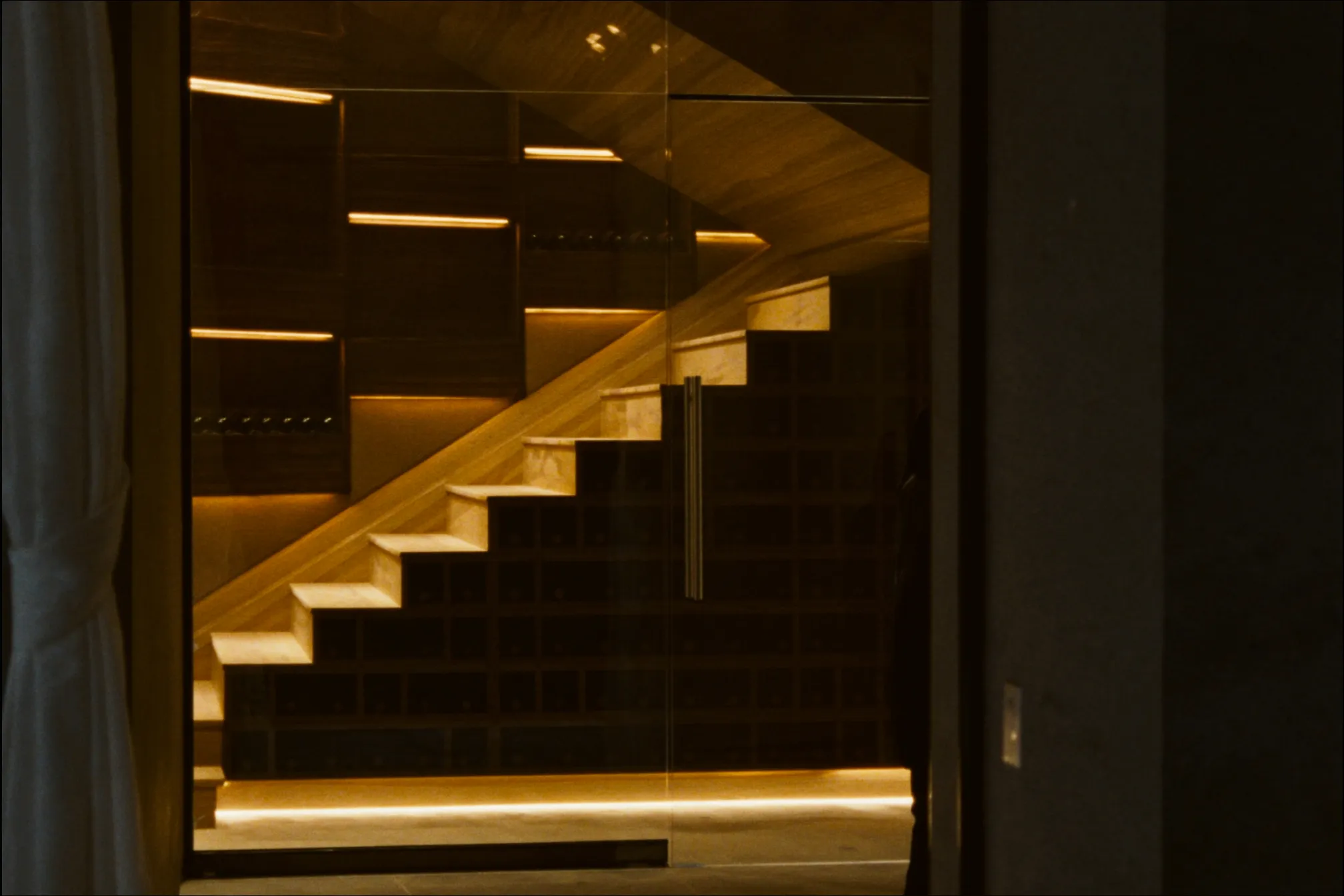
Interior locations are usually safest: a wall off a dining room, a partition in a finished basement, or the space under a stair, which we cover in wine cellar under stairs.
How much glass is too much?
There is no fixed limit, but every added face of glass raises both the load and the fogging risk.
Pros
- Glass door or one glass wall: manageable load, standard cooling, solid walls carry the insulation
- One full glass elevation plus a glass door: practical with an IGU and correct sizing
- Solid walls and ceiling give you somewhere to hide equipment, wiring, and the vapor barrier
Cons
- Glass on three or four sides: load can rise several times over a mostly solid cellar
- Full glass boxes usually need larger or ducted cooling and a carefully conditioned host room
- Every extra glass face is another edge to seal and another surface that can fog
A 6 ft by 8 ft box, 8 ft tall, glazed on three sides has about 160 ft² of glass. With a clear IGU at a 17°F difference, that is roughly 1,360 BTU/h from the glass alone, against about 140 BTU/h for the same area of R-19 wall.
A full glass enclosure works when the host room is conditioned year-round and the budget covers better glass and more capable cooling. If either is uncertain, glaze the face you see from the room and build the rest solid.
Glass doors
Most glass wine cellars have a glass door, and it is usually the weakest part of the envelope. A frameless door on pivot hinges leaves gaps at the top, bottom, and latch side that need sweeps, seals, or a framed jamb. An insulated glass door in a sealed frame performs far better. Our wine cellar doors guide goes deeper.
Safety glazing
US residential codes treat certain locations as hazardous and require safety glazing: tempered or laminated glass tested to the relevant standard. These include glass in and next to doors, large panes close to the floor, and glass near stairs and landings. On a typical glass wine cellar, most or all of the glass qualifies.
In practice, every panel will be tempered, laminated, or an IGU built from tempered or laminated lites, each with a permanent safety glazing mark. Your local building department has the final word, so confirm before you order.
What a glass wine cellar costs
A single per-square-foot number would be misleading, because the range is too wide. As broad orders of magnitude: a glass door with one sidelite often runs into the low thousands of dollars installed, and a full-height, multi-panel insulated glass wall with a door commonly reaches five figures before cooling. What moves the price, roughly in order of impact:
- Glass type. Single-pane tempered is cheapest. Clear IGU costs more, and low-e, argon, laminated, triple-pane, and low-iron (extra-clear) glass each add more.
- Frame system. Frameless single-pane is usually cheapest. Thermally broken steel is usually the most expensive, often by a wide margin.
- Size and panel count. Large panels need heavier glass, special handling, and more installers. More panels mean more joints to seal.
- The door. A sealed, insulated glass door and its hardware can be a large share of the glass budget.
- Cooling. More glass means more capacity, and often a ducted system to keep equipment and airflow away from the glass.
- Site conditions. Stairs, tight access, out-of-plumb walls, and upper floors all add labor.
Ask for itemized quotes that separate glass, framing, door, and cooling so you can see where the money goes.
The trade-off
A glass wine cellar works when it is designed as a system: the right glazing, a sealed frame, cooling sized for the real load, and a host room that stays conditioned. Skip one and you get fogged glass, a cooling unit that never rests, or a cellar that drifts warm every summer.
Weighing glass against a mostly solid cellar? Contact our experts and we will run the numbers for your room before you commit.
FAQ
Frequently asked questions
- Do glass wine cellars need special glass?
- Yes. For a glass wall between a cellar and normal living space, use a double-pane insulated glass unit at minimum, ideally with a low-e coating and argon fill. Most of the glass will also need to be safety glazing, meaning tempered or laminated, because it sits in or near a door or close to the floor. Single-pane glass is only suitable for display or for a partition between the cellar and a space that is also kept cool.
- Why is my glass wine cellar fogging up?
- Glass fogs when its surface is colder than the dew point of the air touching it. In a glass wine cellar this almost always happens on the room side. The usual causes are humid room air, single-pane glass, metal frames without a thermal break, or the cooling unit blowing cold air directly onto the glass. An insulated glass unit, airflow kept off the glass, and a conditioned room usually solve it.
- How much does a glass wine cellar cost?
- It varies widely with the glass type, frame system, number and size of panels, the door, the cooling needed, and site access. Frameless single-pane tempered glass is the least expensive option. Insulated, low-e, or laminated glass in a thermally broken steel frame is the most expensive. Ask for quotes that separate glass, framing, door, and cooling.
- Does a glass wine cellar need a bigger cooling unit?
- Usually, yes. A clear double-pane glass unit is around R-2, compared with R-19 to R-30 for an insulated wall, so each square foot of glass lets in about ten times as much heat. Enter the glass area and type separately in a load calculation, then size the cooling unit to that result.
- Can you put a glass wine cellar under the stairs?
- Yes, and it is a popular location because it uses otherwise wasted space and is usually away from direct sun. Glass near stairs and landings generally has to be safety glazing, and the small volume means the glass can be a large share of the total heat load, so the cooling has to be sized for it.
- Is a glass wine closet worth it compared with a solid cellar?
- It is worth it if seeing the collection matters to you and you accept higher cost for glass and cooling. If your priority is long-term storage at the lowest running cost, a mostly solid cellar with a glass door or one glass panel gives you some display with far less load.