guide
Wine cellar cooling unit cost: unit prices, installation, and running costs in 2026
How much a wine cellar cooling unit costs in the US and Canada in November 2026: list prices by system type, installation trades, accessories, a worked running-cost example, lifespan, and the hidden cost of a weak room.
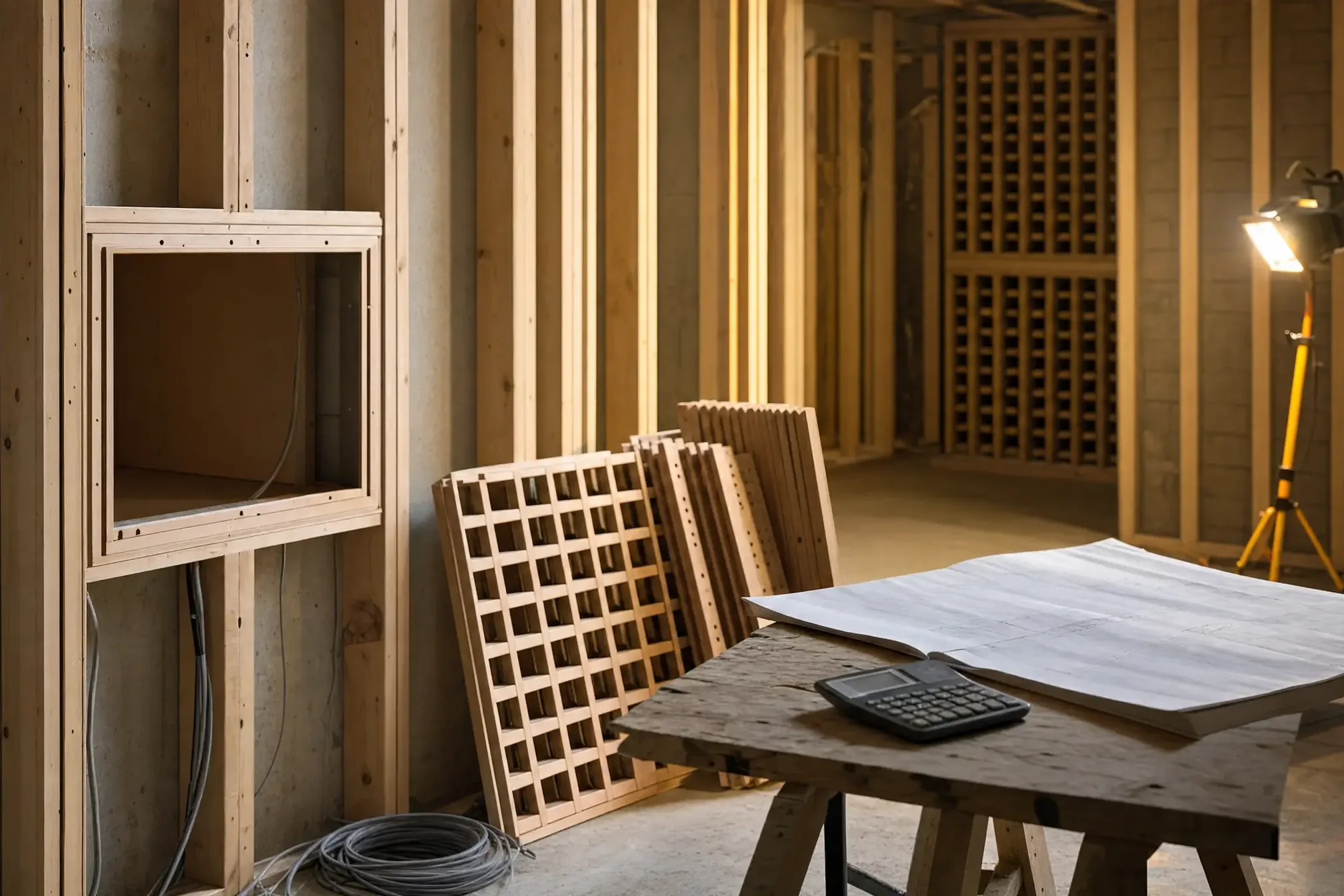
"How much does a wine cellar cooling unit cost?" usually comes right after "which one do I need?" The price on the box is only part of the answer. Installation, accessories, electricity, and the room itself all land on the same bill.
Below are list prices from makers and named retailers, seen in November 2026. Prices change often (several makers were running promotions when we checked), and installed cost varies a lot by region. Treat every number as a starting point for a quote. If you haven't picked a system type yet, start with our overview of wine cellar cooling units.
How much does a wine cellar cooling unit cost?
For a typical residential cellar, expect to pay roughly $2,100 to $6,000 for a through-the-wall unit and $3,700 to $11,700 for a ducted or split system, before installation. Installed, the full range runs from under $3,000 for a small through-the-wall job to well over $15,000 for a large ducted split.
| System type | Unit list price (USD, Nov 2026) | Installation (our rough planning range, USD) | Trades usually involved | Rough installed total (USD) |
|---|---|---|---|---|
| Self-contained, through-the-wall | $2,100–$6,000 | $800–$1,800 | Carpenter, electrician, drain | $2,900–$7,800 |
| Self-contained, ducted | $3,700–$7,000, plus duct kits on some models | $1,500–$4,000 | Carpenter, HVAC or duct installer, electrician, drain | $5,200–$11,000 |
| Ductless split | $4,700–$9,100 | $2,500–$5,000 | Licensed refrigeration or HVAC technician, electrician, drain | $7,200–$14,100 |
| Ducted split | $5,700–$11,700 | $3,500–$5,500 | Licensed HVAC technician, ductwork, electrician, drain | $9,200–$17,200 |
Unit prices come from the listings below. The installation column is our own planning range for a straightforward job, not a quote; it moves with local labor rates, access, and permits. Each maker rates capacity (BTU/h) under its own cellar and ambient conditions, so don't compare brands by BTU/h alone. Size to your room with the BTU calculator, then compare prices among units that fit.
What does a through-the-wall unit cost?
Through-the-wall units cost least, because everything is in one box and the install is mostly carpentry. Small and mid-size models listed in November 2026:
- CellarPro 1800XT-HE: $2,095 on the maker's site, with the 1800XTS-HE at $2,295 on its 1800 series page.
- Wine-R WR2500: $2,450 on the maker's site.
- Breezaire WKL 3000: $3,055 at the retailer ShopAppliances.
- WhisperKOOL SC PRO 3000: from $3,425 at the retailer Vigilant.
- Wine Guardian TTW02B Classic: $4,069 on the maker's site.
Larger self-contained units cost more. CellarPro's VS series runs from $3,695 (2000VSi-HE) to $5,795 (8200VSi) for the indoor models, and these can go through a wall or be ducted with hood kits.
Rated room sizes, noise, and exhaust-room limits differ between these units, so price alone tells you little. Our guide to choosing a through-the-wall unit covers what to check, and through-the-wall units compared lays the models side by side.
What does a ducted self-contained unit cost?
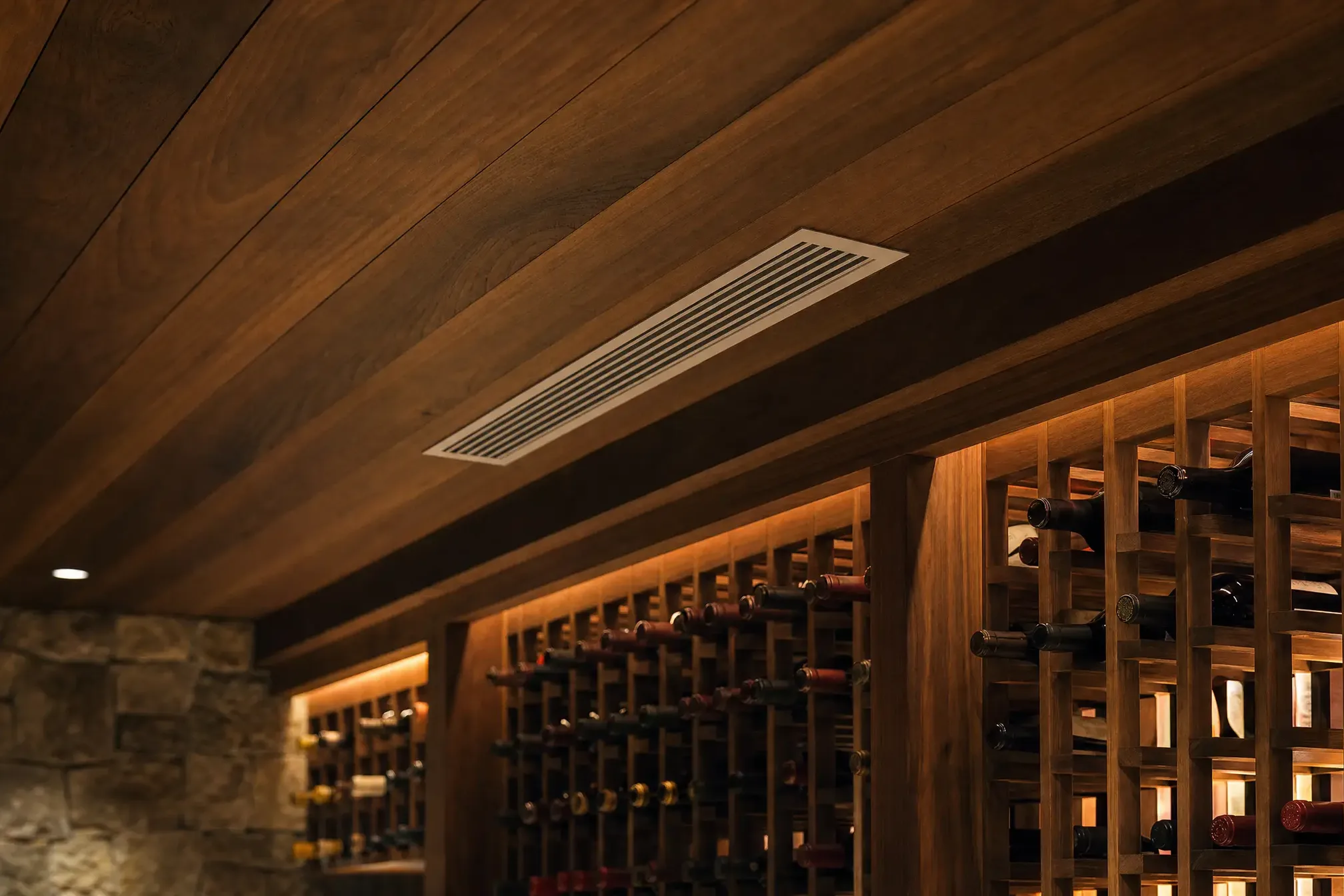
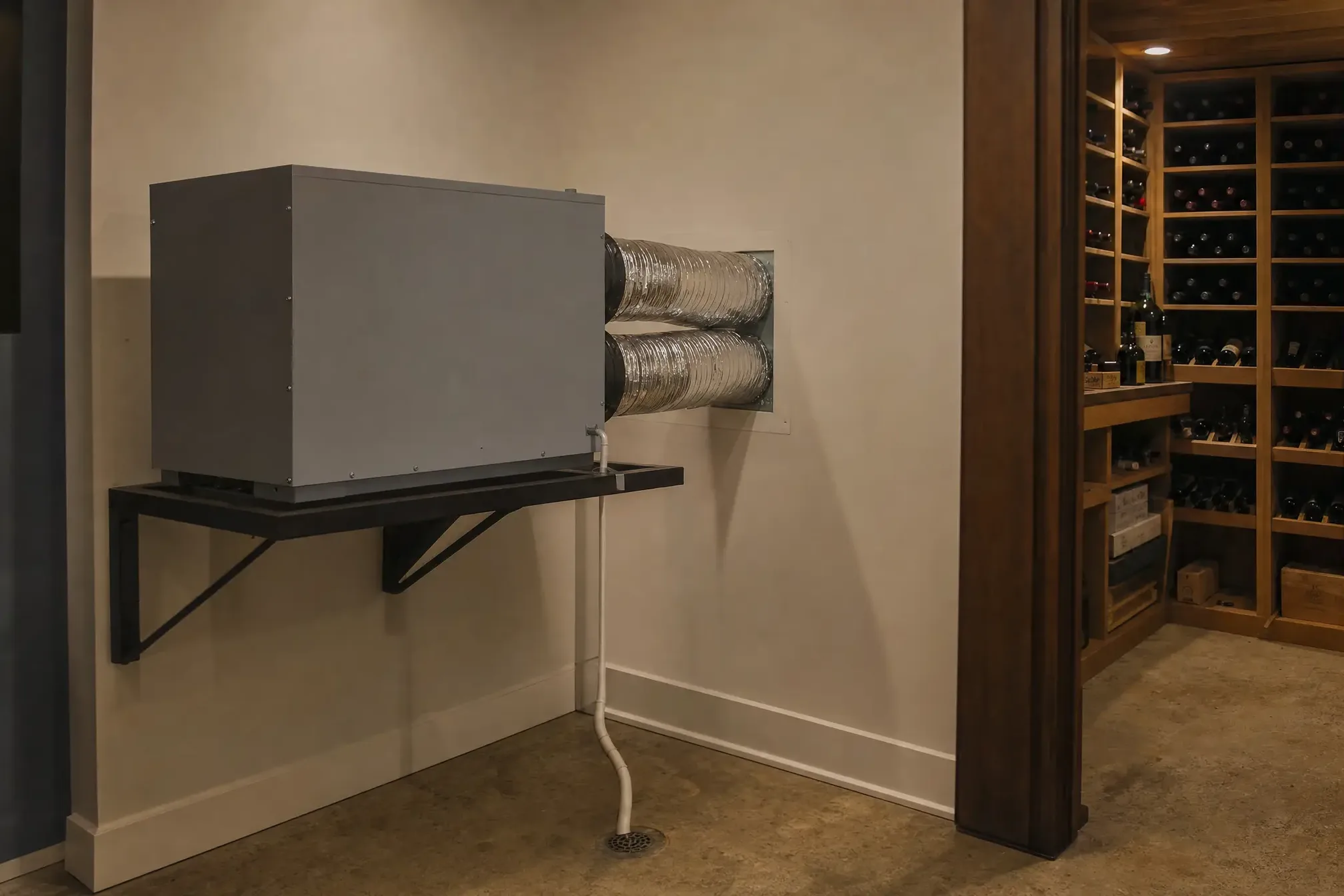
A ducted self-contained unit is still one box, but it sits in a mechanical room, closet, or attic and ducts air to the cellar. You pay more for the unit and the duct work, and only grilles show in the cellar.
- Panthaire APEX series: $5,599.95 for the APEX 3500, $5,725.95 for the APEX 5000, and $6,995.95 for the APEX 7000 on the maker's US site, each listed with a 25 ft duct kit.
- Wine Guardian D025: $6,043 on the maker's site.
- CellarPro 3200VSi: $4,495 for the unit, with duct hoods sold separately. The maker lists an insulated cold-side hood at $995 and a hot-side hood at $415, so ducting both sides adds about $1,400 before any duct or labor.
When you compare quotes, ask what is in the box: some ducted units ship with a duct kit and others price it separately. Our comparison of ducted wine cellar cooling units goes model by model.
What do ductless and ducted split systems cost?
Splits separate the cold half (the evaporator) from the hot, noisy half (the condensing unit), joined by a refrigerant line set. They are the most expensive to buy and install, and the right answer when there is nowhere indoors for the heat to go.
Ductless splits put a wall or ceiling evaporator in the cellar:
- CellarPro split wall-mounted 3000S: $4,695, with its split range running to $7,150 for the 1-ton 8000S wall unit and $7,850 for the largest recessed ceiling mount. The maker sells a line set for the 3000S at $350.
- Wine Guardian CS025 wine wall system: $9,118 on the maker's site.
Ducted splits put the evaporator outside the cellar too, so only grilles show:
- CellarPro ducted air handler splits: from $5,695 for the AH3500Sx to $11,695 for the largest (AH24Sx).
- Wine Guardian DS025: $8,329 on the maker's site, which notes that contractor installation is required.
Our split systems compared article covers the differences, and self-contained vs ducted split covers when the extra spend is worth it.
What does installation cost, and who does it?
Installation is where regional prices swing most. These are the pieces behind the number, so you can read a quote line by line.
Carpentry and the wall cutout. A through-the-wall unit needs a framed opening sized to the maker's cutout, a header in a load-bearing wall, and a clean finish on both sides. A handy owner can manage this in an open wall; in a finished or tiled wall, budget for a carpenter.
Duct work. Ducted units need insulated runs within the maker's length limits (CellarPro lists 8-inch ducting, for example) plus grilles in the cellar. Long runs and finished ceilings add labor.
A refrigeration or HVAC technician. On a split, someone licensed runs the line set, pulls a vacuum, charges the system, and starts it up. Some warranties depend on professional installation: Panthaire's APEX warranty runs from installation by a licensed HVAC contractor, and WhisperKOOL activates its split warranty only after its installation checklist is approved.
An electrician for a dedicated circuit. Many units call for one. The WR2500 and the CellarPro 1800XT-HE pages both specify a dedicated 115-volt, 15-amp circuit, and CellarPro's larger 6000S and 8000S splits call for a 25-amp dedicated breaker. If your panel is full or far from the cellar, this line grows.
A condensate drain. Every unit makes water, and the makers we checked require or strongly recommend a drain line. Wine-R calls its drain mandatory and includes a drain kit; CellarPro sells rear and bottom drain lines for the 1800 series at $85 and $135. Where there is no floor drain nearby, add a condensate pump and an outlet for it.
Which accessories add to the price?
Accessories are where quotes drift apart. Common add-ons, with maker list prices:
- Humidifier. Most cellars don't need one (our humidifier guide explains how to tell). CellarPro lists an integrated humidifier for its air handlers at $1,495; Wine Guardian lists a freestanding humidifier at $1,749. Both kinds can need a water line.
- Controller or remote display. CellarPro lists a remote display kit at $315 and a networkable thermostat upgrade at $325. Some units, such as the WR2500, include a wall controller.
- Duct kits and hoods. From $325 for a CellarPro 1800 hot-side hood with fan to $995 for an insulated VS cold-side hood.
- Extended warranties. CellarPro lists $150 (1800 series), $375 (VS and Houdini), and $795 (splits and air handlers). Wine Guardian lists a Platinum warranty on its through-the-wall units at $497.
- Shipping. From free (Panthaire, lower 48 states) to $60 ground for the CellarPro 1800XT-HE and $195 curbside for CellarPro splits.
How much does a wine cellar cooling unit cost to run?
Less than most people expect, if the room is built well. The arithmetic:
Power draw (kW) × hours per day × share of time the compressor runs × 365 × your electricity rate = yearly cost
For a worked example we use two published power figures and the US average residential electricity price from the EIA's Electric Power Monthly, which was 18.16 cents per kWh in August 2026.
A small through-the-wall unit. CellarPro lists "Total Watts: 237" for the 1800XT-HE. Assume it runs half the time in a well-built room:
- 0.237 kW × 24 h × 0.5 = 2.84 kWh per day
- 2.84 × 365 = about 1,038 kWh per year
- 1,038 × $0.1816 = about $189 per year, or roughly $16 a month
A 1/3-ton ducted split. CellarPro lists 558 watts (medium fan speed) for the AH3500Sx. At the same 50% run time:
- 0.558 kW × 24 h × 0.5 = 6.70 kWh per day
- 6.70 × 365 = about 2,444 kWh per year
- 2,444 × $0.1816 = about $444 per year
The 50% run time is our round planning assumption, not a measurement; CellarPro's own energy comparisons assume 75%, which would raise both figures by half. Published wattage is also measured at one set of conditions, and real draw varies.
In Canada, rates differ widely between provinces, and your bill is the best source. Divide the total charges on a recent bill by the kWh used to get your all-in rate. Using the small unit above, an all-in rate of 10 cents per kWh gives about $104 a year; 30 cents gives about $311.
How long does a unit last, and what does replacement cost?
As a broad range, self-contained units commonly last around 5 to 10 years and split systems often last longer. Sizing, a cool exhaust side, and clean coils push a unit toward the long end.
Warranties vary:
- CellarPro lists a 5-year standard warranty on its 1800 and VS self-contained units and a 2-year/5-year warranty on its splits.
- WhisperKOOL's warranty page lists a 2-year product and 5-year compressor warranty on self-contained units, and a 2-year product warranty on splits.
- Wine-R lists a 2-year parts warranty on the WR2500, extendable to 4 years total with a paid plan.
- Panthaire lists a 2-year parts and labor warranty on APEX systems.
Read what each covers: parts-only cover leaves the labor bill with you.
Replacement usually costs less than the first install, because the opening, ducts, circuit, and drain already exist, but only if the new unit fits the old cutout or duct sizes. Re-framing an opening puts carpentry back on the bill. Our guide to repairing or replacing a cellar cooling unit covers when a repair is worth it.
What does an undersized or leaky room really cost?
Higher power bills. In the example above, the small unit costs about $189 a year at 50% run time. If a leaky door or thin insulation keeps it running around the clock, the same unit draws about 2,076 kWh, or about $377 a year. The room doubled the bill.
A bigger unit than you needed. Each step up in capacity is a step up in price. In the CellarPro line alone, moving from an 1800-series unit to a VS-series unit takes the list price from about $2,100 to $3,700 or more.
A shorter life. A unit that never rests, or that fights an exhaust room hotter than its rating, wears out sooner and pulls the replacement forward.
Humidity and mold repairs. A missing warm-side vapor barrier leads to condensation in the walls and mold behind racks, repairs that can cost more than the unit. See our guide to insulation and vapor barriers.
The fixes are the ones we push on every build: walls at R-19 or better, a ceiling at R-30, a warm-side vapor barrier, and a sealed cellar door. Glass adds far more load per square foot than an insulated wall; see glass wine cellars. Then run the BTU calculator on the room you actually built.
Does buying in Canada change the cost?
Expect different numbers. Canadian retailer listings we checked showed the Panthaire APEX 3500 at $7,799 at Doyon Després and a CellarPro 1/4-ton horizontal split at $8,833 at Toronto Brewing. Neither page showed a currency code; both are Canadian retailers, so confirm the currency and taxes at checkout.
Two other things to check before ordering across the border:
- Shipping. Several US maker sites we checked quote shipping only to the 48 contiguous states. Cross-border orders can also add brokerage, duties, and taxes.
- Residential approval. A Canadian retailer, Vinum Design, marks some cooling units it sells as for commercial or industrial use only, citing Canada's Ozone-depleting Substances and Halocarbon Alternatives Regulations. Ask the maker in writing whether a model is approved for a Canadian home before you buy it.
How to keep the total down
- Size to the load, not the bottle count. Our BTU sizing guide explains why; oversizing costs you at purchase and again in short-cycling.
- Pick the type the room needs. If an adjacent room can take the heat year-round, a through-the-wall unit is often the lowest total cost. If it can't, a ducted or split system costs more up front but avoids a unit fighting a hot closet.
- Compare like with like. Duct kits, controllers, drain kits, and line sets are included by some makers and extra with others, and a split quote without a licensed technician's line isn't complete.
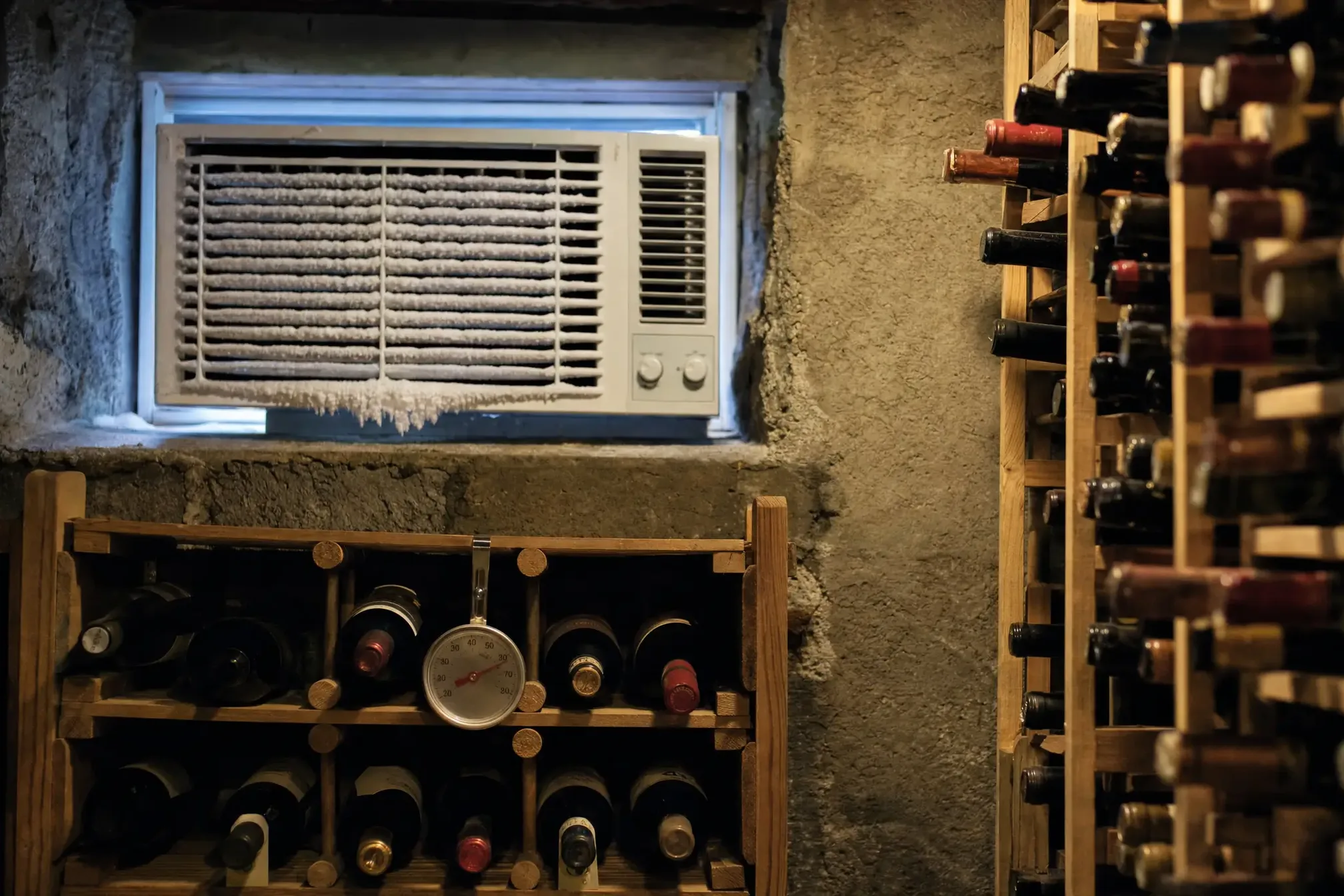
- Skip the comfort AC. Our guide to using an air conditioner for a wine cellar explains why it usually costs more in the end.
If you'd like a second opinion on a quote, or on which system type your room needs, our experts can look at the plan with you.
FAQ
Frequently asked questions
- How much does a wine cellar cooling unit cost?
- In November 2026, list prices we saw ran from about $2,100 to $6,000 for through-the-wall units and from about $3,700 to $11,700 for ducted and split systems, before installation. Installed totals range from under $3,000 for a small through-the-wall job to more than $15,000 for a large ducted split. Prices change often and installed cost varies by region.
- How much does it cost to install a wine cellar cooling unit?
- Our rough planning ranges are $800 to $1,800 for a through-the-wall unit, $1,500 to $4,000 for a ducted self-contained unit, $2,500 to $5,000 for a ductless split, and $3,500 to $5,500 for a ducted split. Splits need a licensed technician, and most units need a dedicated circuit and a drain. Local quotes are the only reliable number.
- How much electricity does a wine cellar cooling unit use?
- Multiply the unit's power draw in kW by 24 hours, by the share of time the compressor runs, and by 365. A unit listed at 237 watts running half the time uses about 1,038 kWh a year, about $189 at the August 2026 US average residential rate of 18.16 cents per kWh. A leaky or under-insulated room can double that.
- Is a split system worth the extra cost?
- It is when there is no indoor space that can absorb the heat year-round, or when the cellar sits next to living space where compressor noise matters. If an adjacent room stays within a through-the-wall unit's rated range and you can accept some noise, a self-contained unit usually costs much less in total.
- How long does a wine cellar cooling unit last?
- Self-contained units commonly last around 5 to 10 years, and split systems often last longer. Correct sizing, a cool exhaust side, and clean coils push a unit toward the long end. Replacement usually costs less than the first install if the new unit fits the existing opening or ducts.
New guides from people who build cellars, sent to your inbox.
Planning a cellar? Ask the people who build them.
Contact our expertsKeep reading
Related