guide
Self-contained vs ducted-split cellar cooling, compared
When to choose a through-the-wall unit, when to step up to a ducted split, and what each one really costs once installed.
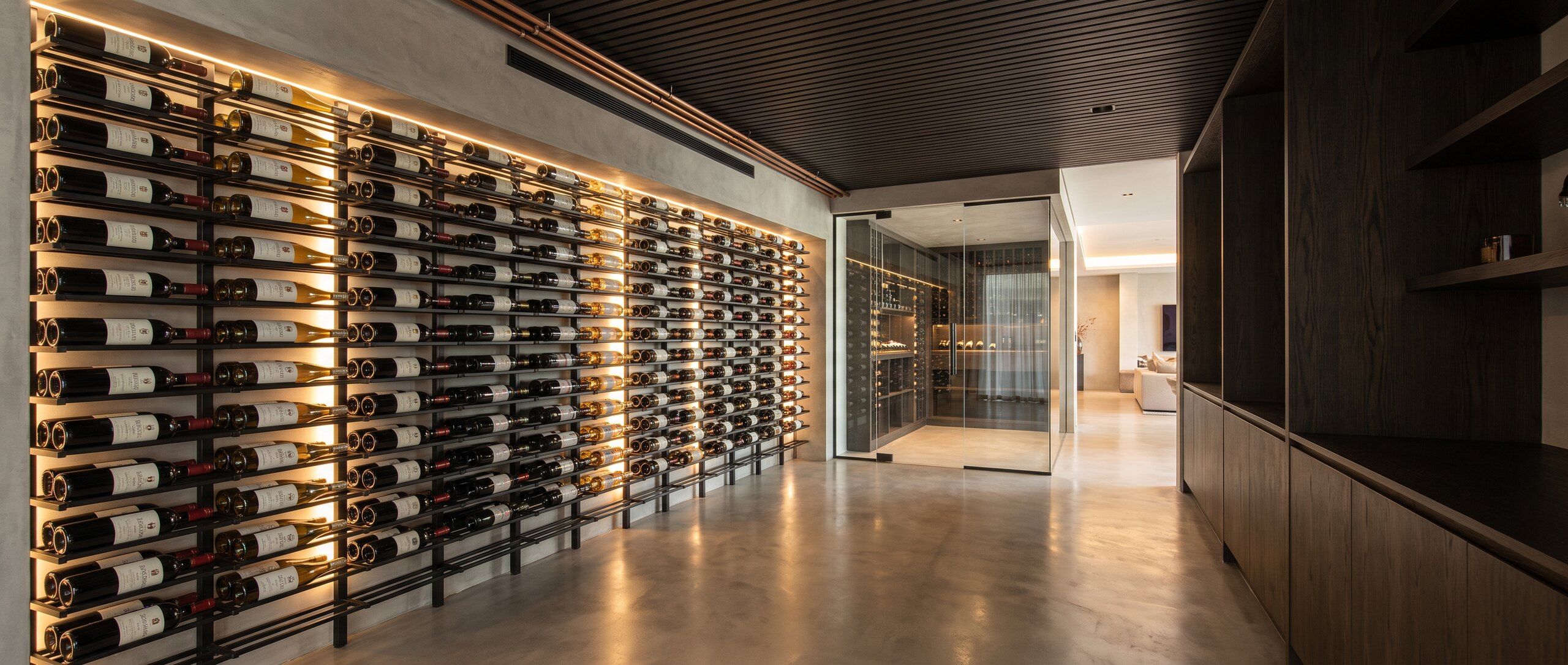
The two dominant cooling architectures for residential wine cellars are self-contained units (the whole refrigeration cycle in one box, through-the-wall) and ducted splits (evaporator inside, condenser elsewhere, refrigerant lines between them).
Both work. They suit very different rooms. Here's how to know which is yours, and what each one actually costs.
The fundamental difference
A self-contained unit treats your cellar wall like a window: hot air goes out one side, cool air comes out the other. Everything lives in one chassis. Inexpensive to buy, inexpensive to install, but it requires the adjacent room to absorb the rejected heat.
A ducted split separates the two halves. The evaporator (quiet, cool) sits in or near the cellar. The condenser (loud, hot) lives wherever makes sense: attic, mechanical room, outdoors. Refrigerant lines connect them. More expensive to buy, much more expensive to install, but the hot and noisy work happens somewhere you don't care about.
When to choose self-contained
Pros
- Direct access to an adjacent room or exterior wall
- Adjacent space stays in the unit's rated ambient range year-round
- Total cellar volume under ~2,000 ft³
- Budget for the whole project is tight
Cons
- Compressor noise lives inside or next to the cellar
- Adjacent room receives all rejected heat
- Limits your install location to walls that border a tolerant space
When to choose a ducted split
Pros
- Mid-floor cellar or basement with no exterior wall access
- Cellar opens onto living space (you don't want compressor noise there)
- Adjacent rooms can't tolerate the heat load
- You want the absolute lowest sound inside the cellar
Cons
- Refrigerant lines require a licensed HVAC pro
- Total installed cost roughly 2–3× a self-contained unit
- Long line sets reduce capacity; respect manufacturer limits
- Service calls are more expensive because of the split architecture
Cost reality
These are rough installed costs in 2026 USD for a ~600 ft³ cellar:
| Architecture | Equipment | Install | Total |
|---|---|---|---|
| Self-contained, DIY install | $1,400–$2,400 | $200–$600 | $1,600–$3,000 |
| Self-contained, pro install | $1,400–$2,400 | $800–$1,800 | $2,200–$4,200 |
| Ducted split, pro install | $2,800–$4,500 | $3,500–$5,500 | $6,300–$10,000 |
Ducted splits aren't more expensive because they're better units. They're more expensive because they're real HVAC equipment, with refrigerant work, electrical, and condensate management at both ends.
The wrong question
"Which is better?" is the wrong question. Both architectures are correct for specific rooms. The right question is:
- Can I locate a self-contained unit such that the adjacent space stays in the unit's rated range year-round?
- If yes, the cellar volume is under ~2,000 ft³, and I can live with compressor sound nearby: self-contained.
- Otherwise: ducted split.
That's the entire decision tree. For sizing once you've picked an architecture, see our BTU sizing guide. And before either, see choosing a through-the-wall unit for what to look for once you've decided.
Disclosure
We don't get paid based on which architecture you pick or which brand you buy. Both architectures are well-served by multiple reputable manufacturers, and we'll publish neutral writeups on them over time.
Keep reading