guide
Wine cellar cooling units: the four system types, sizing, and how to choose
A brand-neutral guide to wine cellar cooling systems: why a regular AC or mini split falls short, how the four system types compare, how to size one, and what to check when it stops cooling.
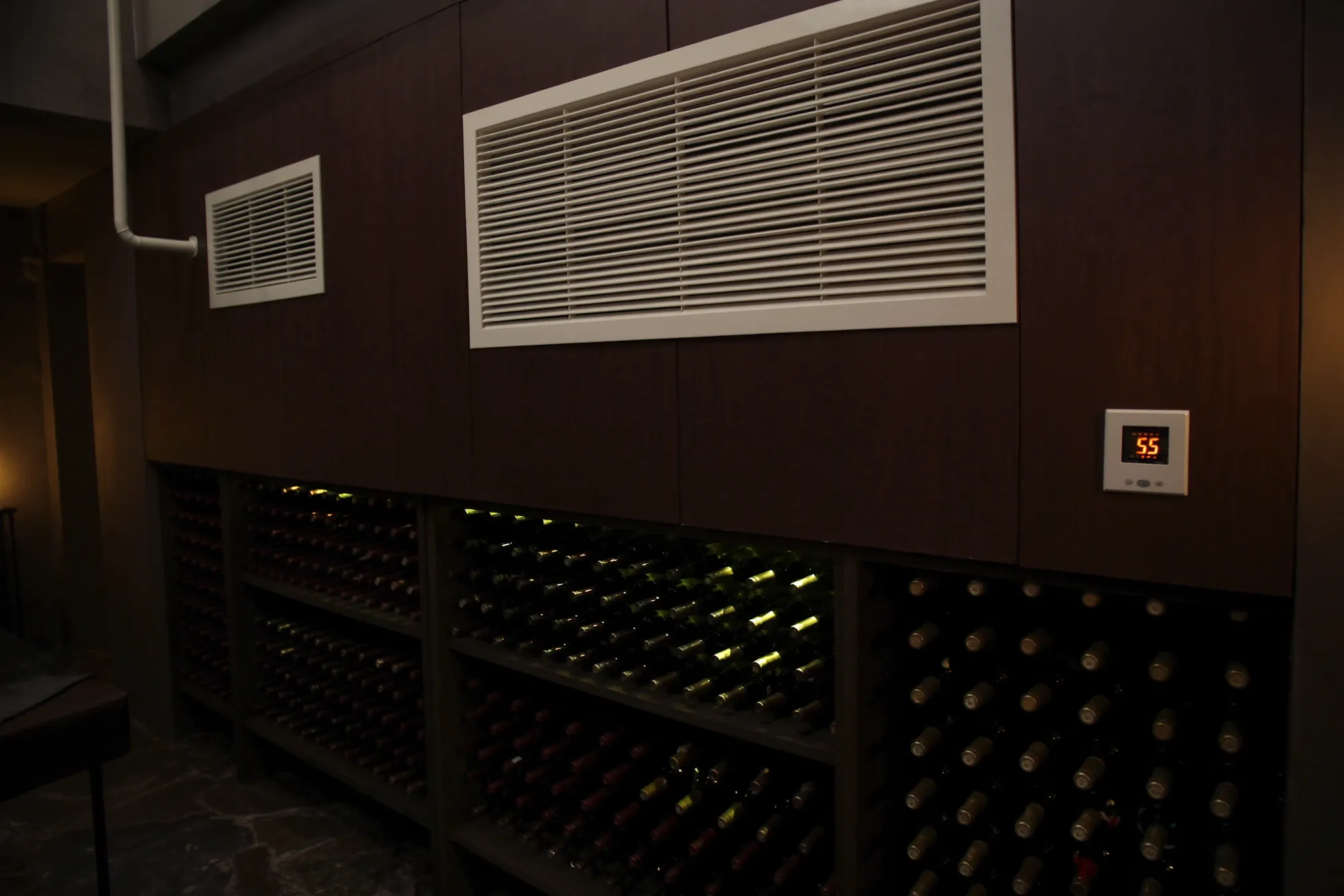
A wine cellar cooling unit has one job: hold the room at a steady cellar temperature, all year, without stripping the moisture out of the air. That sounds simple. It's the reason a cellar needs dedicated equipment instead of the air conditioner that cools the rest of your house.
This is our starting point for cellar cooling. Where a topic deserves more depth, we link to the guide that covers it.
Disclosure
We're an independent firm that designs and builds wine cellars. No manufacturer pays us, we take no affiliate commissions, and nothing on this page is a paid placement. We don't recommend brands here; we help you pick the right type and size.
Why a cellar needs a dedicated cooling unit
Most collections are kept around 55°F (13°C) at 50–70% relative humidity. Our guide to ideal cellar temperature and humidity explains the range and why stability matters more than the exact number.
A wine cellar cooling system is built to work in that band. Two design choices set it apart:
- It's made to run at cellar temperatures. The controls, refrigerant circuit, and defrost logic are designed around a room sitting in the 50s °F, all day, every day.
- It runs a warmer coil. Cellar units are generally designed so the evaporator coil doesn't run as cold as a comfort AC's. A colder coil condenses more water out of the air. A warmer coil cools the room while pulling out far less moisture, which is what keeps cellar humidity in a healthy range.
Can I use a regular AC or mini split for a wine cellar?
Usually not, and the reasons are mechanical, not marketing.
- Most comfort systems won't go low enough. Typical residential thermostats and mini split remotes bottom out somewhere in the low 60s °F (around 16–17°C). That's above where most people want a cellar.
- They're built to dehumidify. A comfort AC is designed to remove moisture because that's part of making people comfortable. In a sealed cellar it keeps doing that, and humidity drifts down toward levels where labels and capsules suffer on long holds.
- They aren't designed for low return air. When a comfort coil sees air in the 50s °F for long periods, it can ice up. Cellar units handle this with defrost cycles; most comfort units don't expect to need them.
CoolBot-style controllers trick a window or mini split AC into running colder than its thermostat allows. They're popular for produce walk-ins, where the goal is cold and wet produce sheds plenty of moisture. In a wine cellar, the same trick tends to run the coil very cold, pull humidity down hard, and push the equipment outside what its manufacturer designed for, which can affect the warranty. We don't specify them for cellars.
The four types of wine cellar cooling systems
Residential cellar cooling units come in four types. They differ in where the hot, noisy half of the refrigeration cycle lives and how cool air reaches the cellar.
Self-contained, through-the-wall. The whole system sits in one box mounted in a cellar wall. Cool air blows into the cellar; hot air exhausts into the room on the other side. The simplest and least expensive option. See choosing a through-the-wall unit.
Self-contained, ducted. Still one box, but it sits outside the cellar (in a mechanical room, closet, or attic) with ducts running supply and return air to the cellar and, on many models, ducting the exhaust heat somewhere it won't bother anyone. Nothing visible in the cellar except grilles.
Ductless split. A wall-mounted evaporator sits inside the cellar. The condenser sits outdoors or in a remote space, connected by a refrigerant line set. The hot half is gone from the cellar, but the evaporator is part of the room's look.
Ducted split. The evaporator sits outside the cellar and ducts air in; the condenser sits outdoors or in a remote space. The quietest and most flexible option, and the most involved to install. See self-contained vs ducted split for the full comparison and installed costs.
| System type | Noise in the cellar | Where the heat goes | Install complexity | Typical cellar size | HVAC tech and line set? |
|---|---|---|---|---|---|
| Self-contained, through-the-wall | Highest: compressor and fans are in the wall | Into the adjacent room | Low | Small to mid, roughly under 2,000 ft³ | No |
| Self-contained, ducted | Low: only air movement at the grilles | Into a remote room, or ducted elsewhere | Moderate: ductwork and access | Small to large | No |
| Ductless split | Low: evaporator fan only | Outdoors or a remote space | Moderate to high | Small to large | Yes |
| Ducted split | Lowest: grilles only | Outdoors or a remote space | High | Mid to very large | Yes |
The decision usually comes down to two questions: is there a space next to the cellar that can take the heat year-round, and how much noise can you live with inside or beside the room? If the answer to the first is no, you're looking at a ducted or split system.
Sizing: get the BTU right, not the biggest
Cooling capacity is rated in BTU/h, the amount of heat the unit can remove per hour. The load your cellar puts on it depends on volume, insulation, the temperature on the hot side of the walls, door activity, glass, and anything that makes heat inside the room.
- Run a load calculation. Our BTU calculator gives a sized-with-margin estimate in about a minute. The BTU sizing guide explains every input.
- Don't size by bottle count. Two cellars holding the same number of bottles can have very different loads. Bottle count ignores insulation, ambient temperature, glass, and door use.
- Don't oversize. An oversized unit short-cycles: it cools the air fast, shuts off, and starts again. It never runs long enough to manage humidity, and frequent starts wear the compressor. We aim for capacity roughly 15–20% above the calculated load, not double.
- Watch the glass. Glass walls and doors add far more load per square foot than an insulated wall. If your design has a lot of it, read our guide to glass wine cellars before you size anything.
Small cellars and wine closets
Small wine closet cooling units and small through-the-wall units exist for reach-ins and closet conversions. The same rules apply: a real load calculation, a sealed envelope, and somewhere for the heat to go. Closets and under-stairs cellars often have limited exhaust space, which is where small ducted units earn their price. If your space is cool year-round already, check whether you need active cooling at all in designing a small passive cellar.
Where the heat goes, and what you'll hear
A cooling unit doesn't destroy heat. It moves heat from the cellar to somewhere else, plus the heat from running its own compressor. That heat has to land somewhere that can absorb it.
- Through-the-wall units exhaust into the adjacent room. That room needs enough volume and air movement to dissipate the heat, and it has to stay inside the unit's rated ambient range in every season. Many manufacturers list a maximum around 85–95°F (29–35°C) and a minimum volume for the exhaust space. A small closet or a hot garage often fails one or both.
- Ducted self-contained units can send the exhaust to a larger space or another part of the house, within the duct lengths the manufacturer allows.
- Splits put the heat outdoors or in a mechanical space, which is why they suit cellars surrounded by living areas.
Noise follows the compressor. A through-the-wall unit puts it in the cellar wall, audible on both sides. Ducted units and splits move it elsewhere. Next to a dining room or home theater, that matters more than any spec sheet. A basement wine cellar often has the easiest answer, since a mechanical room or unfinished space is usually nearby.
Humidity: what a cooling unit does and doesn't do
Every cooling unit removes some moisture. A properly sized cellar unit removes little, because its coil runs warmer and its cycles run long. That's why most cellars sit comfortably in the 50–70% RH range with nothing more than a good envelope and a right-sized unit.
Two common problems:
- Too dry. Usually an oversized unit, a very cold coil, a leaky door pulling in dry house air in winter, or a comfort AC doing what comfort ACs do.
- Too humid. Usually an oversized unit that short-cycles and never runs long enough to pull moisture out, or a missing vapor barrier.
Some systems offer an add-on humidifier. Before buying one, log humidity for a full week. A steady 55°F with modestly low humidity is a fine cellar; chasing a number with extra equipment often adds problems.
Installation and condensate drainage
Every cellar cooling unit produces condensate. Plan where it goes before the walls close.
- Run a real drain line. To a floor drain, a plumbing connection, or a condensate pump. Some units evaporate condensate internally, but we still plan a drain on every job. Overflowing pans mean water on the floor and mold behind racks.
- Respect clearances. Units need open air on both the supply and exhaust sides. Racking, crown molding, or a shelf in front of the grille will cut capacity.
- Place the sensor well. The temperature probe should read the room, not the cold supply air coming off the unit.
- Use the right trade. Through-the-wall and most ducted self-contained units need a carpenter and an electrician. Splits need a licensed HVAC technician to run and charge the refrigerant line set.
- Dedicated circuit. Check the manufacturer's electrical requirements; larger units often call for their own circuit.
Maintenance and lifespan
Cellar cooling units are low-maintenance, not no-maintenance.
- Clean the condenser coil and filters on the schedule the manufacturer gives, more often if the exhaust side is dusty. A dirty condenser is a common cause of lost capacity.
- Check the drain line at least once a year for clogs or algae.
- Keep the exhaust side clear. Boxes stacked in front of a through-the-wall exhaust will cook the unit.
Lifespan depends heavily on sizing, installation, and how hot the exhaust side runs. As a broad range, self-contained units commonly last around 5 to 10 years and split systems often last longer. An oversized unit that short-cycles, or a through-the-wall unit fighting a hot exhaust room, will land at the short end.
Troubleshooting: wine cellar cooling unit not cooling
Start simple. Most problems trace back to the room or the install, not a failed unit.
- Not cooling. Confirm power and setpoint. Feel the exhaust: if it's not warm, the compressor may not be running. Check whether the exhaust side is blocked or too hot, and whether the condenser coil is dirty. A refrigerant problem needs a technician.
- Running constantly. Usually undersized, a door seal leaking, an insulation gap, or an exhaust room above the unit's rated ambient. Re-run the BTU calculator with honest inputs.
- Icing on the coil. Restricted airflow (blocked grille, dirty filter), a setpoint below what the unit is designed for, or a refrigerant issue. Shut it off, let it thaw, and fix the airflow before restarting. Recurring ice needs a technician.
- Short-cycling. Oversized for the room, or the sensor sitting in the cold supply airstream. Moving the probe is a cheap first fix.
- Water on the floor. A clogged or missing drain line, or a unit not mounted level.
How to choose in five questions
- What's the calculated load? Run the calculator first. Capacity follows the load, not the bottle count.
- Where can the heat go? If an adjacent room can take it year-round, through-the-wall is on the table. If not, look at ducted or split.
- How much noise can you accept? Next to living space, favor ducted or split systems.
- What do you want to see in the cellar? A wall unit, an evaporator, or only grilles.
- Who will install it? Splits need a licensed HVAC technician and a line set. Self-contained units don't.
If the answers point in different directions, that's normal. Contact our experts and we'll help you work through it.
FAQ
Frequently asked questions
- Can I use a regular air conditioner or mini split to cool a wine cellar?
- Usually not. Most comfort systems won't hold a setpoint as low as 55°F, they are designed to remove moisture so they dry the room out, and their coils can ice up when they run on cool return air for long periods. A dedicated wine cellar cooling unit is designed for cellar temperatures and runs a warmer coil to protect humidity.
- What size cooling unit do I need for my wine cellar?
- It depends on the room's volume, insulation, the temperature on the hot side of the walls, glass, and how often the door opens. Run a load calculation rather than sizing by bottle count, and choose a unit roughly 15 to 20 percent above the calculated load, not double it.
- Where does the heat from a wine cellar cooling unit go?
- A through-the-wall unit exhausts heat into the room on the other side of the wall, so that room must stay within the unit's rated temperature range all year. Ducted self-contained units can send the heat to a remote space, and split systems put it outdoors or in a mechanical room.
- Do wine cellar cooling units control humidity?
- They limit how much moisture is removed rather than adding it. A right-sized cellar unit runs a warmer coil and long cycles, which usually keeps humidity in the 50 to 70 percent range. Some systems offer an add-on humidifier, but measure for a week before buying one.
- Why is my wine cellar cooling unit running all the time?
- The most common causes are a leaking door seal, an insulation gap, an exhaust room that gets hotter than the unit is rated for, a dirty condenser coil, or a unit that was undersized for the room. Check the envelope and the exhaust side before assuming the unit has failed.
- How long does a wine cellar cooling unit last?
- Self-contained units commonly last around 5 to 10 years and split systems often last longer. Correct sizing, a cool and clear exhaust side, and regular coil cleaning push a unit toward the long end of that range.