guide
Designing a small passive cellar (under 100 bottles)
You don't always need a cooling unit. A well-located passive cellar can hold safe temperatures year-round if you understand the four things that actually matter.
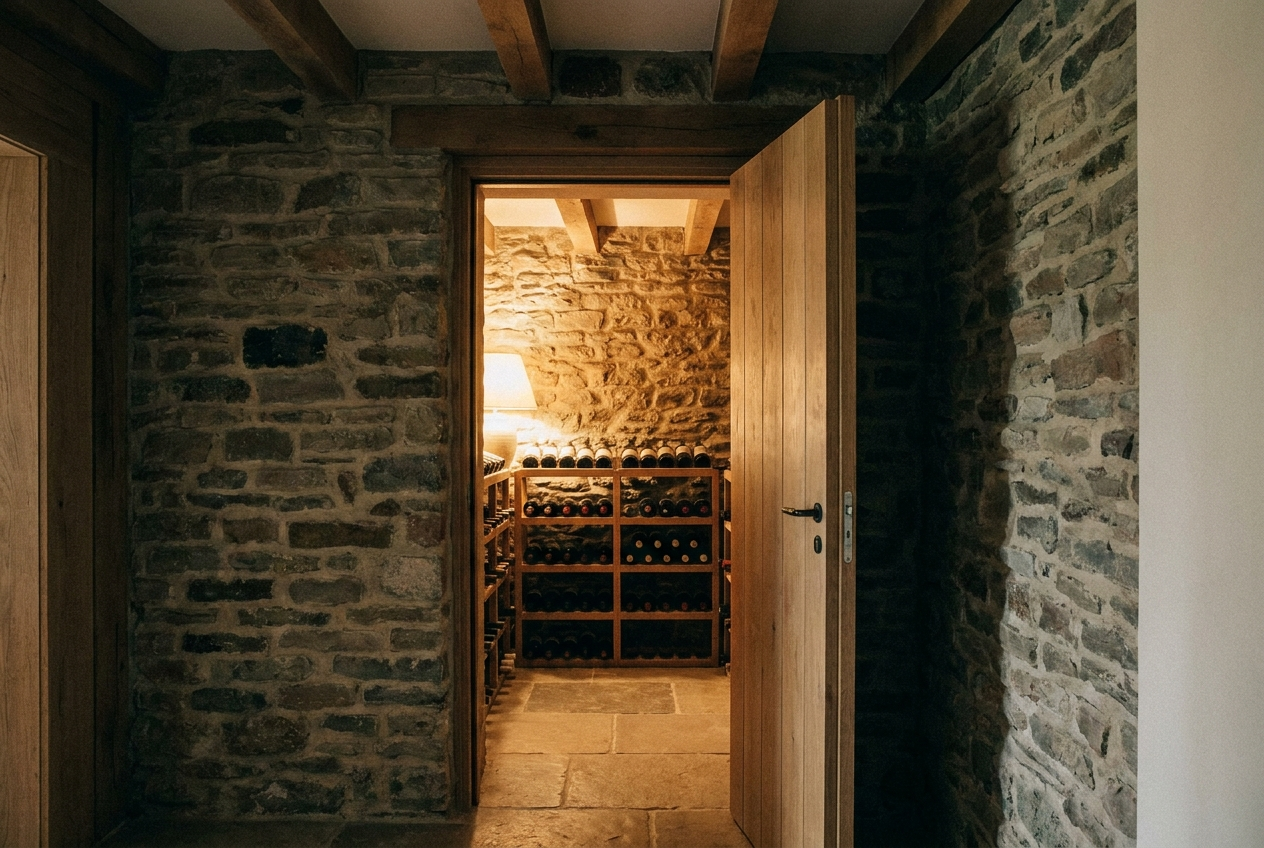
The smallest cellars don't need cooling units. They need to be in the right place, built to a reasonable standard, and accepted for what they are: a seasonal range, not a precise setpoint. Here's how to think about a passive cellar under 100 bottles.
What "passive" really means
A passive cellar uses soil mass and shade to hold a stable temperature without active cooling. It's not unconditioned: you're using the building envelope and the earth as your conditioning. Done right, you can hold 50–62°F year-round without a single watt of electricity.
The four things that matter
-
Depth. A north-facing basement room with at least one full wall and the floor below grade is the starting point. Above-grade rooms lose this advantage entirely.
-
Shade. No west-facing windows. No skylights. Exterior walls that see direct afternoon sun in summer are disqualifying.
-
Mass on the cold side. Concrete walls, stone floors, brick: anything that buffers swings. The more thermal mass on the cellar side of your insulation, the more stable your interior temperature.
-
A good door. This is where most passive cellars fail. A standard interior door with no seal will dump your cellar's stability every time the adjacent room runs hot or cold. Use an insulated exterior-style door with a real perimeter seal.
Where passive falls apart
Two scenarios where you should skip passive and accept that you need active cooling:
- Open-plan basements with the HVAC return nearby. Your cellar will track the rest of the house, not the earth.
- Climates with summer extremes above 90°F. Soil temperature follows the long-term average; six weeks of 95°F outside will push even a well-isolated basement above 62°F.
If your space passes the four tests above and your climate cooperates, a passive cellar can be one of the most satisfying wine storage projects you can build, and the cheapest to operate.
Next steps
If you're not sure, measure your candidate space across a full year with a logging hygrometer before committing. If the numbers don't cooperate, see our BTU sizing guide and pick an active unit appropriate for the space.
Keep reading