guide
Choosing a through-the-wall cellar cooling unit
What we look for in a self-contained cooling unit, and the four traps to avoid when buying one for a residential wine cellar.
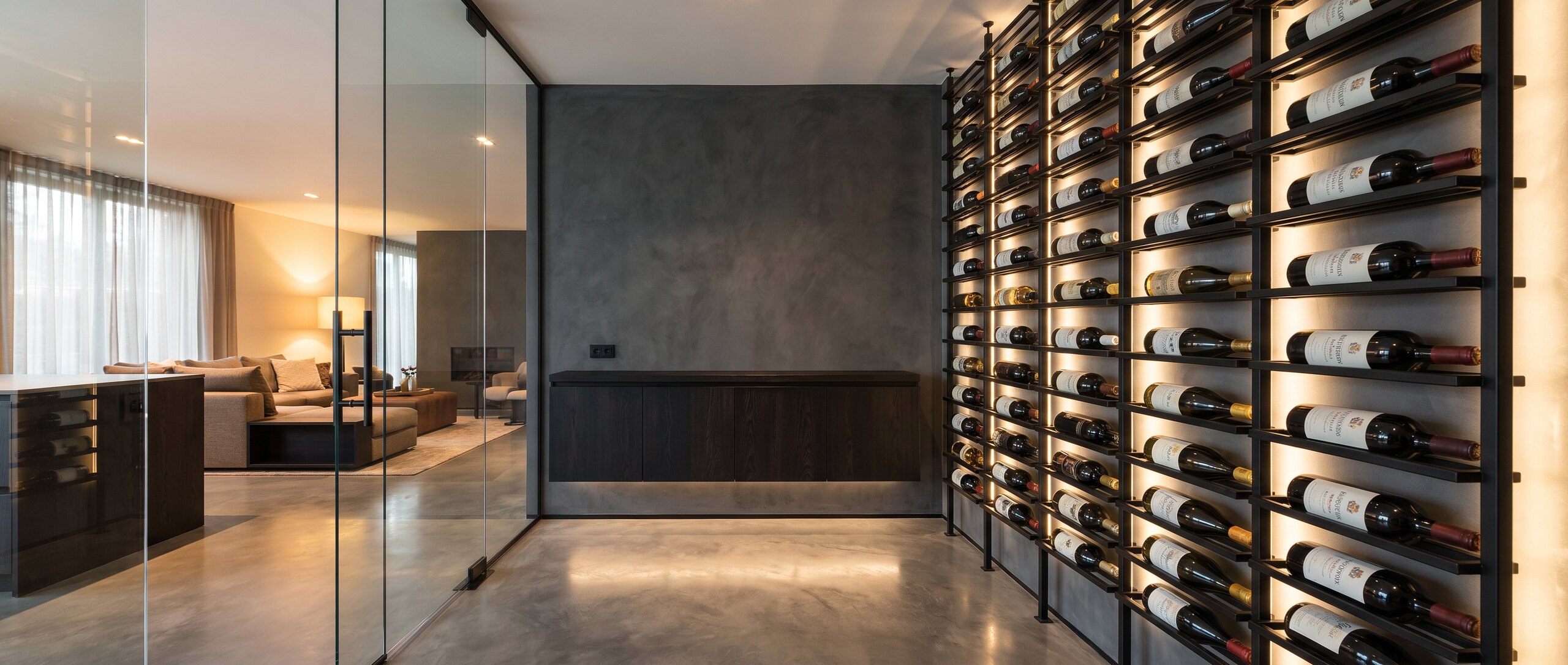
Through-the-wall ("self-contained") cooling units are the workhorse of residential wine cellars. They're the right answer for the vast majority of installations under 2,000 cubic feet, but only when the room, the adjacent space, and the unit itself are matched honestly.
Here's how we evaluate them, and what we wish more buyers asked before clicking purchase.
The room comes first, the unit second
You can't fix a leaky envelope with a bigger compressor. Before you look at any unit:
- Insulate to at least R-19 on walls and R-30 on ceiling. A cellar with R-13 walls will tax any unit, no matter the brand.
- Vapor-barrier the warm side. Failure to install a vapor barrier on the warm side of the insulation is the most common construction defect we see, and it ruins cellars regardless of equipment.
- Specify a real cellar door. An insulated exterior-style door with a full perimeter seal. Standard interior doors will dump your envelope.
What we look for in a unit
Five things, in order of importance:
- Capacity matched to your calculated load, within ~15–20% above it, not double. Use the BTU calculator or get an HVAC tech to do a manual load calc.
- Wide ambient operating range. The adjacent room (the "hot side") shouldn't push the unit outside its rated temperature band in summer. A wider range = more forgiving installation.
- Honest specs. Cooling capacity that's been measured at meaningful conditions, not a single best-case figure. Reputable manufacturers publish full performance curves.
- Serviceability. Standard fasteners. Parts inventory that ships from stock. A real service manual.
- Condensate management. Many units treat this as an afterthought. Plan for a drain line from day one regardless of the unit's promises.
The four traps
| Trap | What goes wrong | How to avoid |
|---|---|---|
| Sizing by bottle count | Bottle count ignores volume, insulation, ambient, and door activity | Use a real load calculation |
| Oversizing 'just in case' | Short-cycles, can't pull humidity down, kills the compressor early | Stay within ~20% above calculated load |
| Ignoring the hot side | Cellar performs in spring and fall, fails in August | Confirm the adjacent room stays inside the unit's rated range year-round |
| No condensate plan | Drip pans overflow, water on floor, mold under racks | Always run a real drain line; never rely on evaporative pans alone |
Self-contained vs split
A self-contained unit is the right call when:
- You have direct access to an adjacent room or exterior wall.
- That adjacent space stays in the unit's rated ambient range year-round.
- Total volume is roughly under 2,000 ft³.
If any of those is in doubt, look at a ducted split. See our writeup on self-contained vs ducted-split cooling.
Verdict
A correctly-sized self-contained unit in a properly-built room is one of the most reliable appliances in your house. The reverse, a premium unit in a leaky room, is one of the most frustrating. Build the room, then match the unit, in that order.
Keep reading