guide
Ducted wine cellar cooling units compared: specs, duct runs, and what installation takes
A sourced comparison of ducted self-contained cellar cooling units from Panthaire, Wine Guardian, CellarPro and WhisperKOOL: capacity, room volume, duct limits, mechanical room needs, condensate, power, warranty terms and price.
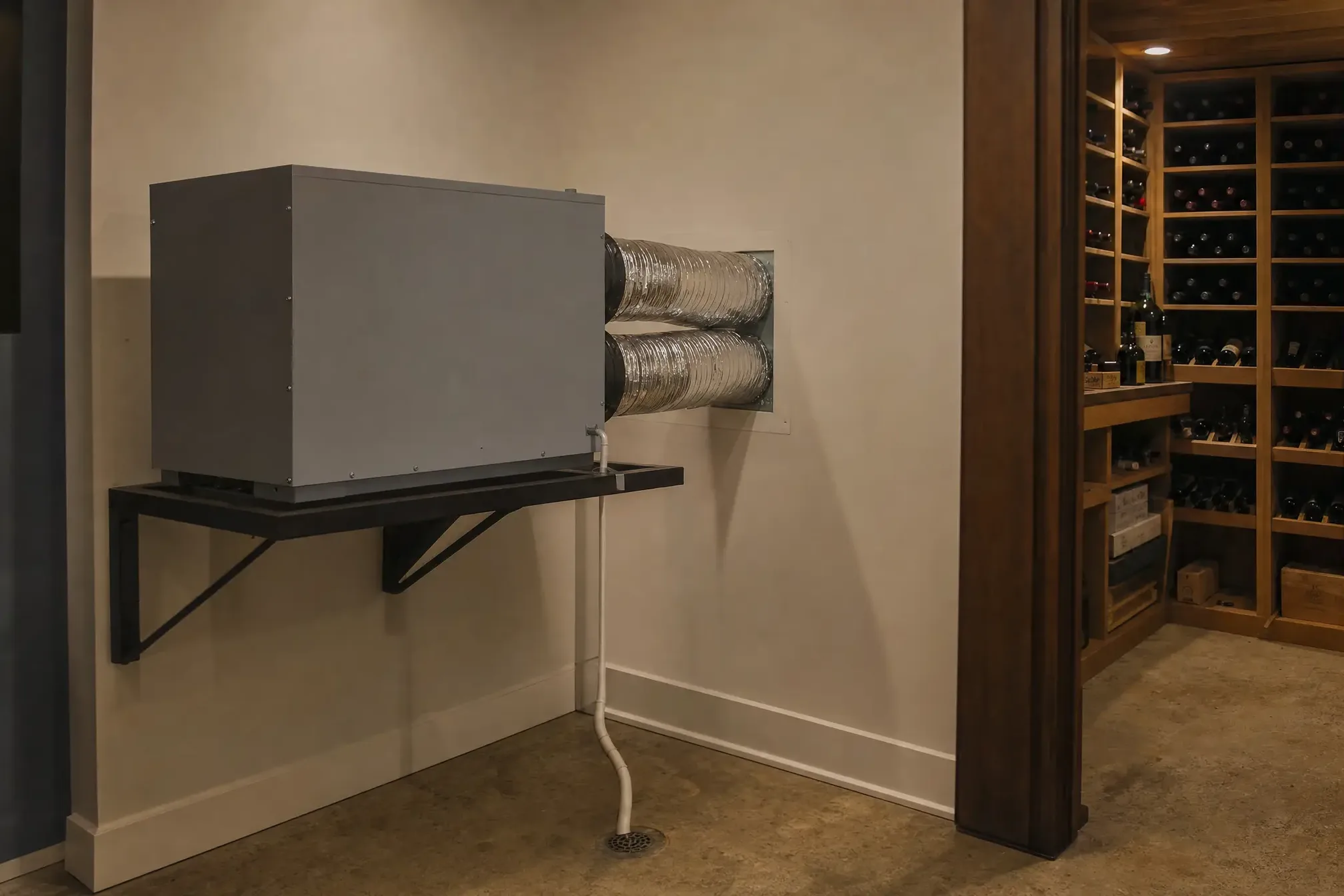
A ducted self-contained cooling unit puts the whole refrigeration system in one box outside the cellar, then runs a supply duct and a return duct to two grilles in the room. Inside the cellar you see the grilles and hear the air moving through them. The compressor, its heat and its hum stay somewhere else.
The trade-off is a new set of requirements: a second room that stays within a temperature range, duct runs with hard limits, a drain, and a dedicated circuit. Below we compare four makers' ducted self-contained lines on their published figures, then walk through what the installation asks of your house.
If you are still choosing between system types, start with our overview of wine cellar cooling units and our comparison of self-contained vs ducted-split cooling. This article assumes you are already leaning ducted.
What does "ducted" mean for a wine cellar cooling unit?
Makers use "ducted" for two different systems, so check which one a quote describes:
- Ducted self-contained. One cabinet holds the evaporator, compressor, condenser and fans. It ships charged with refrigerant, so nobody brazes copper lines on site. The cold side connects to the cellar by duct, and the hot side either breathes the room it sits in or is ducted elsewhere. This is the type compared here.
- Ducted split. The evaporator (ducted to the cellar) and the condenser (often outdoors) are separate, joined by a refrigerant line set that a licensed HVAC technician installs and charges. We cover those in split wine cellar cooling systems compared.
Some through-the-wall units can also be ducted with add-on hoods, such as CellarPro's 3200VSi, which CellarPro says can sit up to 50 equivalent feet (15 m) from the cellar with its front duct packages. Those are covered in our through-the-wall comparison.
Ducted self-contained units side by side
Every figure below comes from the maker's own product page, spec sheet or manual, checked in November 2026. Where a maker doesn't publish a figure, we say so rather than fill the gap.
| Model | Rated BTU/h (maker's conditions) | Rated room volume | Max duct run | Noise (maker figure) | Refrigerant | Warranty | List price, Nov 2026 |
|---|---|---|---|---|---|---|---|
| Panthaire APEX 3500 | 3,353 (conditions not published) | Up to 900 ft³ (25 m³) with R20 insulation | 25 ft (7.6 m) per duct | Not published | R290 | 2 years parts and labor | $5,599.95 |
| Panthaire APEX 5000 | 4,462 (conditions not published) | Up to 1,200 ft³ (34 m³) with R20 | 25 ft (7.6 m) per duct | Not published | R290 | 2 years parts and labor | $5,725.95 (promotional price) |
| Panthaire APEX 7000 | 6,346 (conditions not published) | Up to 2,000 ft³ (57 m³) with R20 | 25 ft (7.6 m) per duct | Not published | R290 | 2 years parts and labor | $6,995.95 (promotional price) |
| Wine Guardian D025 | 3,760 at 80°F inlet (4,300 at 70°F) | 250–2,000 ft³ (7–57 m³) | 25 ft (7.6 m) supply and return combined, recommended | Not published | R-134a | 2 years parts, 1 year labor | $6,043 |
| Wine Guardian D050 | 6,320 at 80°F inlet | 650–3,000 ft³ (18–85 m³) | 25 ft (7.6 m) combined, recommended | Not published | R-134a | 2 years parts, 1 year labor | $7,395 |
| Wine Guardian D088 | 9,420 (208 V) or 9,600 (230 V) at 80°F inlet | 850–4,500 ft³ (24–127 m³) | 25 ft (7.6 m) combined, recommended | Not published | R-134a | 2 years parts, 1 year labor | $8,185 |
| CellarPro AH4500SCh | 4,328 sensible at 55°F cellar, 95°F ambient | Up to 1,250 ft³ (35 m³) with R19 | 50 equivalent ft (15 m) per duct | Cellar side, ducted: 38–52 dBA by fan speed (distance not stated) | Not stated on product page | 2 years system, 5 years compressor | $5,950 |
| CellarPro AH6500SCh | 5,771 sensible at 55°F cellar, 95°F ambient | Up to 1,750 ft³ (50 m³) with R19 | 50 equivalent ft (15 m) per duct | Cellar side, ducted: 38–52 dBA (distance not stated) | Not stated on product page | 2 years system, 5 years compressor | $6,495 |
| CellarPro AH8500SCh | 7,156 sensible at 55°F cellar, 95°F ambient | Up to 2,500 ft³ (71 m³) with R19 | 50 equivalent ft (15 m) per duct | Cellar side, ducted: 38–52 dBA (distance not stated) | Not stated on product page | 2 years system, 5 years compressor | $6,950 |
| WhisperKOOL Phantom 3500 | 4,060 at 85°F intake | 800 ft³ (23 m³) with R19 | 25 ft (7.6 m) each side | Not published | R-134a/R-513a | 2 years limited, 5 years compressor | $6,265 |
| WhisperKOOL Phantom 5000 | 5,521 at 85°F intake | 1,250 ft³ (35 m³) with R19 | 25 ft (7.6 m) each side | Not published | R-134a/R-513a | 2 years limited, 5 years compressor | $7,185 |
| WhisperKOOL Phantom 8000 | 6,025 at 85°F intake | 2,000 ft³ (57 m³) with R19 | 25 ft (7.6 m) each side | Not published | R-134a/R-513a | 2 years limited, 5 years compressor | $8,275 |
Prices are list prices shown on each maker's own site in November 2026, for the unit alone. Panthaire was running an $800-off promotion on the APEX 5000 and 7000 at the time. Ducts, grilles, accessories, electrical work and labor are extra, and installed cost varies a lot from house to house.
A few notes the table can't carry:
- WhisperKOOL also sells a fully ducted version of its Extreme tiR (Extreme tiR 3500 FD, from $6,725), rated 2,688 to 5,760 BTU/h at 85°F intake across three sizes.
- Wine Guardian sizes by its own calculator rather than a single volume figure, which is why it publishes a range for each unit. It also offers a Platinum warranty with two years of labor and a longer term on the compressor and coils.
- Breezaire currently lists through-the-wall (WKL) and split (WKSL) systems, not a ducted self-contained line. We left Vinotemp's Wine-Mate self-contained units out of the table because we could not confirm duct limits from the maker's own pages.
When is a ducted unit worth it?
A ducted self-contained unit usually costs more than a through-the-wall unit of similar capacity, and its installation involves more trades. It tends to earn that premium in four situations:
- The cellar opens onto living space. A dining room, a home theater, a glass wine wall in a kitchen. Through-the-wall units put the compressor in the cellar wall. A ducted unit leaves you with air sound at the grilles. Our guide to quiet cellar cooling units covers the noise question across all system types.
- You don't want to see equipment. Two grilles can sit in a ceiling, a soffit or behind racking. Nothing takes up a rack bay.
- No wall borders a suitable room. Through-the-wall units need the room behind them to absorb the heat. A ducted unit can sit in a mechanical room, closet or attic space up to its duct limit away, and many can duct their exhaust elsewhere too.
- You want to avoid refrigerant work on site. Unlike a ducted split, a self-contained unit arrives charged, though that doesn't make it a weekend project.
It is usually not worth it when a through-the-wall unit can exhaust into a garage or utility room that stays in range all year and nobody will hear it.
What does the mechanical room need?
This is where ducted projects most often go wrong. The unit's hot side breathes the air around it, so that room's temperature limits the system. Each maker states its own range:
- Panthaire APEX: the room housing the unit must stay between 50°F and 77°F (10–25°C). Panthaire says not to duct the condenser intake directly outdoors in climates that drop below freezing or rise above 77°F; draw from a tempered indoor space instead.
- Wine Guardian D series: the manual gives a safe condenser inlet range of 45°F to 95°F (7–35°C). An optional Extreme Climate Protection bundle covers inlet air below 40°F (4°C) or from 100°F to 120°F (38–49°C). The manual also notes the exhaust runs 25 to 35°F (15–18°C) warmer than the intake, and asks for it to go outdoors or into a space at least three times the size of the wine room.
- CellarPro AH SCh: rated to hold cellar conditions with up to 110°F (43°C) around the unit. A compressor heater covers rooms down to 20°F (-7°C), and a fan-cycling switch is needed below that. The fresh-air intake must come from outside the cellar.
- WhisperKOOL Phantom: holds a 55°F (13°C) cellar with condenser intake air up to 110°F (43°C). WhisperKOOL lists an external insulation kit as required in unconditioned areas.
These ranges differ a lot. A tempered basement utility room suits all four. An unconditioned attic in a hot climate or a garage in a cold one narrows the list quickly, so measure that room's summer highs and winter lows before you choose a unit, not after.
How long can the ducts be, and why does static pressure matter?
Every duct, elbow, grille and filter adds resistance to airflow, called static pressure. Past a certain point the unit's fans can't move their rated airflow, capacity drops, and the coil can run cold enough to frost. That is why each maker publishes a run limit:
- Panthaire: 25 ft (7.6 m) per duct, 50 ft (15 m) combined, with 8 in (20 cm) supply and 8 or 10 in (20 or 25 cm) return depending on model. Its ductwork guide asks for insulated flex rated at least R-6 (R-8 for colder spaces or longer runs) and a return grille with at least as much free area as the supply.
- Wine Guardian: recommends a cumulative maximum of 25 ft (7.6 m) for supply and return together, bends included, and points to its ductwork calculator for longer runs. Its spec sheet shows how airflow falls with resistance (the D025 moves 245 CFM free-blowing and 200 CFM at 0.10 in of water column) and says capacity drops about 3% for every 10% loss of evaporator airflow.
- CellarPro: 50 equivalent feet (15 m) per duct, 100 per side. "Equivalent" means fittings count against the length, not just straight duct.
- WhisperKOOL: 25 ft (7.6 m) of equivalent run per side, which its static pressure chart calls a hard limit. The same chart gives a maximum external static pressure of 0.65 in of water column for the Phantom 3500 and 0.5 in for the 5000 and 8000, with a 12 × 12 in (30 × 30 cm) register (144 in² of free area) on each.
In practice that means keeping the unit close, routing ducts as straight as the framing allows, using long-radius bends, never necking a duct below the stated diameter, and choosing grilles by free area rather than looks. We usually put the supply high and the return low on the opposite side, the pattern Panthaire's ductwork guide describes. Insulate the cold-side ducts fully: a bare duct through a warm ceiling sweats and loses capacity.
Sizing comes first, of course. Run your room through the BTU calculator and read our guide to sizing cellar cooling; with a ducted unit, add the heat the cold-side ducts pick up on the way to the cellar.
Where does the condensate go?
Every cooling coil pulls water from the air. A ducted unit sits outside the cellar, often above a finished ceiling, so plan the drain as carefully as the ducts:
- Panthaire uses a 5/8 in ID drain and asks for a drain within 15 in (38 cm) of the unit, or a condensate pump.
- Wine Guardian uses a 1/2 in ID line with a built-in trap (no external trap), pitched 1/4 in per foot, to an open floor drain or a condensate pump, and says not to tie it directly into the sanitary sewer.
- CellarPro and WhisperKOOL both use a 1/2 in drain line.
When the unit sits over living space, we usually add a secondary drip pan with a leak sensor. Wine Guardian's manual suggests the drip pan for hot, humid locations, where the cabinet itself can sweat.
What electrical service does a ducted unit need?
Plan a dedicated circuit for any of them. The details differ:
- Panthaire APEX: 115 V, 15 A for the 3500 and 5000 and 20 A for the 7000, with no GFCI outlet per its installation checklist.
- Wine Guardian: 115 V for the D025 and D050; the D088 needs 208–230 V, which may mean a new 240 V circuit in many homes.
- CellarPro AH SCh: two 110 V cords, one for the compressor on its own dedicated circuit (15 A on the AH4500SCh, 20 A on the larger two) and one for the rest of the components on a 15 A circuit.
- WhisperKOOL Phantom: 115 V on a 20 A dedicated circuit.
Have an electrician confirm panel capacity before you pick a model.
Who installs it, and what does the warranty require?
This is where the makers differ most, and it changes who you hire:
- Panthaire requires installation by a certified HVAC technician or qualified professional to keep warranty coverage, and its product pages describe the two-year parts and labor warranty as running from installation by a licensed HVAC contractor.
- Wine Guardian says its ducted units need no copper cutting and no licensed contractor on site, lists the installation level as handyperson or contractor, and recommends contractor installation. Labor is reimbursed in the first year with prior authorization.
- CellarPro ships its air handlers fully charged. Its warranty excludes damage from improper installation, and warranty service is done by CellarPro or a designated repair facility, with removal, reinstallation and shipping at the owner's cost.
- WhisperKOOL recommends an HVAC-R technician. Its warranty excludes improper installation, puts installation and removal costs on the owner, and applies only in the continental United States.
Whatever the maker allows, a ducted install touches carpentry, ductwork, electrical and plumbing. Keep every invoice: Panthaire's warranty asks for installation records with a claim. If you'd like a builder to look at the route before you buy, our experts can review your plans.
What does a ducted system cost?
On the makers' own sites in November 2026, the units in our table listed from about $5,600 to about $8,300 before accessories. Options can add materially: CellarPro lists an integrated humidifier at $1,495 and an integrated heater at $700 for its air handlers, and WhisperKOOL lists the Phantom 3500's external insulation kit at $300.
Installation is quoted per job, and the route drives it more than the unit does. A short run from a utility room next to the cellar, with a drain and a spare breaker nearby, is a modest job. A long route through finished ceilings, a new 240 V circuit, a condensate pump and an access panel is a much bigger one. Our guide to wine cellar cooling unit cost breaks down installed costs across all system types.
How to choose between them
There's no single right unit here, only a right fit for the room. Size the cellar, measure the mechanical room through a summer and a winter, draw the duct route against each maker's run limit, check your power, and read the warranty's installation terms before you buy.
If the cellar is small, the mechanical space is tempered and the run is short, most of these units will work, and price, power and warranty terms decide. If the space is hot, long runs are unavoidable, or the cellar is large, the field narrows to units whose published limits cover your case. If you can't stay inside any maker's duct limit, move the unit or look at a split.
FAQ
Frequently asked questions
- What is a ducted wine cellar cooling unit?
- A self-contained cooling unit installed outside the cellar, usually in a mechanical room, closet or attic, connected to the cellar by an insulated supply duct and return duct. The unit ships charged with refrigerant, so there are no refrigerant lines to run. Inside the cellar you see only two grilles.
- Are ducted wine cellar cooling units quiet?
- Inside the cellar, generally yes: the compressor is in another room, so what you hear is air at the grilles. Few makers publish noise figures for ducted units. CellarPro lists 38 to 52 dBA on the cellar side of its ducted air handlers depending on fan speed, without stating the measuring distance.
- How far can a ducted cooling unit be from the cellar?
- It depends on the maker. Panthaire and WhisperKOOL allow 25 feet per duct or per side, Wine Guardian recommends 25 feet for supply and return combined, and CellarPro allows 50 equivalent feet per duct. Elbows and fittings count against those limits.
- Can a ducted unit go in an attic or garage?
- Only if that space stays within the maker's range. Panthaire asks for 50 to 77°F (10 to 25°C) around the unit; Wine Guardian's manual gives 45 to 95°F (7 to 35°C) at the condenser inlet, with an optional bundle for colder or hotter air; CellarPro and WhisperKOOL rate their units for intake air up to 110°F (43°C). Measure the space through a summer and a winter first.
- Do I need an HVAC technician to install a ducted self-contained unit?
- There is no refrigerant work, but the makers differ. Panthaire requires a certified HVAC technician or qualified professional for warranty coverage, WhisperKOOL recommends an HVAC-R technician, and Wine Guardian says no licensed contractor is needed on site while recommending contractor installation. You will also need an electrician for the dedicated circuit.
- Does a ducted unit control humidity?
- It removes some moisture as it cools, like any cooling unit. Adding humidity takes a separate or integrated humidifier; Wine Guardian and CellarPro offer ones that attach to their ducted units. Aim for 50 to 70 percent relative humidity, about 60 percent, at a steady 55°F (13°C).
New guides from people who build cellars, sent to your inbox.
Planning a cellar? Ask the people who build them.
Contact our expertsKeep reading
Related