guide
Split wine cellar cooling systems compared: ductless and ducted splits, line sets, and installation
A sourced comparison of split wine cellar cooling systems from CellarPro, WhisperKOOL, Wine Guardian, Vinotemp and Breezaire: capacity, line-set limits, outdoor range, warranty, cost, and when a split is overkill.
A split wine cellar cooling system puts the quiet half of the refrigeration cycle (the evaporator and its fan) in or near the cellar and the loud, hot half (the compressor and condenser) somewhere else: outdoors, in a garage, or in a mechanical room. Copper refrigerant lines, the line set, join the two. That solves the two problems that rule out a through-the-wall unit in many homes, compressor noise next to living space and nowhere to dump the heat, at the price of real HVAC work and a bigger bill.
If you are still choosing between a one-box unit and a split, start with self-contained vs ducted-split cooling. This page assumes you are leaning toward a split and want to know how the published options compare and what installing one involves.
Ductless or ducted split: what's the difference?
Both put the condenser remotely. They differ in where the evaporator sits.
- Ductless split. The evaporator (often called a fan coil) mounts on a cellar wall, in the ceiling, or recessed into a wall. You see it and hear its fan, but not a compressor.
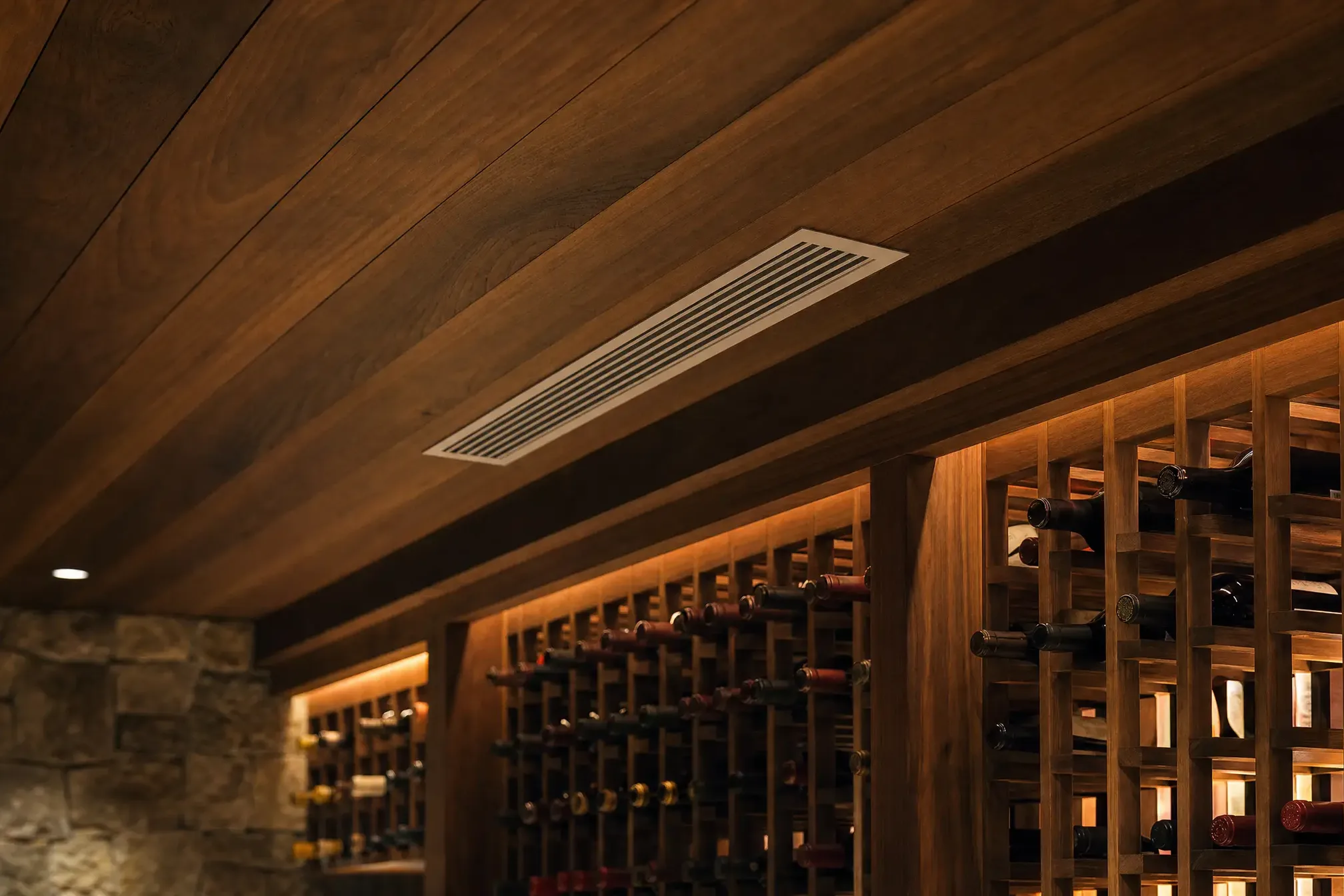
- Ducted split. The evaporator sits outside the cellar, in a closet, attic or mechanical room, and short ducts carry air to grilles in the cellar. Nothing mechanical shows in the room.
Our overview of the four types of cellar cooling places both beside self-contained units. For ducted cooling without refrigerant work, see our ducted cooling units comparison.
How do the split systems compare?
We picked one small-to-mid-size model from each maker's current split range, where most residential cellars land. Each family comes in larger and smaller sizes.
| Model | Type | Capacity as published (BTU/h) and rating conditions | Rated cellar volume | Condenser location and line-set limits | Refrigerant | Warranty | Who must install |
|---|---|---|---|---|---|---|---|
| CellarPro 3000S | Ductless, wall-mounted evaporator | 2,491 sensible (high fan) at a 55°F (13°C) cellar, 60% RH, 95°F (35°C) ambient | Up to 600 ft³ (17 m³), assuming R-19 and up to 85°F (29°C) outside the cellar | Outside the cellar; 100 equivalent ft (30 m), 30 ft (9 m) vertical | Not stated on the product page | 2 years system, 5 years compressor; checklist activates it | Qualified HVAC professional installs and charges |
| CellarPro AH4500Sx | Ducted (air handler) | 4,328 sensible (high fan), same conditions | Up to 1,250 ft³ (35 m³), same assumptions | Exterior; 100 equivalent ft (30 m), 30 ft (9 m) vertical; ducts up to 50 equivalent ft (15 m) each | Not stated on the product page | 2 years system, 5 years compressor; checklist activates it | Qualified HVAC professional installs and charges |
| WhisperKOOL Platinum Split 4000 | Ductless, wall-mounted evaporator | 3,650–4,315 on the product page; spec sheet rates at 60, 75 and 85°F (16, 24, 29°C) condenser inlet air | Not published | Up to 100 ft (30 m); exterior housing required outdoors | R-134a/R-513a | 2-year limited product warranty; approved checklist activates it | Licensed HVAC/R technician, or the warranty is void |
| WhisperKOOL Ceiling Mount 4000 | Ductless, recessed ceiling evaporator | 4,000–6,087 on the product page; same spec-sheet conditions | Not published | Up to 100 ft (30 m); exterior housing required outdoors | R-134a/R-513a | 2-year limited product warranty; approved checklist activates it | Licensed HVAC/R technician, or the warranty is void |
| Wine Guardian SS018 | Ductless, surface or through-the-wall fan coil | 2,800 net at 57°F (14°C), 55% RH entering air, 80°F (27°C) condenser inlet | 100–1,200 ft³ (3–34 m³) | Outdoor enclosure standard; 50 equivalent ft (15 m), 15 ft (4.6 m) lift | R-134a | 2 years parts, 1 year labor | Qualified technician with refrigerant-handling certification |
| Wine Guardian DS025 | Ducted, ductable fan coil | 3,485 total (3,178 sensible) at 57°F (14°C), 55% RH entering air, 80°F (27°C) condenser inlet | 250–2,000 ft³ (7–57 m³) | Outdoor enclosure; 50 ft (15 m) without added oil, 80 ft (24 m) maximum; 15 ft (4.6 m) lift | R-134a | 2 years parts, 1 year labor | Qualified contractor with refrigerant-handling certification |
| Vinotemp Wine-Mate 2500SSW | Ductless, wall-recessed evaporator | 2,500; conditions not stated | 250 ft³ (7 m³) | Up to 75 ft (23 m) from the wine room; vertical limit not published | R-134a | Not published | Licensed refrigeration technician |
| Breezaire WKSL 4000 | Ductless, wall-mounted fan coil | Not published by the maker | Up to 1,000 ft³ (28 m³), built to Breezaire's construction guidelines | 50 ft (15 m) calculated length, less 10 ft (3 m) per hard 90° bend | R-134a | 1 year, all components | Licensed refrigeration technician recommended |
Two things the table doesn't show. Line sets are usually extra: WhisperKOOL says its systems don't include one, Wine Guardian's manuals say the installer supplies the copper, and CellarPro sells one for the 3000S as an option. Warranties need paperwork: CellarPro and WhisperKOOL both activate split warranties only once the installer's checklist is returned, so ask your technician to submit it before they leave.
What do they cost to buy?
List prices on the makers' own sites in November 2026, before shipping, line set, options and installation:
- CellarPro: $4,695 (3000S), $6,250 (AH4500Sx).
- WhisperKOOL: $7,805–$8,059 (Platinum Split 4000), $8,295–$8,549 (Ceiling Mount 4000), depending on the condenser chosen.
- Wine Guardian: $7,266 (SS018), $8,329 (DS025).
- Vinotemp: $5,249 (Wine-Mate 2500SSW), shown as sold out when we checked.
- Breezaire: no price on its site; it sells through dealers.
Installed cost varies widely with the line-set route, penetrations, electrical work and local labor rates. Our guide to wine cellar cooling unit cost breaks it down.
Why choose a split system?
Two reasons drive almost every split decision.
The quietest cellar you can build. The compressor is the loudest part of any cooling unit, and a split takes it out of the room. A ductless split leaves the evaporator fan; a ducted split leaves air noise at the grilles. Next to a dining room, home theater or bedroom, that matters more than any spec sheet. See our guide to quiet wine cellar cooling units.
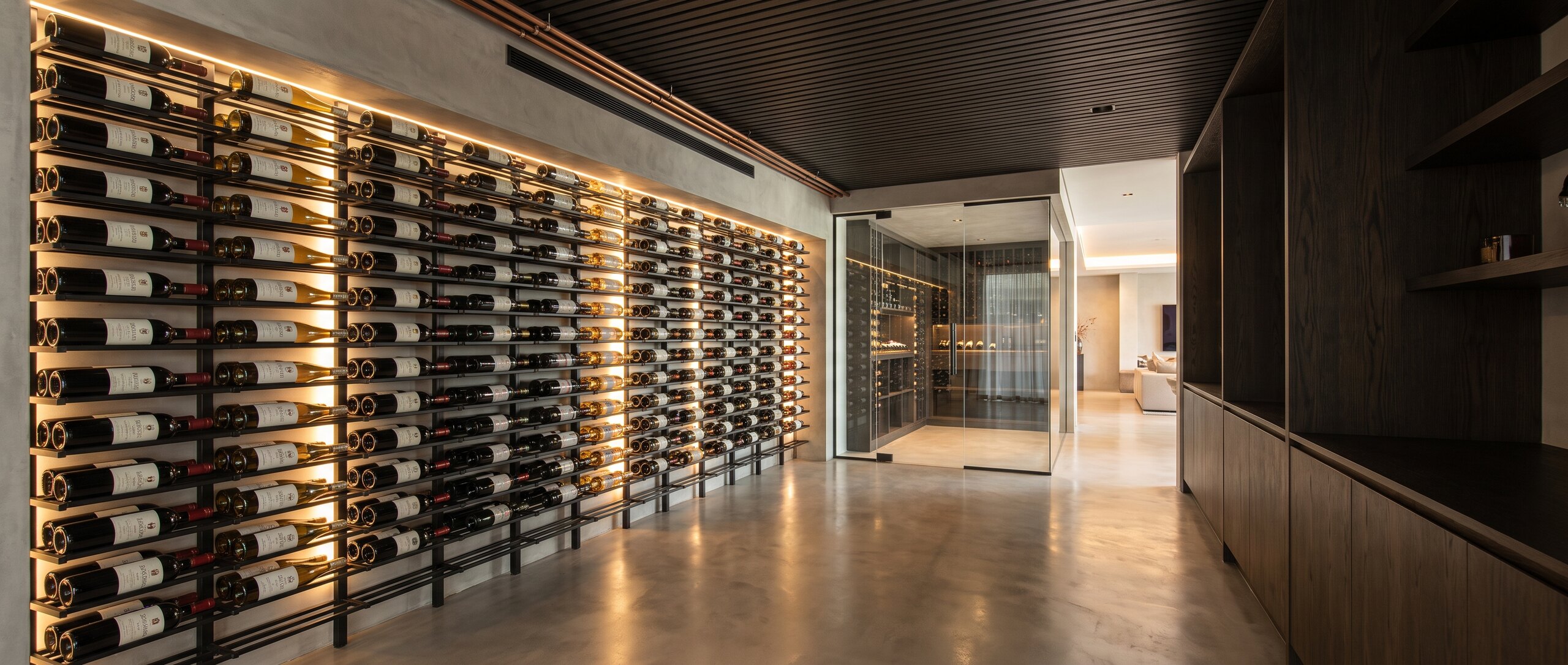
The heat leaves the house. A through-the-wall unit dumps the cellar's heat, plus its own compressor heat, into the next room, which must stay inside the unit's rated range all year. An outdoor condenser sends that heat outside. That's why splits suit cellars in the middle of a finished floor, glass wine rooms in living space, and basements whose only neighbour is a family room. If your design has a lot of glass, read our guide to glass wine cellars before sizing.
How far can the condenser be from the cellar?
This decides whether a split works in your house, and makers differ more than buyers expect. CellarPro publishes 100 equivalent feet (30 m) with up to 30 feet (9 m) vertical. WhisperKOOL publishes 100 feet (30 m), with a larger suction line past 50 feet (15 m). Vinotemp allows 75 feet (23 m). Wine Guardian lists 50 feet (15 m) for the SS018, and 50 to 80 feet (15 to 24 m) for the DS025 depending on added oil, both with 15 feet (4.6 m) of lift. Breezaire allows 50 feet (15 m) per line. We found no published vertical limit from WhisperKOOL or Vinotemp.
"Equivalent feet" is the catch. Makers count each elbow as extra length (Breezaire says to subtract 10 feet for every hard 90° bend), so a run that measures 40 feet on a tape can calculate past 50 once it turns a few corners and climbs a floor. Long runs also need the right suction-line size, sometimes added oil and refrigerant, and careful pitch so oil returns to the compressor. Wine Guardian's manual says a system run past its maximum line length must be upsized. Have your installer sketch the real route, count the bends, and check the rise against the maker's table before you settle on a condenser spot.
Do you need a licensed refrigeration technician?
Yes. Every maker in our table requires or recommends one. WhisperKOOL says installation by anyone else voids the warranty; CellarPro says all split systems must be installed and charged on site by a qualified HVAC professional; Wine Guardian adds that certification to handle refrigerants is required; Vinotemp requires, and Breezaire recommends, a licensed refrigeration technician.
The job is real refrigeration work: brazing copper, pressure testing, pulling a vacuum and charging the system, usually with an electrician for dedicated circuits and, depending on where you live, a permit. Your cellar builder can frame and insulate around the line set but shouldn't charge it. Book the technician early, and ask whether they have installed this brand before and will complete its warranty checklist. Plenty of HVAC companies install comfort mini splits every week but rarely see a cellar system.
How cold or hot can it get where the condenser sits?
The condenser has to work through your hottest afternoon and coldest night. Published ranges:
- CellarPro: -20°F to 110°F (-29°C to 43°C) on the 3000S page, with a fan cycling switch and compressor heater needed below 20°F (-7°C).
- WhisperKOOL: -20°F to 110°F (-29°C to 43°C) for the Omega 110V condenser, -20°F to 120°F (-29°C to 49°C) for the 220V Advanced.
- Wine Guardian: 20°F to 115°F (-7°C to 46°C) standard, with optional protection down to -20°F (-29°C).
- Breezaire: capacity falls above 85°F (29°C) condenser inlet, and a crankcase heater or fan speed control is advised below 20°F (-7°C).
- Vinotemp: no range on the Wine-Mate spec sheets we found.
In a cold climate, budget for the low-ambient option from the start: the cellar still needs cooling on a mild winter day while the condenser sits in freezing air. In a hot one, capacity falls as condenser air heats up, so give the condenser shade and clear airflow, and raise it above snow and standing water. On the coast, read the warranty: CellarPro's 3000S page excludes marine exposure within 5 miles of the ocean.
What does installing a split really involve?
Beyond the equipment, budget for:
- The line set and its route: copper, suction-line insulation, wall or roof penetrations, and resealing the cellar's vapor barrier at each one (see insulation and vapor barriers).
- A condensate drain from the evaporator to a floor drain or pump.
- Electrical: often separate circuits at each end; the Wine Guardian condensers above run on 208–230V.
- A pad or bracket for the condenser, plus any housing the maker requires outdoors.
- For ducted splits, a space for the air handler and insulated ducts within the maker's limits.
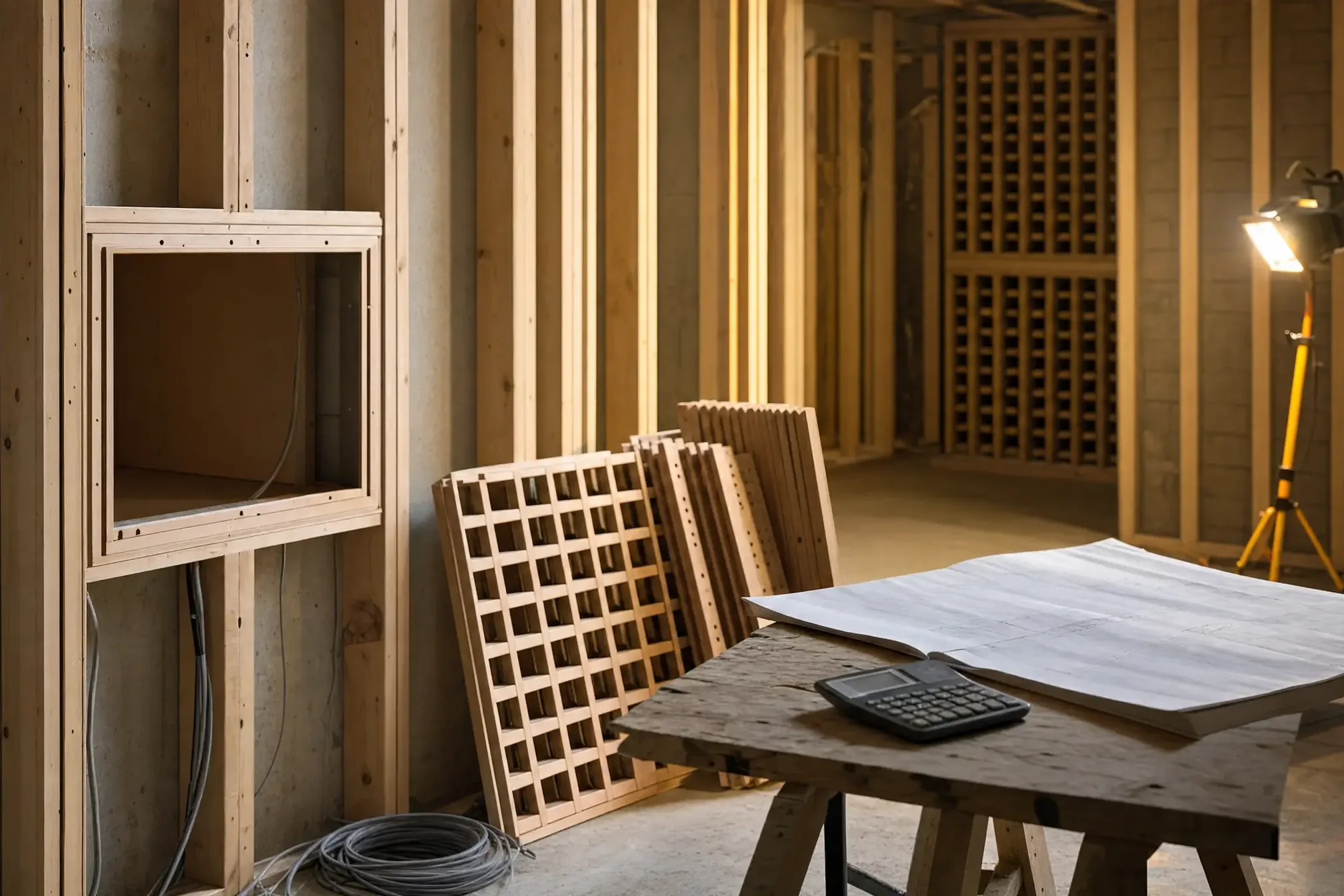
Run the line set before drywall; retrofitting one through a finished basement ceiling is where installs get expensive. Our build sequence guide shows where cooling rough-in fits. Service costs more later too, because a leak or compressor failure means a technician working at both ends.
When is a split system overkill?
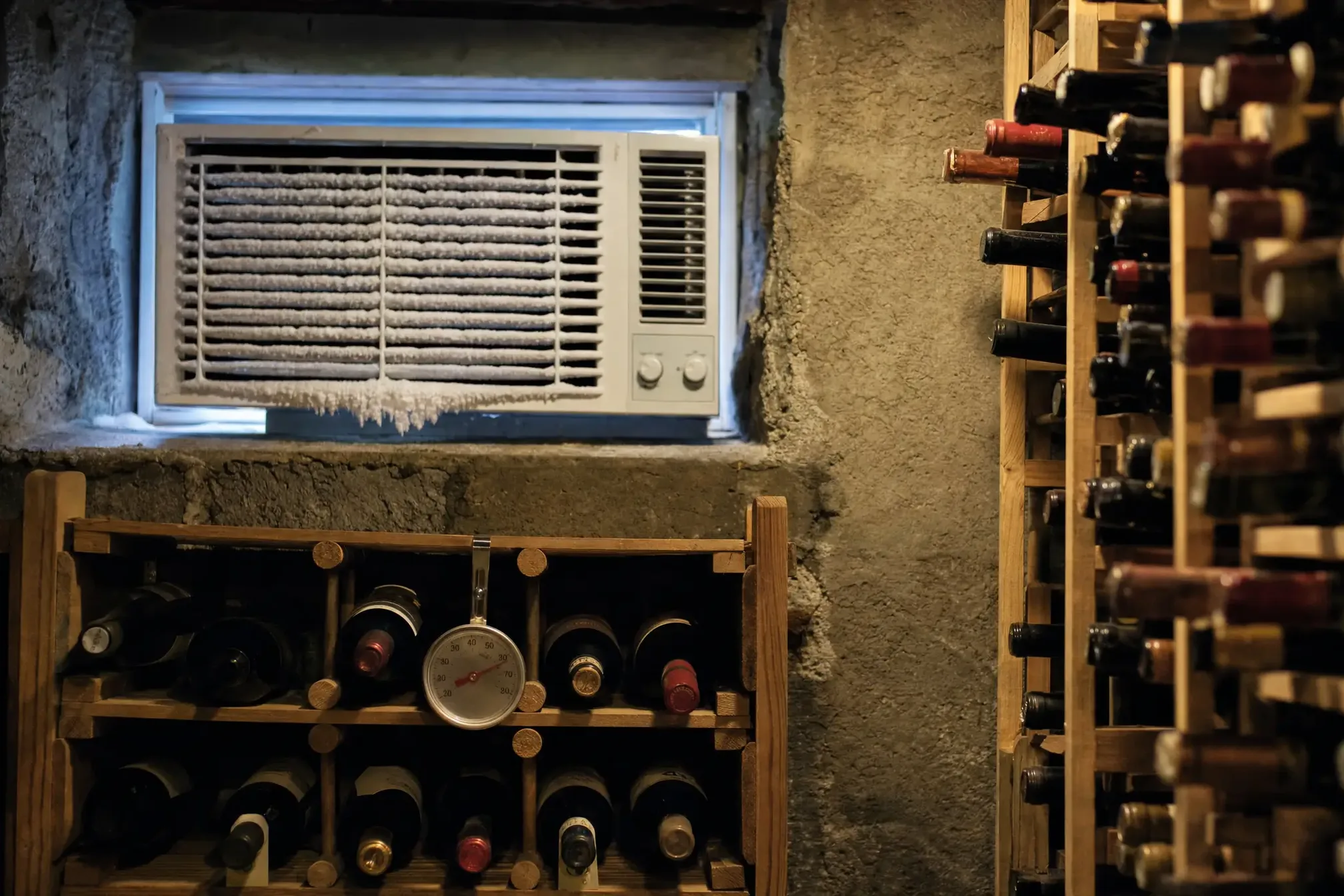
- A small cellar beside a tolerant room. If the other side of the wall is a large unfinished basement or utility room that stays inside a through-the-wall unit's rated range all year, a self-contained unit does the job for much less. See choosing a through-the-wall unit.
- Noise is the only concern and a mechanical room is next door. A self-contained ducted unit moves the compressor out of the cellar without refrigerant work.
- The line-set route runs past the maker's limits. A self-contained ducted unit exhausting to a larger space may be simpler.
- A closet or reach-in. Mini splits exist, but our guide to small wine cellar cooling units covers cheaper ways to cool a closet.
The reverse holds too. If a through-the-wall unit's only exhaust space is a hot garage, a small closet or a room you use every day, a split usually costs less than replacing a unit that lives outside its rated range.
Which split fits which cellar?
We don't rank brands; the room decides.
- Cellar in living space, nothing mechanical visible: ducted splits such as CellarPro's AH series, WhisperKOOL's ducted Platinum Split and Quantum, Wine Guardian's DS series, or Vinotemp's Wine-Mate central-ducted (SSH) units. You need a nearby space for the air handler.
- A visible evaporator is fine: wall-mounted ductless splits from CellarPro, WhisperKOOL, Wine Guardian or Breezaire, or a wall-recessed unit such as Vinotemp's Wine-Mate SSW that sits between studs.
- Racking on every wall: ceiling evaporators such as WhisperKOOL's Ceiling Mount series or CellarPro's recessed ceiling-mount models.
- A long or steep route to the condenser: shortlist makers whose published limits cover it, and confirm the vertical rise with each.
If you're weighing a split against a self-contained unit, or unsure the line-set route works, our experts can look at the plan with you.
FAQ
Split cellar cooling: common questions
- What is a split wine cellar cooling system?
- A system in two parts: an evaporator in or near the cellar that cools the air, and a condensing unit placed remotely, often outdoors, that rejects the heat. A refrigerant line set connects them. Ductless splits mount the evaporator in the cellar; ducted splits place it outside and duct the air in.
- How far can the condenser be from the wine cellar?
- It depends on the maker. Published limits for the models we compared run from 50 feet to 100 equivalent feet of line set, and some makers also cap the vertical rise at 15 or 30 feet. Bends count as extra length, so have your installer calculate the actual route.
- Can I install a split wine cellar cooling system myself?
- Not the refrigerant side. The makers we compared require or recommend a qualified, licensed refrigeration technician, and several tie the warranty to professional installation and a submitted checklist. You or your builder can prepare the route, framing and insulation.
- Can the condenser go outside in winter?
- Yes, within the maker's published range. Standard ranges for the models we compared reach down to about 20°F (-7°C), and optional low-ambient kits or compressor heaters extend that to about -20°F (-29°C).
- Is a split system worth the extra cost?
- Usually, when the cellar sits in living space, has no tolerant room next door for exhaust heat, or needs to be as quiet as possible. For a small cellar beside a large unfinished basement or utility room, a self-contained unit typically does the job for much less.
New guides from people who build cellars, sent to your inbox.
Planning a cellar? Ask the people who build them.
Contact our expertsKeep reading