guide
Wine cellar humidifiers: when you need one, which type, and when to dehumidify instead
Most cellars don't need a humidifier. How to tell if yours does, what to try first, how ultrasonic, evaporative and integrated systems compare, and what to do when the room is too damp.
A wine cellar humidifier is one of the most common add-ons people ask us about, and one of the ones we talk people out of most often. Plenty of cellars hold a healthy humidity with nothing more than a tight envelope and a right-sized cooling unit. Some genuinely need help, usually in winter.
Here is how to tell which camp you are in, and what to do when the problem runs the other way.
Does your wine cellar need a humidifier?
The target is the same one we use across this site: a steady 55°F (13°C) at 50–70% relative humidity, with about 60% as a comfortable middle. Our guide to ideal cellar temperature and humidity explains why that band matters and why a steady 55°F at 45% is still a fine cellar.
Added humidity is worth considering when the room sits below about 50% RH for weeks at a time. The usual reasons:
- Dry climates. Desert and high-altitude homes start with dry air, and any air the cellar trades with the house is dry too.
- Winter heating. In cold climates, heated indoor air can fall to 20 to 30% RH. A cellar with a leaky door or shared ductwork follows it down.
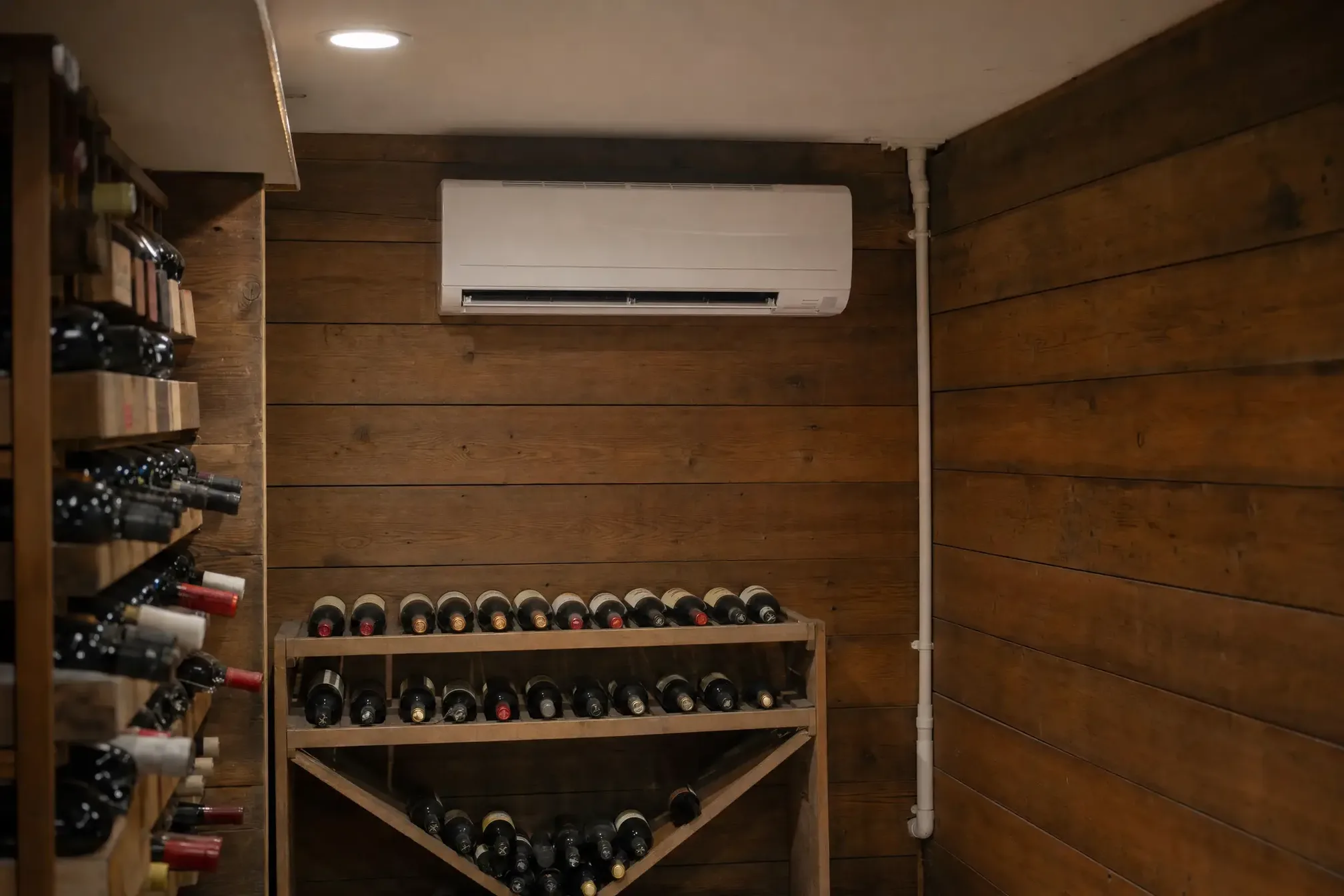
- A cooling unit that pulls moisture. Every cooling coil removes some water. A properly sized cellar unit removes little, but an oversized unit, a very cold coil, or a comfort air conditioner doing cellar duty can dry the room steadily. See our overview of wine cellar cooling units.
- A very tight envelope with no moisture source. A sealed room of foam, glass, and metal racks has nothing to give back what the coil removes.
If none of those apply, and your readings sit in the 50s or 60s most of the year, you probably don't need one. Bottles stored on their side keep the inner face of the cork wet regardless. Room humidity matters mainly for the outer end of the cork, for labels, and for long holds.
Measure first
Don't buy a humidifier on the strength of one reading. Humidity moves on a daily cycle with your home's heating and cooling.
- Use a logging digital hygrometer and record at least a full week, ideally across a cold snap if winter is your concern.
- Mount it at mid-height in the middle of the racking, where the wine is. Keep it away from the cooling unit's supply air, the door, any exterior wall, and the floor.
- Check it with a salt test. Seal the hygrometer in a bag or container with a damp paste of table salt for several hours. A saturated salt solution holds the air near 75% RH, so the gap between your reading and 75 is roughly the instrument's error.
Many consumer hygrometers are only good to within a few points of RH, so read the log as a trend. If it sits at 46 to 52% through winter, that is a very different problem from 30%.
Our guide to wine cellar humidity and mold covers diagnosis in more depth, including what to look for when readings run high.
Passive fixes before you buy anything
Most dry cellars are dry because they leak. Moisture you add to a leaky room walks straight out under the door.
Seal the envelope first. The usual suspects, in order:
- The door. Weatherstripping on all four sides and a sweep or sealed threshold. Our guide to wine cellar doors covers what to fit.
- Penetrations. Line sets, wiring, recessed lights, and outlets cut through the vapor barrier.
- Shared ductwork. A cellar fed by the house HVAC will track the house's winter humidity. Close it off.
A cellar built with the vapor barrier on the warm side, walls at R-19 or better and a ceiling at R-30, holds humidity far better than one without. Our guide to insulation and vapor barriers covers the build.
Then try a tray of water. In a small, well-sealed cellar, a wide, shallow tray can lift humidity by a few points. Surface area matters more than depth. Clean it weekly and keep it off wood racks.
In a passive cellar, consider the floor. Traditional underground cellars often have gravel or earth floors, which give up moisture slowly. Lightly dampening a gravel floor is an old and effective trick in a passive room with no cooling unit. It does not suit a finished basement cellar on a slab, where you want a sealed, dry floor. See designing a small passive cellar for when a passive room makes sense.
Types of wine cellar humidifier
| Type | How it works | Best for | Watch out for |
|---|---|---|---|
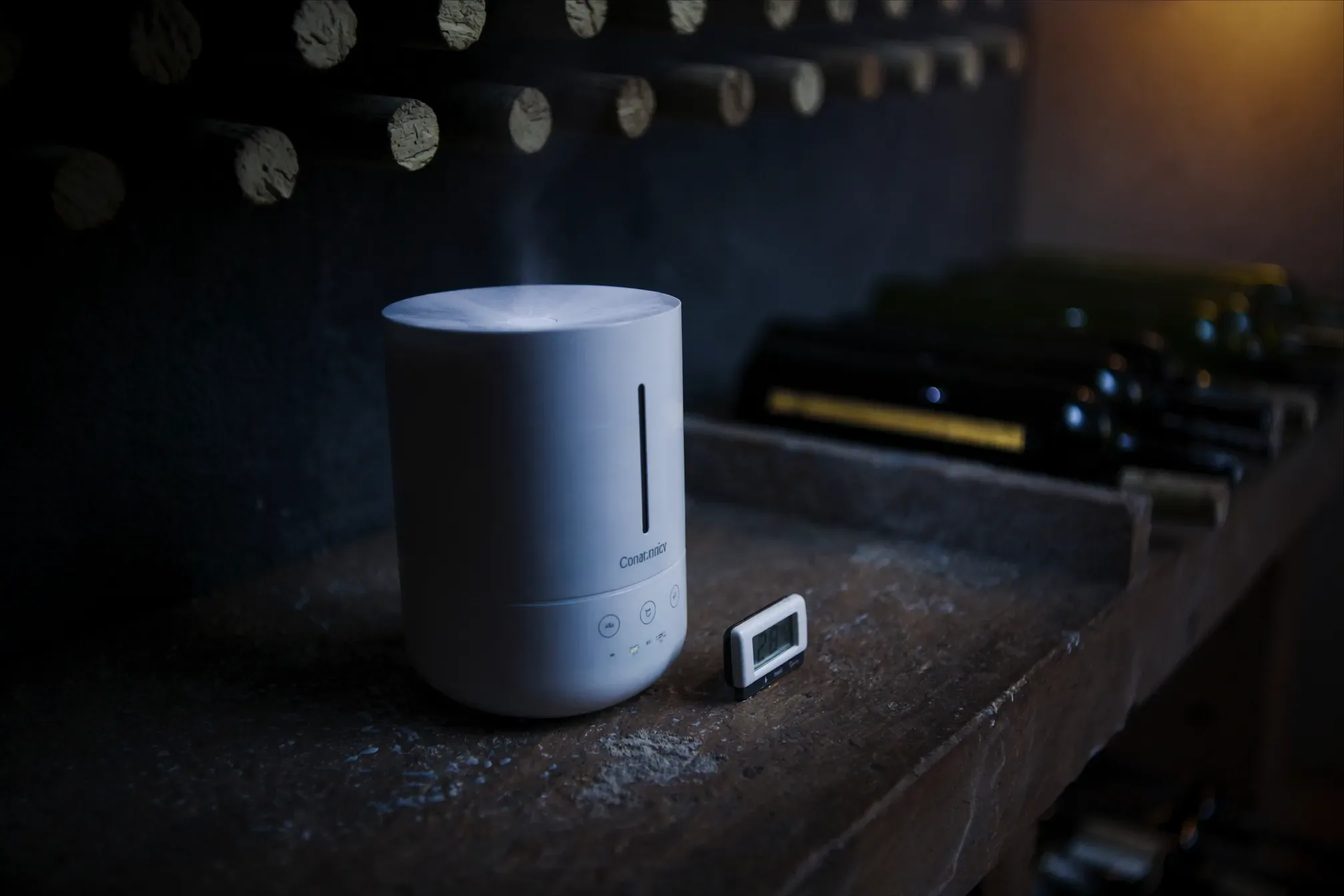
| Standalone ultrasonic | A vibrating plate turns water into a fine cool mist | Small cellars, modest winter top-ups | White mineral dust unless you use distilled water; can spread tank bacteria |
| Standalone evaporative | A fan blows air through a wet wick or filter | Small to mid-size cellars | Wicks need regular replacement and can grow mold |
| Integrated with split or ducted cooling | A matched humidifier mounts on the unit or in the supply air | Larger cellars and new builds with a ducted split | Higher cost, often needs a water line, drain and pro install |
| Warm-mist or steam (standalone) | Boils water into vapor | Rarely a good fit in a cellar | Adds heat the cooling unit must remove |
Standalone ultrasonic
Ultrasonic units are small, quiet, and inexpensive. The catch is the water. Minerals in tap water leave the tank with the mist and settle as white dust on bottles, racks, and labels. Hard water makes it worse. The EPA has also noted that ultrasonic and other cool-mist units can disperse microorganisms from a dirty tank. Use distilled water and clean the tank on a schedule.
Standalone evaporative
An evaporative unit pulls air through a wet wick. The minerals stay in the wick, so there's no white dust. They are also somewhat self-limiting: evaporation slows as the room gets more humid, which makes them harder to overshoot with. The trade-offs are a little fan noise and wicks that need replacing, because a wick that stays damp in a cool room is a good place for mold to grow.
Built into split and ducted systems
Several cellar cooling manufacturers offer a matched humidifier for their split and ducted systems. These typically mount on the evaporator or in the supply duct and are controlled from the same controller, so the system can cool and add moisture without the two fighting each other. For a large cellar, or a new build already getting a ducted split, this is usually the cleanest answer. Our comparison of self-contained and ducted-split cooling covers the cooling side.
Plumbed vs refill
A refill unit is fine for a small cellar that needs help a few months a year. If you are filling a tank every day or two, a plumbed unit on a water line removes the chore. It usually needs a drain or overflow too, plus a shutoff valve and a floor leak sensor.
How to size a wine cellar humidifier
Cellars need far less output than the square-footage ratings on room humidifiers suggest. The air in a 1,000 ft³ (28 m³) cellar at 55°F and 60% RH holds only about 7 ounces (200 g) of water. Raising it from 40% to 60% takes roughly 2 ounces (60 g).
What drives sizing is the ongoing loss: air leaking out, and moisture the cooling coil condenses and sends down the drain. A tight room with a right-sized unit loses little. A leaky room or a hard-running unit loses a lot. That's why sealing comes first.
As rough starting points, assuming a reasonably sealed room:
| Cellar volume | Typical approach |
|---|---|
| Under about 500 ft³ (14 m³) | A water tray first. If needed, the smallest standalone unit on its lowest setting |
| About 500–1,500 ft³ (14–42 m³) | A small standalone unit with a humidistat |
| About 1,500–3,000 ft³ (42–85 m³) | A larger standalone unit, or plumbed if you're refilling often |
| Over about 3,000 ft³ (85 m³) | A plumbed unit or a humidifier matched to the cooling system |
These are rough ranges, not specifications. If a unit can't hold 50% in a sealed room, look for a leak or an oversized cooling unit before you buy a bigger humidifier. Our BTU sizing guide and the BTU calculator will tell you whether the cooling unit is the culprit.
Where to put it
Placement decides whether a humidifier helps or just wets one corner.
- Keep it clear of the racks. Mist that lands on labels, wood racking, or cardboard cases before it evaporates is exactly what grows mold. Give it open space, ideally a few feet from the nearest bottles, and point the output into the room, not at a wall of wine.
- Don't feed it to the cooling unit's return. A humidifier right under the return grille sends moist air straight across the cold coil, where some of it condenses back out. Place it where the room's air circulation carries moisture through the racks first.
- Keep it away from the hygrometer. A sensor next to the humidifier reads high and shuts it off early. Use a separate hygrometer at mid-rack to judge results.
- Put it on a hard, waterproof surface, such as a stone floor, tile, or a drip tray, not on a wood shelf.
Cleaning and maintenance
A neglected humidifier in a cool, dark room grows mold and bacteria. What we recommend:
- Empty and rinse the tank rather than topping it up. Standing water is where growth starts.
- Clean it weekly during the season with the method the manufacturer specifies, typically a vinegar soak for scale and a mild disinfectant rinse, then rinse well.
- Replace wicks and filters on schedule, sooner if they smell or discolor.
- Dry it out for storage at the end of the season. Don't leave water sitting in it all summer.
If you smell mustiness in the cellar after adding a humidifier, turn it off and check the unit before anything else.
When the problem is too much humidity
In damp basements, the more common complaint is the reverse: readings above 70%, musty smells, mold on labels or racks, sweating walls.
Start with the cooling unit. A right-sized cellar unit dehumidifies as it runs, because its coil condenses water from the air on every cycle. A cellar that stays damp with the unit installed usually has one of two problems:
- The unit is oversized, so it short-cycles. It cools the air quickly, shuts off, and never runs long enough to pull moisture out. Check the sizing against the BTU calculator.
- Moisture is getting in. A missing or misplaced vapor barrier, damp foundation walls, or groundwater. No machine keeps up with a wall that is wicking water. Fix the source; see our basement wine cellar guide.
If you still need a dehumidifier, be aware that many household compressor dehumidifiers are designed for warmer rooms and lose capacity, or frost their coils, in the 50s °F. Look for a model rated for low temperatures, or a desiccant type, which copes better in cool air. Any dehumidifier also releases heat into the room, which adds to the cooling load.
Often the better fix is to dehumidify the space around the cellar rather than the cellar itself. Bringing a damp basement down to around 50% reduces how much moisture reaches the cellar envelope in the first place.
If your readings don't match any of these patterns, or you're weighing a humidifier against a cooling change, contact our experts. We'll tell you which problem you actually have before you buy anything.
FAQ
Frequently asked questions
- Do I need a humidifier for my wine cellar?
- Often not. If a logging hygrometer shows the cellar holding 50 to 70 percent relative humidity most of the year, no humidifier is needed. Consider one if readings stay below about 50 percent for weeks at a time, usually in winter in cold or dry climates, and only after sealing the door and other air leaks.
- What humidity should a wine cellar be?
- Aim for 50 to 70 percent relative humidity, with about 60 percent as a comfortable target, at a steady 55°F (13°C). Below about 40 percent for long periods, labels and the outer end of the cork can dry. Above about 75 percent, mold becomes a risk for labels, boxes, and wood racks.
- Can I use a regular room humidifier in a wine cellar?
- Yes, for a small cellar, if you control it with a humidistat, keep it away from the racks, and avoid warm-mist or steam models that add heat. Ultrasonic units should run on distilled water to avoid white mineral dust.
- Will a bowl or tray of water raise humidity in a wine cellar?
- In a small, well-sealed cellar, a wide, shallow tray can raise humidity a few points. Surface area matters more than depth. In a leaky room it makes little difference, because the moisture escapes with the air.
- Does a wine cellar cooling unit dehumidify?
- Yes. Every cooling unit removes some moisture as it cools. A right-sized cellar unit runs a warmer coil and long cycles, so it removes enough to keep a damp room in check without drying a sealed room out. An oversized unit can short-cycle and leave the room humid.
- Should I put a dehumidifier in my wine cellar?
- Fix the cause first: check the cooling unit's sizing and look for missing vapor barrier or damp walls. If you still need one, choose a model rated for low temperatures or a desiccant type, since many household dehumidifiers struggle in the 50s °F. Dehumidifying the basement around the cellar is often more effective.