guide
Can I use an air conditioner for a wine cellar? Window units, mini splits, and CoolBot
Why window ACs and comfort mini splits usually fall short in a wine cellar, how CoolBot-style controllers work around it, when a workaround is reasonable, and what purpose-built cellar units do differently.
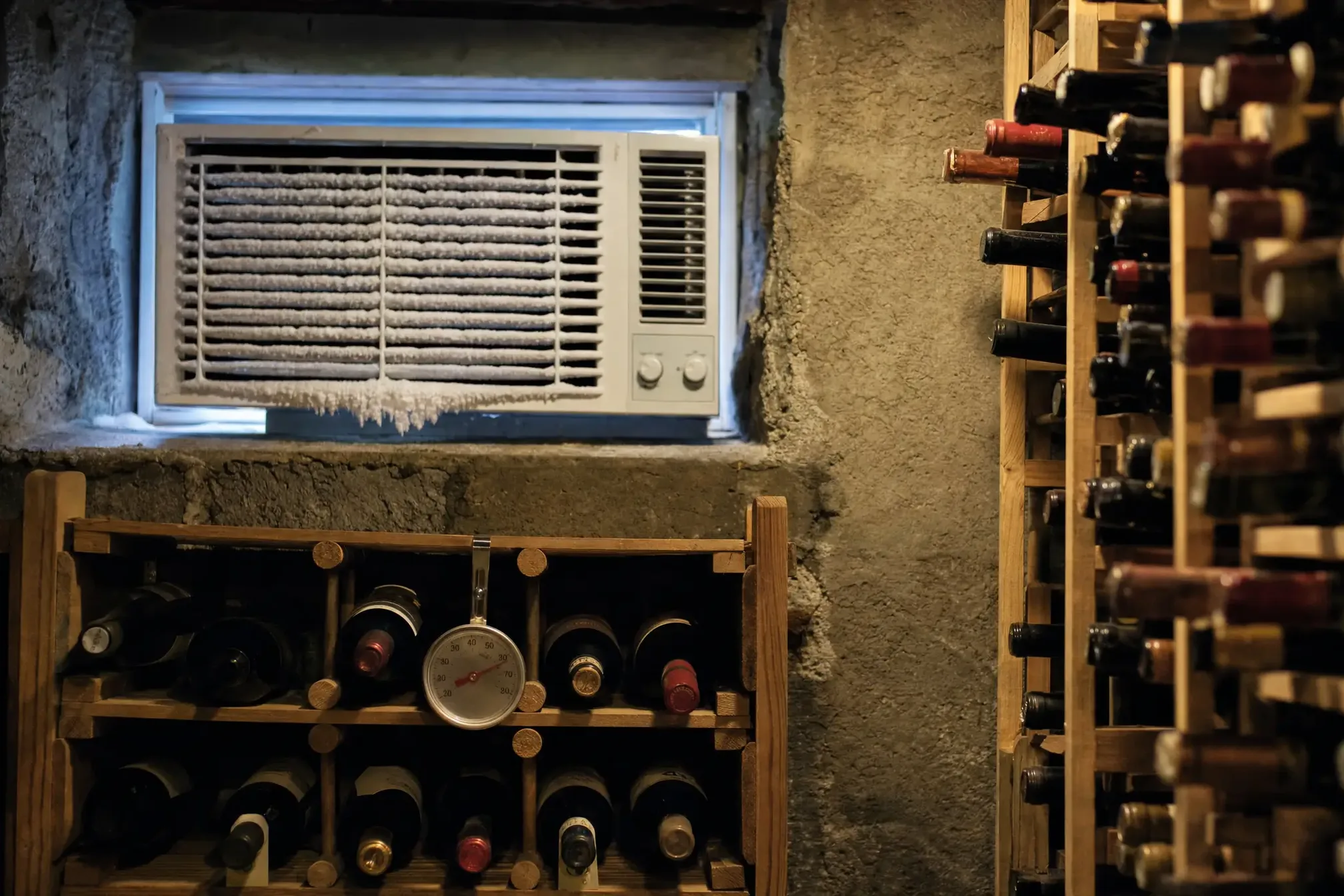
A window air conditioner costs a few hundred dollars and a cellar cooling unit costs a few thousand, so why not use the air conditioner? It's a fair question. Both use the same refrigeration cycle, but they are tuned for very different rooms, and the differences land exactly where a cellar cares.
Here is why a window or through-the-wall air conditioner or a comfort mini split usually falls short, how people work around it, when that's a reasonable call, and what equipment built for the job does differently. For the full overview of cellar systems, start with our guide to wine cellar cooling units.
Can I use an air conditioner for a wine cellar?
Usually not as it comes out of the box, and only with trade-offs if you modify it. The target we use across this site is a steady 55°F (13°C) at 50–70% relative humidity, with about 60% as the middle. Our guide to ideal cellar temperature and humidity explains why.
A comfort air conditioner runs into four problems in that room:
- Its thermostat stops too high. Most comfort units won't accept a setpoint below about 60–64°F (16–18°C).
- Its coil ices up when it runs for long periods on cool return air.
- It dries the room, because removing moisture is part of what it was designed to do for people.
- It may not run when it's cold outside, and a cellar inside a heated house can need cooling in January.
None of these is a defect. They're what you want in a living room.
Why does a regular air conditioner struggle in a cellar?
The setpoint floor
Comfort controls bottom out where comfort ends. A few examples from manufacturers' own manuals:
- The GE room air conditioner manual for its AHH24 and AHL24 models sets temperature "between 64°F and 86°F."
- The MRCOOL mini split remote manual lists a minimum setting of 60°F (16°C) on one remote and 62°F (17°C) on another.
- Mitsubishi Electric's MSZ-GS user manual (the Australian edition) gives a guaranteed cooling range with an indoor lower limit of 21°C (70°F) dry bulb. A 55°F cellar sits well below it.
Ranges vary by model, so check the manual for your exact unit. The pattern holds: comfort equipment is built for rooms in the 60s and 70s °F.
Coil icing
An air conditioner's evaporator coil runs colder than the room. In a living room at 75°F that's fine. In a cellar at 55°F, the coil runs colder still, and once its surface drops below freezing, condensed water turns to frost. Frost blocks airflow, which makes the coil colder, which makes more frost. GE's troubleshooting advice for a freezing room air conditioner is to run high fan and "set the thermostat to a higher temperature," which is the opposite of what a cellar needs.
Cellar units expect this. A room in the 50s °F all day is their design condition, and many run defrost logic as part of normal operation.
Drying the room
Dehumidifying is part of a comfort air conditioner's job, and it does it by running a coil below the dew point of the room's air. At 55°F and 60% RH, the dew point is about 41°F (5°C). A coil running near or below that condenses water out of the cellar on every cycle and sends it down the drain.
In a house, people, cooking, and outdoor air replace that moisture. In a sealed cellar, almost nothing does, so humidity drifts down. Our guide to wine cellar humidifiers covers what to do when a room runs dry, and wine cellar humidity and mold covers the opposite problem.
Outdoor temperature limits
A window unit or a mini split rejects its heat outdoors, and both have a lower outdoor limit for cooling. The same Mitsubishi manual lists an outdoor cooling lower limit of -10°C (14°F). Store It Cold, which makes the CoolBot, notes on its compatibility page that mini splits generally run in cool mode only above about 15°F outdoors.
A basement cellar may need little cooling in winter. A cellar in the middle of a heated house can need it on the coldest night of the year, which is exactly when a comfort unit is outside its rated range.
Size and the hole in the wall
Window units push their heat out the back, which in a cellar means an opening to the outdoors through an insulated, vapor-barriered wall. Comfort units are also sized for bedrooms, which can be more capacity than a small, well-insulated cellar needs, and an oversized unit short-cycles (our BTU sizing guide explains why). Run the BTU calculator before you buy anything.
Can a mini split cool a wine cellar?
A comfort mini split (the ductless wall units sold for bedrooms and additions) has the same setpoint floor, drying tendency, and icing risk as any other comfort system. Its inverter compressor ramps down smoothly, which helps steadiness, but the controls still stop at comfort temperatures, and the Mitsubishi manual above puts its rated indoor range well above a cellar.
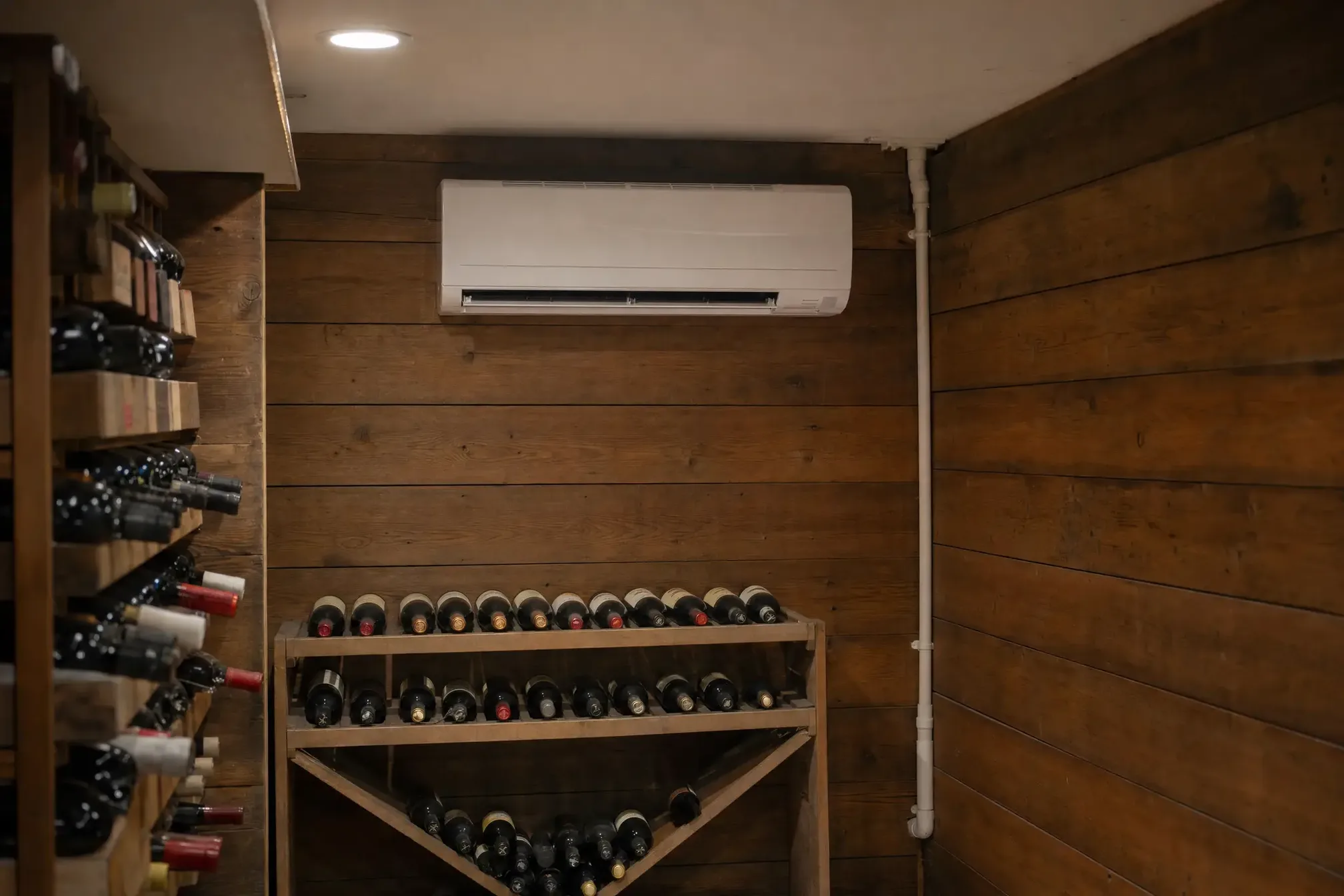
A cellar-rated ductless split looks similar: a wall or ceiling evaporator inside the room and a condenser outside, joined by a refrigerant line set. The difference is in the tuning. For example, CellarPro's 3000S split lists a setpoint range of 47–62°F and a condensing unit rated down to -20°F (with options), and must be charged on site by an HVAC professional. WhisperKOOL and Wine Guardian also sell ductless splits made for cellars. Our comparison of split wine cellar cooling systems goes into the options.
So yes, a split is a good architecture for a cellar. It just needs to be one built for cellar conditions.
What is a CoolBot, and does it work in a wine cellar?
The CoolBot is a controller from Store It Cold that lets a standard window or wall-mounted mini split air conditioner cool a room below its normal thermostat limit. Store It Cold says it uses "sensors, a heating element, and a micro-controller" to let the air conditioner cool rooms to 36°F "without freezing up." In practice, it warms the air conditioner's own temperature sensor so the unit keeps cooling, and watches the coil so it can back off before ice builds.
It was built for small walk-in coolers. Store It Cold lists a range of 34–65°F (1–18°C), and its FAQ says "50°F – 60°F (10°-15.6°C) is no problem," so 55°F is within reach. Three points from Store It Cold's own pages are worth reading first:
- Compatibility is specific. The air conditioner must have a digital display and automatic restart. Portable units, central systems, PTACs, and cassette-type mini splits are listed as not compatible.
- Humidity. The FAQ says humidity in a CoolBot room "usually ends up in the 70% – 90% range," and the wine cellar page claims 50–80%. Most CoolBot rooms hold produce or flowers, which give off moisture. A sealed cellar of glass bottles doesn't, so log it rather than assume.
- Warranty. The FAQ states that "the use of an air conditioner outside the manufacturer's guidelines may void the warranty." That's the air conditioner's warranty, not the CoolBot's.
The CoolBot was listed at $349 (marked down from $399) on storeitcold.com in November 2026, plus the air conditioner and installation.
When is a workaround reasonable?
We don't specify air conditioner workarounds in finished cellars. That doesn't make them wrong for everyone. A controller with a window unit or a comfort mini split can be a sensible choice when:
- The room is a garage, utility room, or outbuilding, where noise, looks, and a hole in the wall matter less.
- The wine is for drinking over the next few years, not long holds.
- Budget is the constraint, and the alternative is no cooling at all.
- You'll monitor it with a logging thermometer and hygrometer, and add a humidifier if readings run low.
- The outdoor side stays inside the air conditioner's limits, or you accept some drift on very cold nights.
Pros
- Far lower equipment cost than a cellar unit
- Replacement air conditioners are easy to find
- Reaches cellar temperatures in a well-insulated room
Cons
- Cold coil can pull humidity down in a sealed room
- May void the air conditioner's warranty
- Outdoor cooling limits can leave a gap in cold weather
When isn't it?
A workaround is the wrong call when:
- The cellar is part of the living space, where a window unit is loud, visible, and needs an exterior opening.
- The collection is valuable or meant to age for a decade or more. Steady conditions are the point of a cellar.
- The room is small and tight. That's where a cold coil dries things out fastest.
- You need cooling in deep winter inside a heated house in a cold climate.
- The build is new. With the walls open, the cost gap is a small share of the project, and getting the insulation and vapor barrier right matters more than either choice.
What do purpose-built cellar units do differently?
Cellar units are designed around the room's conditions, not a person's. Three differences matter most:
- Setpoints in the 50s °F. The CellarPro 1800XT-HE lists a setpoint range of 47–62°F. Breezaire's WKL installation instructions give 48–63°F. Wine Guardian says its units are designed for 55–58°F at 50–70% RH.
- Less moisture removal. CellarPro states a sensible heat ratio above 90% for its units, meaning more than 90% of the cooling goes to temperature rather than pulling water out. Breezaire says its units lower the temperature "while removing only excessive moisture."
- Defrost and controls built in. Low-temperature operation is the normal case, so the controller, defrost logic, and sensor placement are designed for it.
None of this makes a cellar unit a humidifier. Breezaire says "the unit does not add moisture," and CellarPro says its units "don't create humidity." They just avoid taking out more than the room can spare.
Comfort AC vs mini split vs controller workaround vs cellar unit
| Comfort window or wall AC | Comfort mini split | AC plus CoolBot-style controller | Purpose-built cellar unit | |
|---|---|---|---|---|
| Reaches 55°F (13°C)? | No, setpoints usually stop around 60–64°F | No, setpoints usually stop around 60–64°F | Yes, in a well-insulated room | Yes, setpoints in the 40s to low 60s °F |
| Humidity in a sealed cellar | Tends to dry the room | Tends to dry the room | Depends on the room; log it | Designed to remove less moisture |
| Coil icing at cellar temperatures | Likely on long runs | Likely on long runs | Controller backs off to prevent it | Handled by design and defrost |
| Cold-weather operation | Limited by outdoor range | Limited by outdoor range | Limited by the AC's outdoor range | Varies; some split condensers rated well below freezing |
| Warranty position | Used outside intended conditions | Used outside intended conditions | AC warranty may be void | Cellar use is the intended use |
| Install | Window or wall sleeve to outdoors | Line set, HVAC technician | Same as the AC, plus controller wiring | Through-the-wall, ducted, or split |
| Where it fits | Not a cellar solution | Not a cellar solution | Garage or utility storage on a budget | Finished cellars and long-term storage |
Capacity ratings aren't comparable across these columns. Comfort units, cellar units, and different cellar makers rate BTU/h at different room and ambient temperatures (CellarPro, for example, rates at a 55°F cellar and 60% RH), so size from your room's load, not the number on the box.
Which cellar system type fits which room?
The system type follows from where the heat can go and how much noise you can accept. Our four system types guide covers this in full. In short:
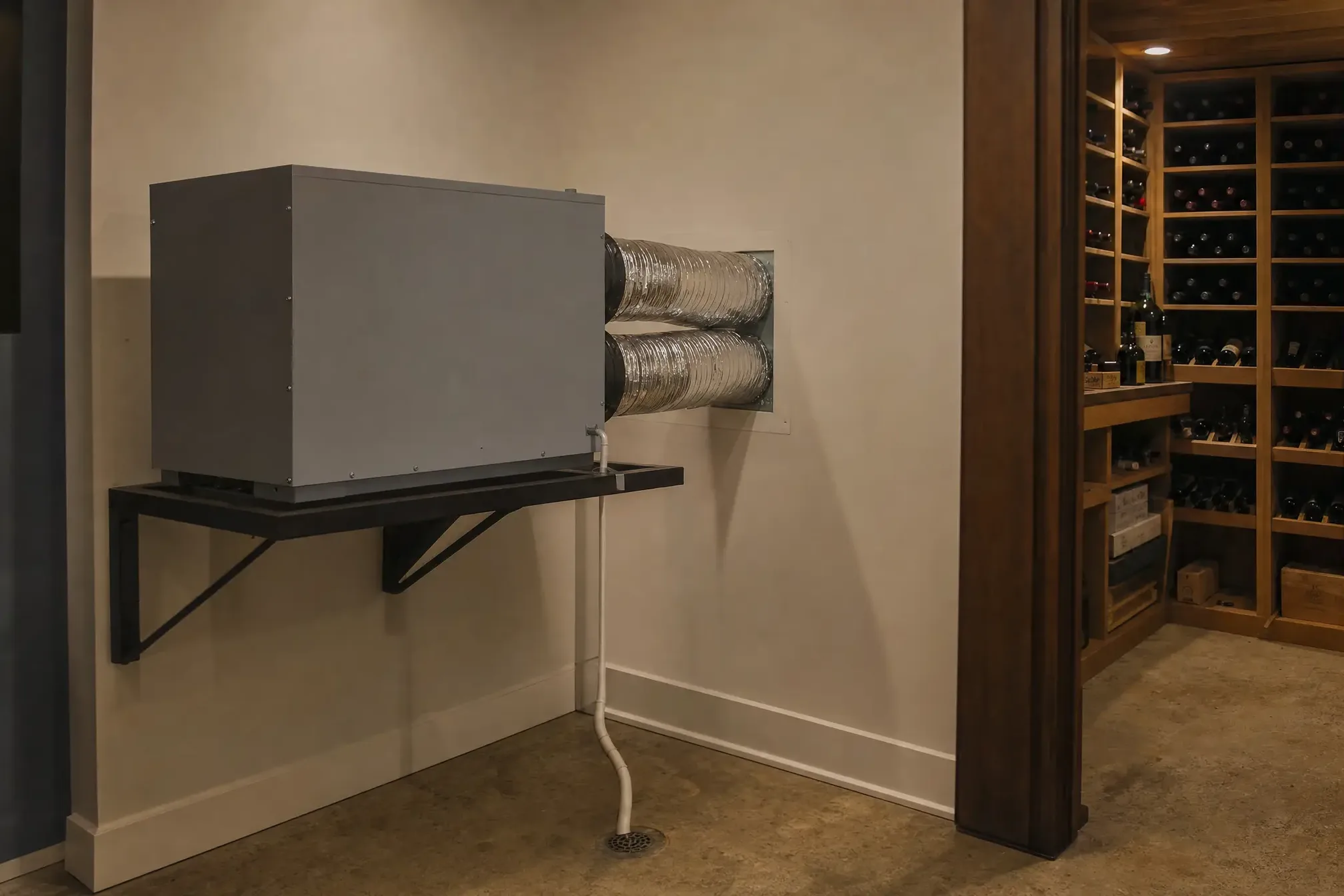
- If an adjacent room can take the heat year-round, look at self-contained through-the-wall units such as the WhisperKOOL SC PRO series, the CellarPro 1800XT-HE, the Breezaire WKL series, the Wine Guardian through-the-wall range, or the Wine-R WR2500. Check each one's limit for the exhaust side: WhisperKOOL, for example, rates the SC PRO at an 85°F condenser intake. See choosing a through-the-wall unit.
- If you want the equipment out of sight but don't want a refrigerant line set, look at self-contained ducted units such as Panthaire's APEX line or Wine Guardian's ducted units.
- If the heat needs to go outdoors, or the cellar sits inside living space, look at ductless or ducted splits from makers such as WhisperKOOL, CellarPro, and Wine Guardian. Our self-contained vs ducted split comparison walks through the trade-offs.
What does each route cost?
Rough equipment figures, from list prices seen on makers' sites in November 2026. Installed cost varies with the room, the trade, and the region.
- Controller workaround: the CoolBot at $349–$399 on storeitcold.com, plus a compatible air conditioner and its installation.
- Self-contained cellar unit: the CellarPro 1800XT-HE was listed at $2,095 on cellarprocoolingsystems.com; Panthaire's APEX 3500 ducted unit at $5,599.95 on panthaire.com.
- Split cellar system: the CellarPro 3000S was listed at $4,695, and Wine Guardian's SS018 ductless split at $7,266 on wineguardian.com, before the line set and the HVAC technician.
Our wine cellar cooling unit cost guide breaks down installation. If you're weighing a workaround against a proper unit for a specific room, our experts can look at the room with you and tell you which trade-offs you'd actually be making.
FAQ
Frequently asked questions
- Can I use a window air conditioner to cool a wine cellar?
- Not on its own. Most window units won't accept a setpoint below about 60 to 64°F, their coils can ice up on long runs in a cool room, and they tend to dry a sealed cellar. With a CoolBot-style controller a window unit can reach 55°F, which can be reasonable for a garage or utility room on a budget, but expect to monitor humidity and accept that the air conditioner's warranty may not cover that use.
- Can a mini split be used for a wine cellar?
- A comfort mini split usually can't, because its controls stop at comfort temperatures and its rated indoor range is above cellar conditions. A ductless split built for cellars, with an evaporator in the room and a condenser outside, is a common and effective way to cool a cellar. It needs a licensed HVAC technician to run and charge the line set.
- Does a CoolBot work for a wine cellar?
- It can hold cellar temperatures. Store It Cold says 50 to 60°F is no problem for the CoolBot. The questions are humidity, warranty, and cold-weather operation. Log humidity for a few weeks, plan for a humidifier if it runs low, and note that Store It Cold says using an air conditioner outside its manufacturer's guidelines may void its warranty.
- Will an air conditioner dry out my wine cellar?
- It can. A comfort coil runs below the dew point of cellar air, so it condenses water on every cycle, and a sealed cellar has little to replace it. Cellar units are tuned to remove less moisture. Either way, measure with a logging hygrometer for a week or more before adding a humidifier.
- Can I use a portable air conditioner in a wine cellar?
- It's a poor fit. A portable unit has to vent heat through a hose, which means an opening in the cellar envelope, and most share the same setpoint limits as other comfort units. Store It Cold lists portable units as generally not compatible with the CoolBot, with one dual-hose exception it says only works from 53 to 60°F.
New guides from people who build cellars, sent to your inbox.
Planning a cellar? Ask the people who build them.
Contact our expertsKeep reading
Related