guide
Wine cellar cooling unit not cooling? How to decide between repair and replacement
Signs a cellar cooling unit is failing, what to check before you call anyone, what a refrigeration tech looks at, and how age, warranty, refrigerant and the wall opening decide repair or replace.
A wine cellar cooling unit rarely dies overnight. It drifts: it runs a little longer each week, the room creeps up a degree, a puddle shows up under the grille. By the time the cellar reads 62°F (17°C), most owners are already shopping for a new unit.
Sometimes that's right. Often the fault is in the room, the exhaust space or the drain, and the unit is fine. Here is how to tell the difference, what a technician checks, and how we weigh repair against replacement. For how the system types work, start with our overview of wine cellar cooling units.
What are the signs a cellar cooling unit is failing?
The target doesn't change: a steady 55°F (13°C) at 50–70% relative humidity, with about 60% as the comfortable middle (see ideal cellar temperature and humidity). The symptoms we hear about most:
- It runs constantly and never reaches setpoint.
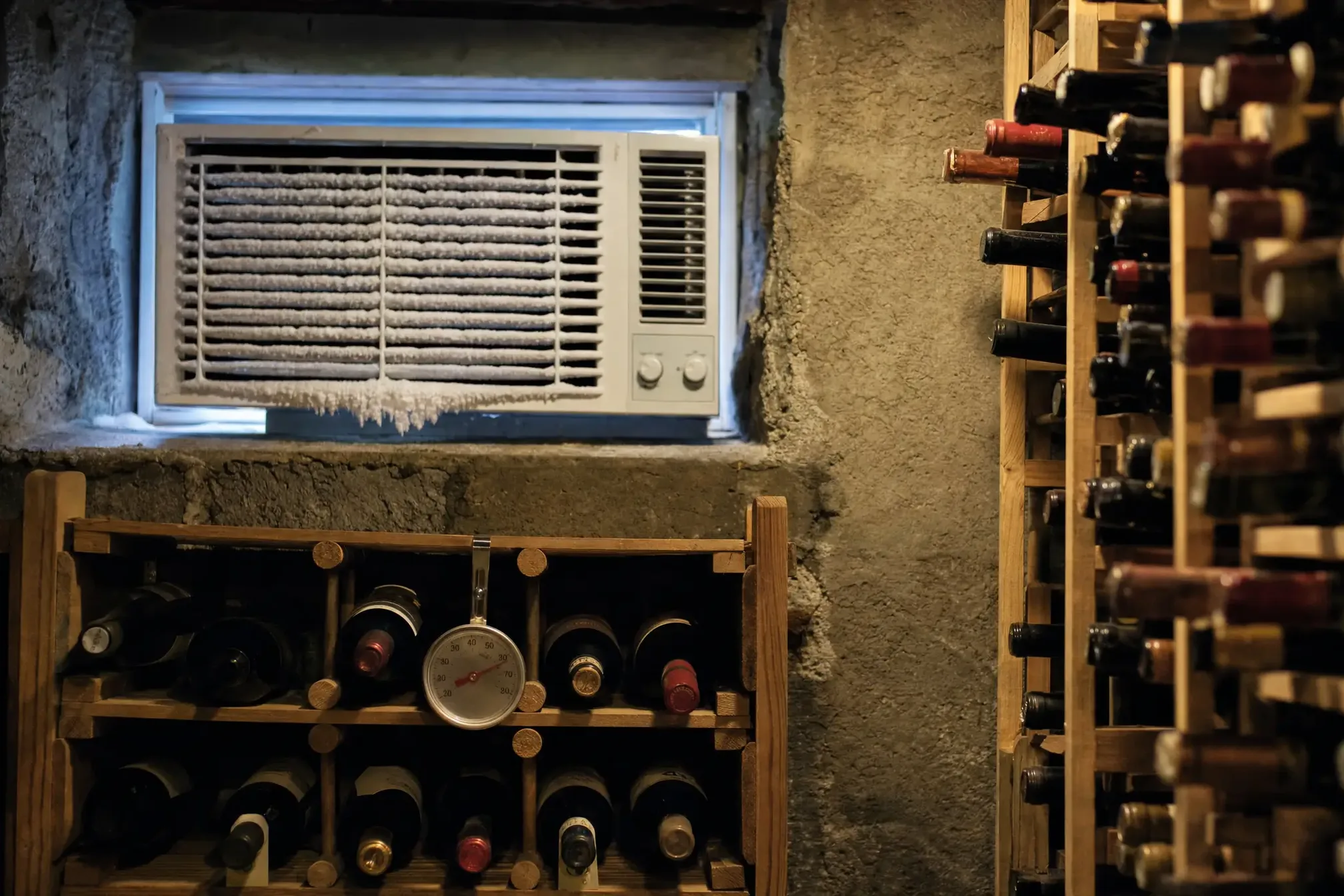
- The coil ices up, and airflow drops.
- It short-cycles, switching on and off every few minutes. Wine Guardian's maintenance guide treats more than eight starts per hour as a sign a system needs service.
- Water on the floor below the unit.
- A new compressor noise: rattling, a loud hum, clicking without starting.
- The room drifts warm over weeks, especially in summer.
- Humidity moves in a way it didn't before.
None of these, on its own, means the compressor is finished. Most have a cheaper cause you can check in an afternoon.
What should you check before calling a technician?
These cost nothing but time, and a technician will ask about each one.
1. Power, setpoint and sensor. Confirm the unit has power, the setpoint is where you think it is, and the temperature probe reads the room. A probe in the cold supply airstream causes short cycles and a warm cellar.
2. Filters and coils. A dirty condenser coil (the hot side) is one of the most common causes of lost capacity, and a blocked filter or evaporator coil (the cold side) starves airflow and can cause icing. Wine Guardian's guide calls for cleaning both coils once a year. Unplug the unit and follow your maker's manual.
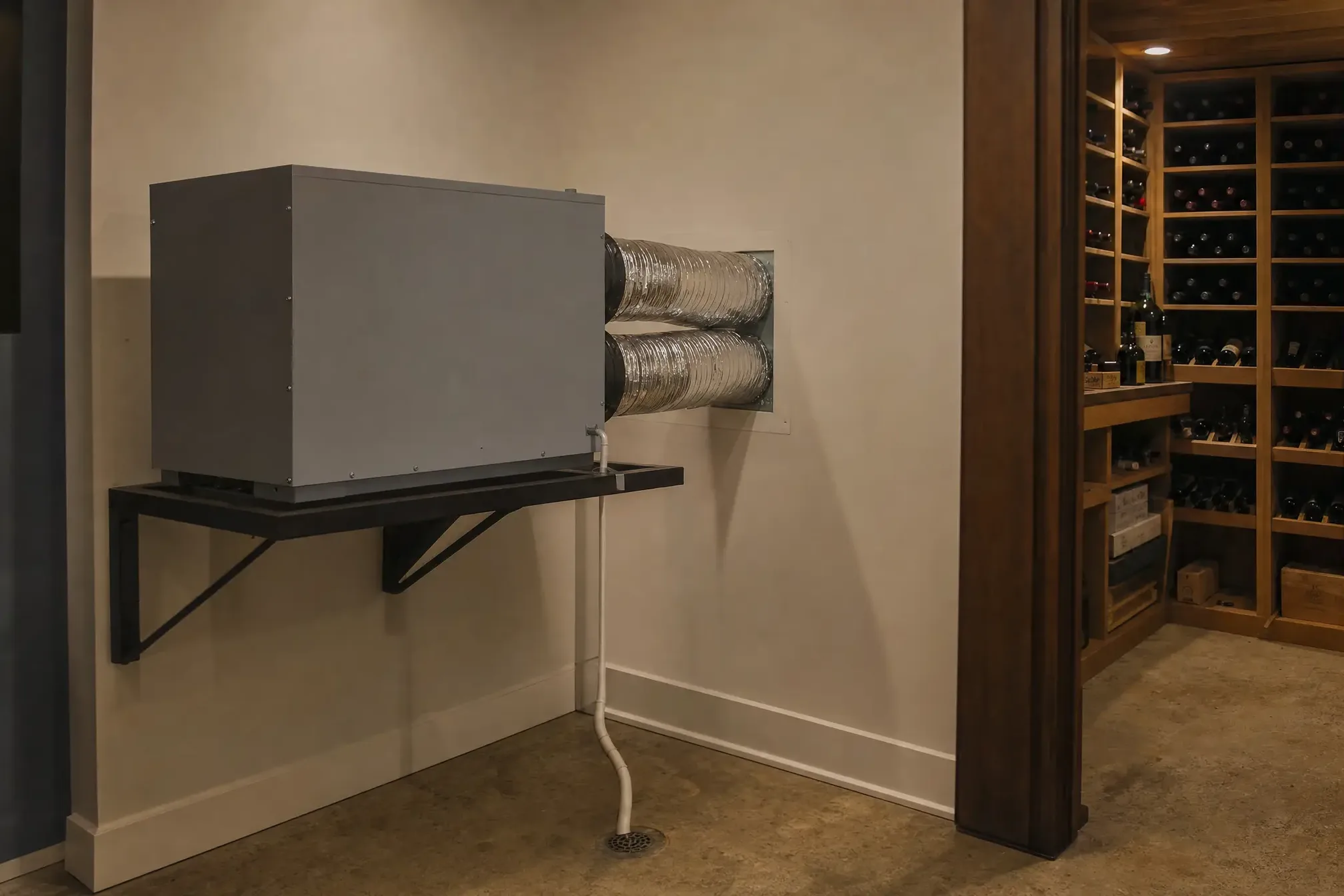
3. The exhaust space. A through-the-wall unit dumps its heat into the room behind it, and that room has to stay inside the unit's rated range in every season. WhisperKOOL, for example, says its SC PRO holds 55°F when condenser intake air does not exceed 85°F (29°C); other makers publish other limits. Put a thermometer in the exhaust room on a hot afternoon, and check nothing has been stacked in front of the grille. If the room is over the limit, the unit isn't failing. It's being asked to do something it wasn't built for.
4. The door seal. Close the door on a strip of paper at several points. If it slides out easily, the seal leaks and the unit is cooling the house. Our guide to wine cellar doors covers what a proper seal looks like.
5. The drain. Confirm condensate reaches the end of the line. A clogged or kinked line, a failed condensate pump or a unit that has shifted out of level will all put water on the floor.
6. What changed in the room. New lighting, a glass door, a freezer moved into the exhaust space. If the load has changed, re-run the BTU calculator before you blame the unit.
| Symptom | Likely causes | What to do |
|---|---|---|
| Runs constantly, never reaches setpoint | Dirty condenser coil; exhaust room too hot; leaking door seal; load has grown; undersized unit; low refrigerant | Clean coils, measure the exhaust room in hot weather, test the door seal, re-run the load calculation. If all pass, call a technician |
| Ice on the coil or cold-side grille | Blocked filter or grille; setpoint below the unit's rated range; failed evaporator fan; low refrigerant | Switch off and let it thaw fully, clear the airflow, check the setpoint. Ice that returns needs a technician |
| Short-cycling | Probe in the cold supply air; oversized unit; failing control or relay | Move the probe to read the room and check sizing. If it continues, call a technician |
| Water on the floor | Clogged or kinked drain; failed condensate pump; unit out of level; ice melting off the coil | Flush the drain, check the pump, re-level the unit, look for icing |
| Noisy compressor | Loose panel or mount; failing fan motor; failing compressor or start components | Check for loose fasteners and fan noise. Compressor noise needs a technician |
| Room drifts warm over weeks | Summer heat in the exhaust room; dirty coils; slow refrigerant leak; envelope gap | Log temperatures on both sides of the wall, clean coils, then call a technician if the trend continues |
| Humidity swings | Oversized unit short-cycling; leaky door; failing humidifier where fitted | Check sizing and seals before adding equipment |
For humidity problems, our guide to wine cellar humidity and mold goes deeper.
What does a refrigeration technician check?
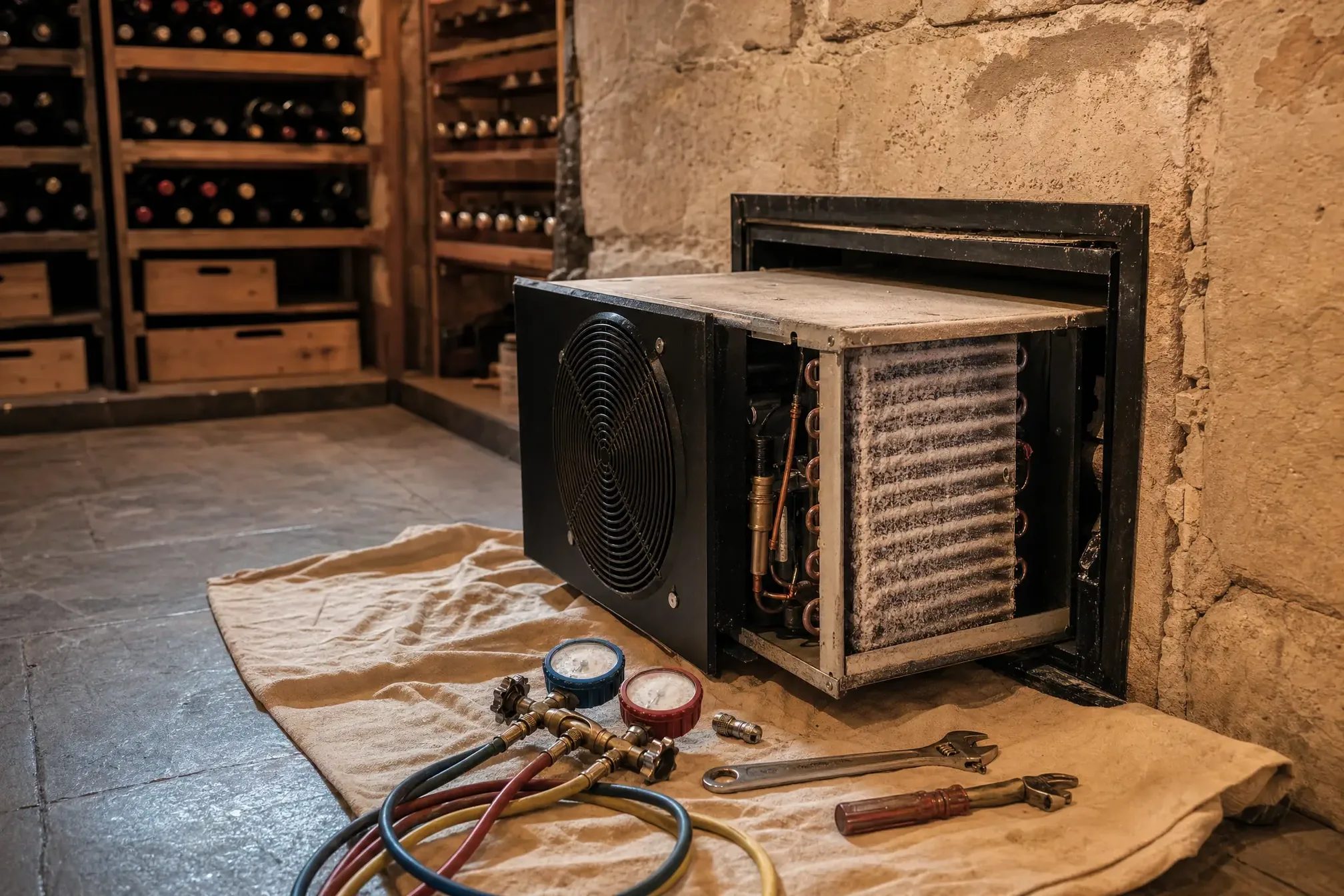
If the owner checks pass and the unit still can't hold temperature, the problem is likely inside the box. A technician will usually:
- Measure temperatures across the cold side. Wine Guardian's guide puts the normal air temperature difference for its systems at 12 to 15 degrees: a smaller gap can point to low refrigerant, a larger one to poor airflow or a dirty filter.
- Check the fans and motors, since a dead fan mimics a refrigerant problem.
- Test the compressor's electrical parts: capacitor, relay, overload, current draw.
- Check the control board and sensors against a reference thermometer.
- Look for a refrigerant leak. Many self-contained units ship sealed and factory-charged. Fixing a leak then means opening the circuit, repairing, evacuating and recharging it, the most expensive repair short of a compressor.
Refrigerant work isn't a homeowner job. The EPA requires technicians who service or repair equipment that could release refrigerant to be certified under Section 608. Not every HVAC technician works on small self-contained units, so ask before booking whether they service your type and brand.
Should you check the warranty before anyone opens the unit?
Yes. Cellar unit warranties are specific, and a well-meant repair can void one.
- Who may repair it. Breezaire's limited warranty covers parts for five years and factory labor for one year, with repairs at its factory, and says repair by anyone other than Breezaire voids it. WhisperKOOL's warranty page says warranty repairs are done at its Stockton, California facility or with its prior permission.
- What, and for how long. CellarPro's limited warranty covers all parts and labor for five years on its 1800 QTL, QT, XT and XTS 110V models, with shorter full coverage on others. WhisperKOOL lists a 2-year product warranty plus a 5-year compressor warranty on self-contained units. Panthaire lists a 2-year parts and labor warranty on its APEX units, and excludes repairs by unapproved technicians and units that weren't maintained.
- Registration. Wine-R says its warranty must be registered within 30 days of purchase to activate. WhisperKOOL says its split-system warranty isn't activated until a Product Warranty Checklist has been submitted and approved.
- Installation conditions. Most warranties exclude damage from poor ventilation or an install that ignores the instructions. Breezaire lists inadequate ventilation and units covered by storage shelves.
When a new unit goes in, register it that day and keep the receipt, serial number and a note of each coil cleaning.
Repair or replace: how do age and cost compare?
No published lifespan holds across brands. As a broad range, self-contained units commonly last around 5 to 10 years and split systems often longer. Right sizing, a cool exhaust side and regular coil cleaning push a unit toward the long end; a through-the-wall unit fighting a hot exhaust room lands at the short end.
A common appliance rule of thumb, the 50% rule, says not to spend more than half the cost of a replacement on a repair. For cellar units we adjust it:
- Compare installed costs. A replacement that reuses the opening, outlet and drain costs little more than the unit. One that needs a new opening, circuit or line set costs far more.
- Weigh the age. A fan, relay or control board on a three-year-old unit is usually worth fixing. A refrigerant leak or compressor on a unit near the end of its expected life usually isn't.
- Weigh parts and service. If parts are hard to source, a repair can stall for weeks while the wine sits warm.
- Ask whether the unit was ever right for the room. If it always ran hard, repairing it puts the same unit back into the same conditions.
For scale, small through-the-wall units we checked list from about $2,100 to $4,100 on their makers' sites in November 2026: the CellarPro 1800XT-HE at $2,095, the Wine-R WR2500 at $2,450 and the Wine Guardian TTW02B at $4,069. They differ in size and features, and installed cost varies by site; our guide to wine cellar cooling unit cost goes further. Set a written repair quote that names the failed part against an installed replacement quote.
Does the refrigerant in an older unit matter?
It matters for who can work on it, not whether you may keep it.
Many older cellar units use R-134a, and newer ones are moving to refrigerants with a lower global warming potential (GWP). Among the makers we checked:
- CellarPro says its 1800XT-HE uses R-290.
- Panthaire says on its refrigeration page that APEX units made before June 2025 use R-134a and units from July 2025 use R-290.
- Wine Guardian says its through-the-wall units use R-513A, which it describes as non-flammable with a low GWP.
- Wine-R, WhisperKOOL and Breezaire don't publish the refrigerant on the product pages we checked. The nameplate will tell you. We found no cellar maker listing R-1234yf.
EPA's SNAP listing puts R-134a at a GWP of 1,430, R-513A at 630 and R-290 (propane) at 3. R-134a and R-513A are in ASHRAE safety class A1 (non-flammable); R-290 is A3 (flammable), so a technician servicing an R-290 unit needs tools and procedures rated for flammable refrigerants. Confirm that before booking.
An R-134a unit can keep running and be repaired. EPA's Technology Transitions fact sheet says the rule doesn't restrict the continued use of existing systems, that they may be serviced throughout their useful life, and that repair components may still be made and sold. The issue is cost over time: an expensive sealed-system repair on an aging unit tips us toward replacement.
Can a new unit go in the same wall opening?
For a through-the-wall unit, this often decides the replacement cost. A unit that fits the existing opening, outlet and drain is a swap. One that doesn't means cutting, reframing and refinishing both sides of the wall.
Measure before you shop: the rough opening at the framing (not the trim), the wall thickness, where the outlet and drain sit, and the exhaust room's temperature on a hot day.
Several makers advertise replacements for older openings. WhisperKOOL says the SC PRO is a direct replacement for its legacy XLT units, fitting similar wall openings. Wine Guardian says its TTW units are designed to fit legacy and competitor wall sleeves. CellarPro says the 1800XT-HE directly replaces its 1800XT-ECX and is sized to replace comparable units such as the Breezaire 2200. Breezaire publishes each WKL model's dimensions. Check every claim against your own measurements.
A fitting opening tells you the unit can be mounted, not that it can carry your load. Check capacity with the BTU calculator, and remember each maker rates BTU/h at its own cellar and exhaust temperatures, so ratings across makers aren't directly comparable. Our guide to choosing a through-the-wall unit covers the rest.
The KoolR Magnum case
The KoolR Magnum is a small through-the-wall unit found in many residential cellars, and owners replacing one face a supply question. As of November 21, 2026, koolr.com shows only a "Store unavailable" page, and we found no public statement from KoolR about its US business. One Canadian retailer, Rosehill Wine Cellars, lists the KoolR Plus (Magnum) as a special-order item, marked sold out.
Wine-R markets its WR2500 as a Magnum replacement. On its KoolR Magnum replacement page, Wine-R says it cannot speak to KoolR's business status, that there is limited US availability for replacement units, and that the WR2500 is compatible with the standard KoolR Magnum wall opening in standard installations. It lists:
| As published by Wine-R | KoolR Magnum | Wine-R WR2500 |
|---|---|---|
| Wall cutout (W x H) | 15 3/4 x 9 3/4 in (400 x 248 mm) | 15 5/8 x 9 1/4 in (397 x 235 mm) |
| Wall thickness | Up to 7 in (178 mm) | 5.5 to 14 in (140 to 355 mm) |
| Rated cellar size | Per KoolR documentation | Up to 900 ft³ (25.5 m³) fully enclosed, 700 ft³ (19.8 m³) with glass walls, R-20 insulation minimum |
| Electrical | Not listed | Dedicated 115V / 60Hz / 15A circuit |
| Exhaust room | Not listed | Ventilated interior space, 50 to 90°F (10 to 32°C) |
Two cautions. Published Magnum cutouts differ: Rosehill lists 15 5/8 x 9 3/8 in (397 x 238 mm) and a maximum wall of 6 1/2 in (165 mm), so measure your own opening. And Wine-R itself says fit depends on site factors, such as a wall thinner than 5.5 in or an opening modified over the years, and that capacity is checked separately. Wine-R lists the WR2500 at $2,450, requires a condensate drain line, and says it is not assumed to fit a KoolR Nuvo or other KoolR model until the opening is measured.
If your Magnum sat in a hot exhaust room and struggled every summer, a same-opening swap brings that problem along. Which leads to the last question.
When is replacement the time to change system type?
A failed unit is the cheapest moment to fix a design problem, because you're paying for equipment and labor anyway. Consider a different system if:
- The exhaust room is the real problem. If the room behind the wall runs hot or is too small, a ducted self-contained unit, such as Panthaire's APEX series, WhisperKOOL's fully ducted units or Wine Guardian's ducted units, can sit in a cooler space and duct air to the cellar. A split puts the heat outdoors.
- Noise was always a complaint. Next to a dining room or theater, moving the compressor out of the cellar wall solves what a new through-the-wall unit can't.
- The room has changed. A new glass wall or a bigger collection may need different capacity. See glass wine cellars.
Our comparison of self-contained and ducted-split cooling covers the trade-offs, and the BTU sizing guide explains how to size the replacement so it doesn't short-cycle. If you'd like a builder to look at the room before you choose, talk to our experts.
FAQ
Repair or replace: common questions
- Why is my wine cellar cooling unit running but not cooling?
- Start with the room and the hot side: a dirty condenser coil, an exhaust room hotter than the unit's rated limit, a blocked grille, a leaking door seal, or a temperature probe in the cold supply air. If those check out, the unit may have a fan, control or refrigerant fault that needs a technician.
- Is it worth repairing a wine cellar cooling unit?
- Often, for a young unit with a fan, relay, sensor or control fault. A refrigerant leak or compressor on a unit near the end of its expected life is harder to justify. Compare a written repair quote with an installed replacement quote, and check the warranty before anyone opens the unit.
- How long should a wine cellar cooling unit last?
- There is no single published figure. Self-contained units commonly last around 5 to 10 years and split systems often longer. Right sizing, a cool exhaust side and yearly coil cleaning push a unit toward the long end.
- Can I still get an R-134a cellar unit repaired?
- Yes. EPA's Technology Transitions rule does not restrict the continued use of existing systems, which may be serviced and repaired throughout their useful life. Refrigerant work must be done by a technician certified under EPA Section 608.
- Will a new unit fit my old wall opening?
- Only if its published cutout and wall-thickness range match your measured opening. Some makers advertise replacements for older openings, such as WhisperKOOL for its legacy XLT units and Wine-R for the standard KoolR Magnum opening. Check capacity separately with a load calculation.
New guides from people who build cellars, sent to your inbox.
Planning a cellar? Ask the people who build them.
Contact our expertsKeep reading
Related