guide
Quiet wine cellar cooling units: what the dBA numbers mean and how to get a quiet cellar
How to read a cooling unit's dBA figure, why brands' numbers don't compare, which system types are quietest in the cellar and the next room, published noise figures by model, and how to cut noise.
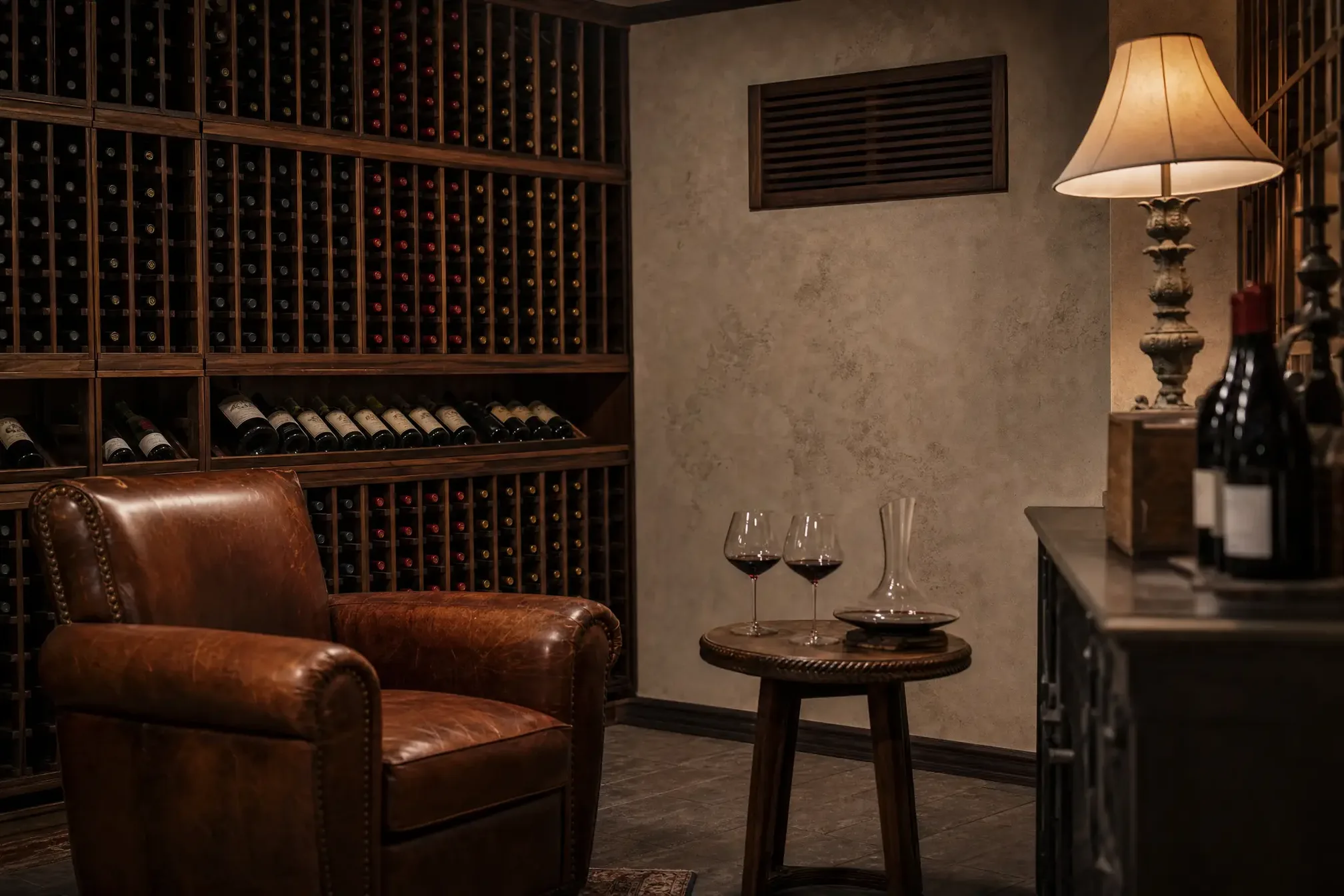
"Which is the quietest wine cellar cooling unit?" is one of the first questions people ask us, usually because the cellar shares a wall with a dining room, a home office, or a bedroom. It is a fair question with an awkward answer: the published numbers can't settle it, because makers measure noise in different places and in different ways, and several don't publish a number at all.
What does settle it is the type of system, where its noisy parts end up, and how it is installed. This guide covers how to read a dBA figure, what makers actually publish, and the practical steps that make any cellar quieter.
What does a dBA number on a cooling unit actually mean?
A dBA figure is a sound level in decibels, A-weighted. A-weighting adjusts the reading to roughly match how human hearing responds to different frequencies, and it is the weighting OSHA's technical manual on noise describes for rating noise.
Three things about decibels change how you should read a spec sheet:
- The scale is logarithmic. OSHA's manual puts it plainly: decibels are logarithmic values, so you can't add or average them like ordinary numbers. Doubling the sound power of a source raises the level by only 3 dB.
- About 10 dB more sounds about twice as loud. As HyperPhysics at Georgia State University explains, a sound's intensity has to rise by a factor of ten (10 dB) before most people perceive it as twice as loud. So a unit rated 55 dBA is not "a bit louder" than one rated 45 dBA under the same test; it is roughly twice as loud.
- Distance changes the number. In open space with no reflections, the level drops about 6 dB each time you double your distance from a small source, per the same OSHA manual. Near reflecting surfaces it drops less. A cellar full of glass, stone, tile, and bottles is a very reflective room, so the sound you hear inside it fades less with distance than an open-air figure suggests.
That last point is why a dBA figure without a stated distance and position is incomplete. A reading taken 3 ft (0.9 m) from a grille and one taken 6 ft (2 m) away can differ by several decibels for the same unit in the same room.
Why can't you compare published noise figures across brands?
Because each maker reports noise its own way. From the maker pages we checked in November 2026:
- CellarPro lists its through-the-wall 1800 Series figures as "dBA (Rear)", meaning the hot side, with no distance on the product page. For its split and variable-speed units it lists a figure for each fan speed, and for splits a separate figure for the condensing unit.
- Wine Guardian gives a single dBA figure on each through-the-wall product page with no distance, while its through-the-wall family page says its Defender units can be as quiet as 48 dBA at 6 ft (2 m).
- Breezaire labels its WKL figures "dB-A (EST)", estimates for the complete unit.
- CellarCool lists two figures on its CX spec sheet: one for the evaporator (cellar side) and one for the condenser (hot side).
- WhisperKOOL, Wine-R and Panthaire describe their units as quiet on the pages we checked but don't publish a dBA figure there.
Add the variables nobody states (the test room, whether the compressor was running, fan speed if the unit has more than one) and two figures from two brands are not measuring the same thing. Treat a published number as a comparison within one maker's range, measured one consistent way. Across brands, use it as a rough signal at best. And "not published" doesn't mean loud; it means you don't have a number.
Which system type is quietest in the cellar, and in the next room?
The biggest factor is where the compressor and condenser fan end up. Our guide to wine cellar cooling units explains the four system types; here is how they compare on noise alone.
| System type | What you hear in the cellar | What you hear next door | The noise lands |
|---|---|---|---|
| Self-contained, through-the-wall | Compressor and both fans, from the wall | Compressor and hot-side fan, from the same wall | On both sides of one wall |
| Self-contained, ducted | Air movement at the grilles, plus some noise carried through the ducts | Depends on where the unit sits | Wherever the unit is installed: a mechanical room, closet, crawl space, or attic |
| Ductless split | The evaporator's fan, from a wall- or ceiling-mounted unit | Little, unless the condensing unit is nearby | Outdoors or in a remote space, with the condensing unit |
| Ducted split | Air movement at the grilles | Little, if the evaporator and condensing unit are well placed | In the remote space holding the evaporator, and with the condensing unit |
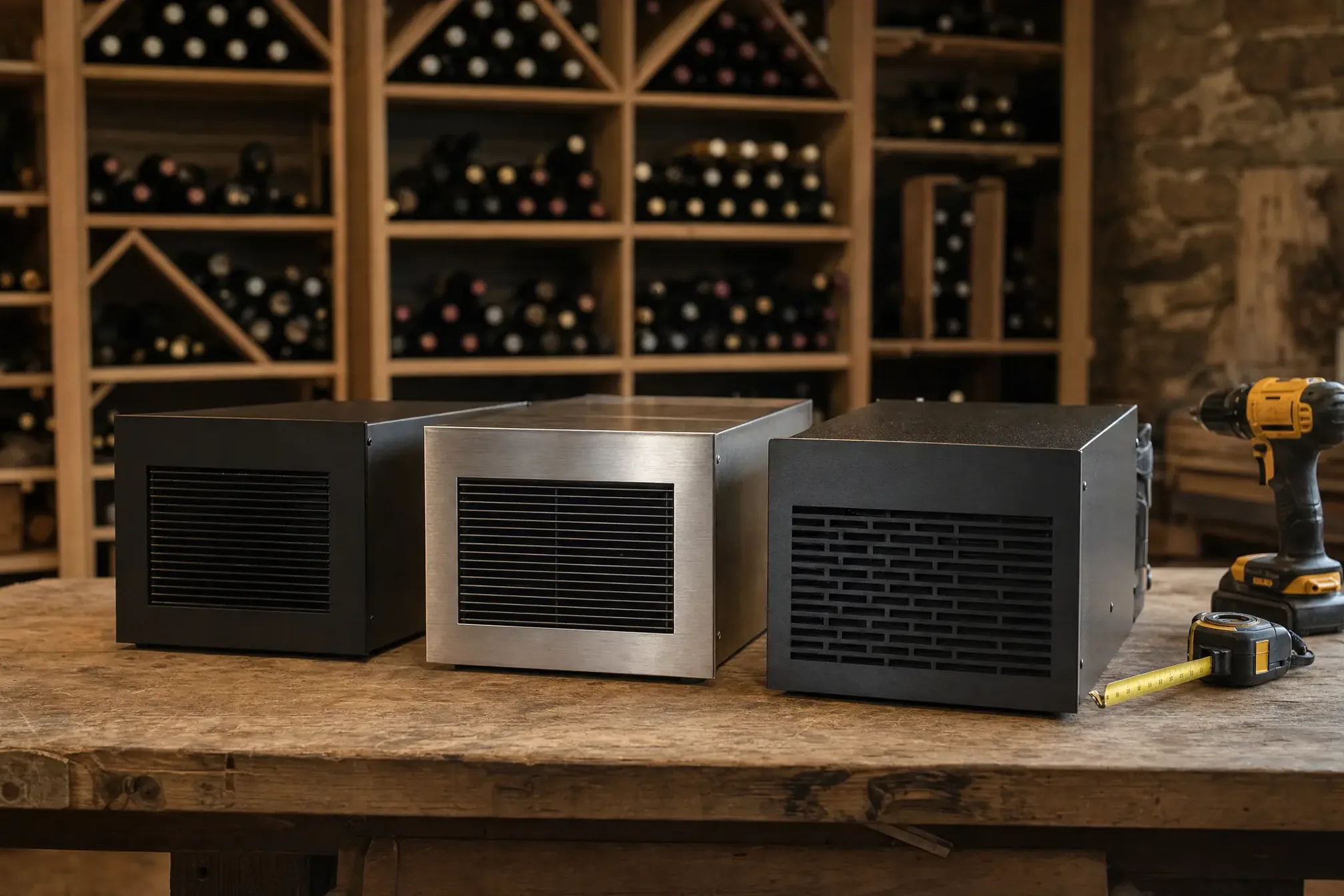
Through-the-wall units are usually the loudest choice inside the cellar and in the room behind it, because the whole refrigeration cycle sits in the wall between them. They are still the right choice for many rooms. If the exhaust side is a storage room, a garage-side utility area, or an unfinished basement, the noise lands somewhere nobody minds. Choosing a through-the-wall unit covers what else to check.
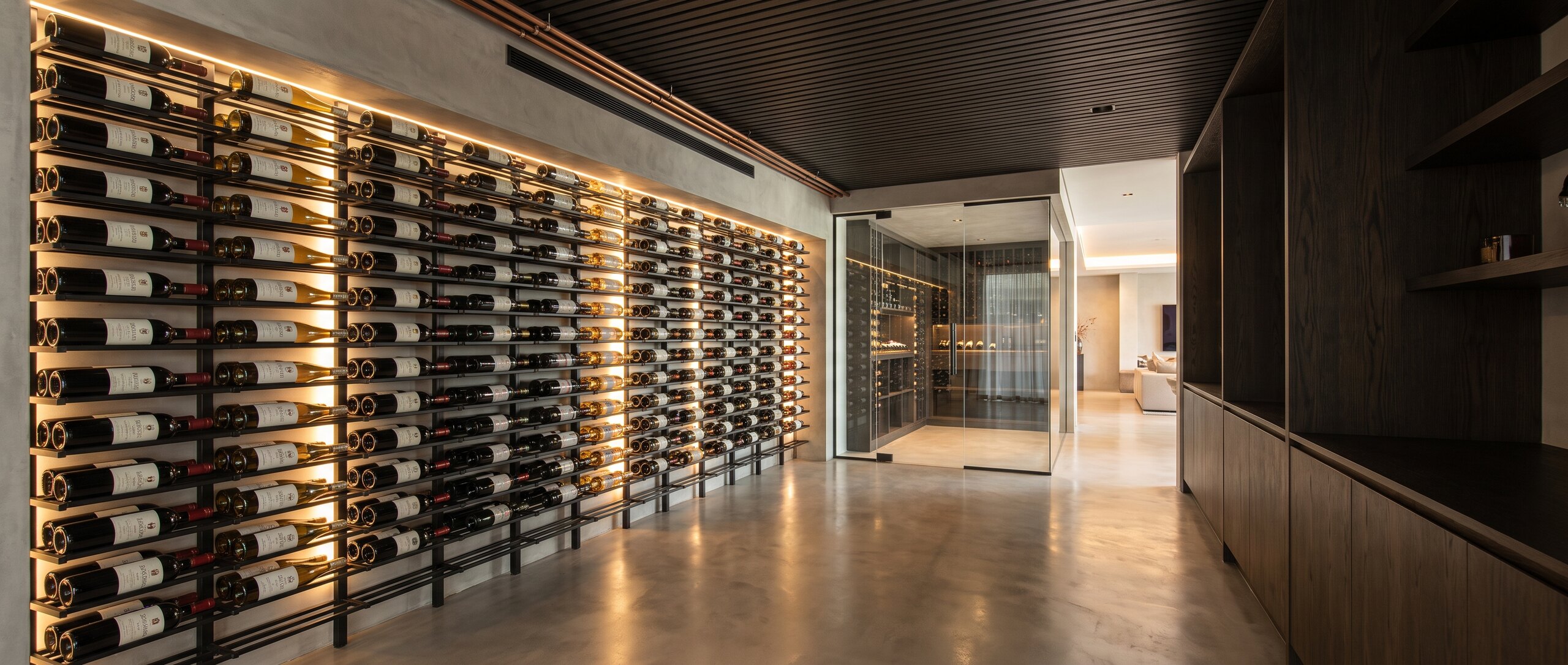
Ducted self-contained units move the box away from both the cellar and the adjacent room. The cellar hears airflow at the grilles. The catch is that the unit's full noise moves with it: a ducted unit in a closet that shares a wall with a bedroom has just moved the problem. Ducted units such as Panthaire's APEX 3500 or Wine Guardian's ducted range suit rooms with a mechanical space or crawl space nearby.
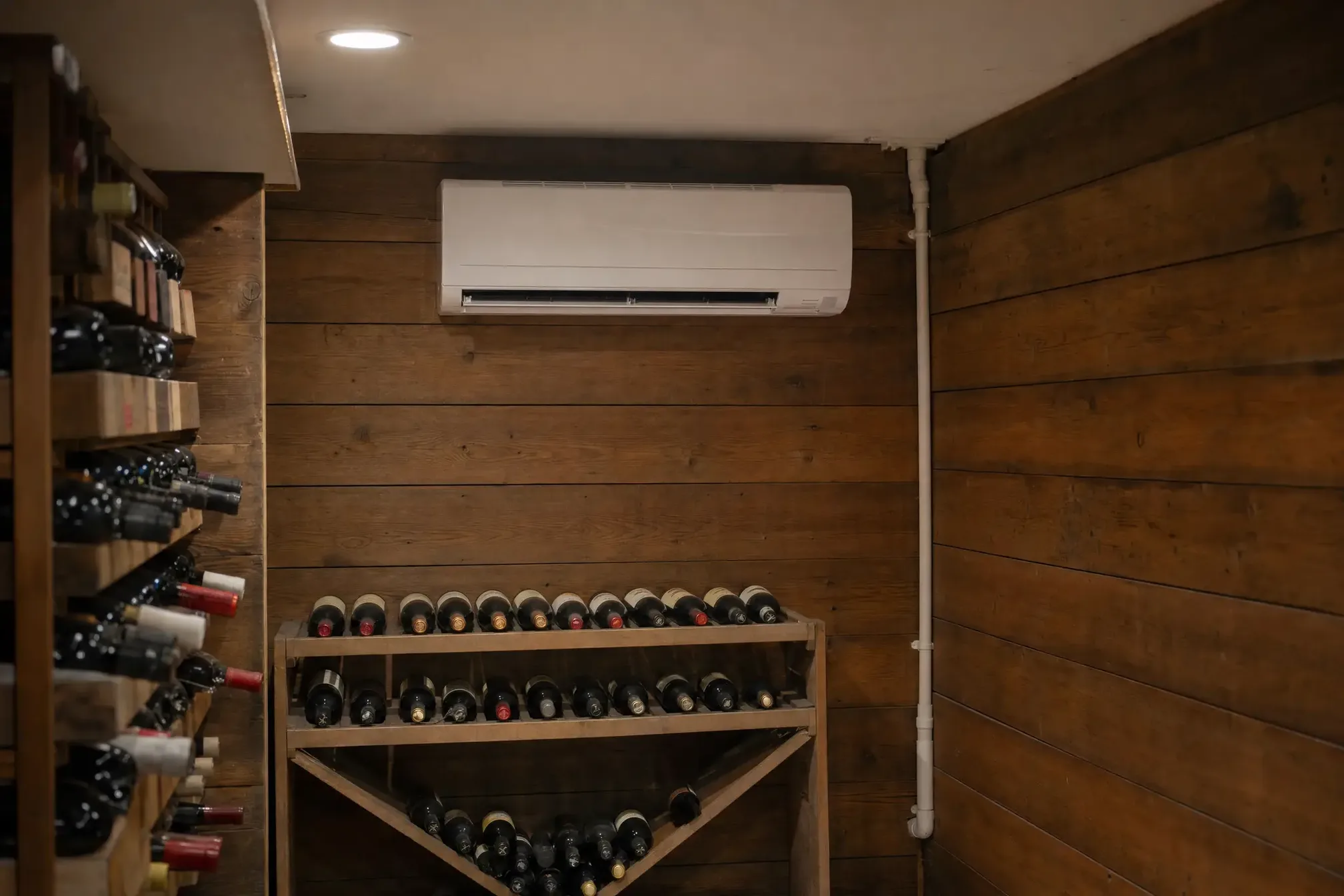
Splits put the compressor outdoors or in a mechanical space, which is why they suit a cellar surrounded by living space. A ductless split leaves an evaporator fan in the cellar; a ducted split removes even that. See self-contained vs ducted split for what a split costs to install.
If the cellar opens onto the room you care most about keeping quiet, and there is no tolerant space beside it, ducted or split is the direction to look, whatever the through-the-wall spec sheets say.
Published noise figures for specific models
The table below lists only what each maker publishes on its own product page or spec sheet, worded as the maker words it. We have not measured any of these units, and the figures are not comparable across brands for the reasons above. Read across a row, not down the column.
| Maker and model | Type | Published noise figure | How the maker describes the measurement |
|---|---|---|---|
| CellarPro 1800QT-HE | Through-the-wall | 45 dBA | "Rear" (hot side); no distance stated |
| CellarPro 1800XT-HE | Through-the-wall | 47 dBA | "Rear"; no distance stated |
| CellarPro 1800XTS-HE | Through-the-wall | 54 dBA | "Rear"; no distance stated |
| CellarPro 3200VSi-ECX | Self-contained, through-the-wall or ducted | 54 / 58 / 66 dBA | Low / medium / high fan speed; no position stated |
| Wine Guardian TTW01B Defender | Through-the-wall | 47.9 dBA | No distance on the product page; family page says Defender units can be as low as 48 dBA at 6 ft (2 m) |
| Wine Guardian TTW02B Defender | Through-the-wall | 54.0 dBA | No distance or position stated |
| Wine Guardian TTW02B Classic | Through-the-wall | 58.0 dBA | No distance or position stated |
| Breezaire WKL 1060 / 3000 / 8000 | Through-the-wall | 41 / 60 / 69 dB-A | Labeled estimates (EST), for the complete unit |
| CellarCool CX2200 / CX3300 | Through-the-wall | 63 / 63 and 63 / 64 dBA | Evaporator / condenser; no distance stated |
| CellarPro Mini-Split 3000S | Ductless split | Evaporator 51 / 55 / 63 dBA; condensing unit 64 indoor, 62 outdoor | Evaporator by fan speed (low / medium / high); no distance stated |
| CellarPro AH3000Scmr-ECX | Ducted split, ceiling-mount evaporator | Evaporator 51 / 55 / 63 dBA; condensing unit 43 / 50 / 55 dBA ducted, 56 / 63 / 68 dBA non-ducted | By fan speed (low / medium / high); no distance stated |
| WhisperKOOL SC PRO series | Through-the-wall | Not published | The page describes reduced noise; no figure given |
| Wine-R WR2500 | Through-the-wall | Not published | The page describes it as quiet; no figure given |
| Panthaire APEX 3500 | Ducted | Not published | The page describes quiet, low-vibration operation; no figure given |
Two things stand out even with those caveats. First, within one maker's range, a smaller unit or a lower fan speed is usually quieter, and the gaps are large: CellarPro's 3200VSi-ECX lists 54 dBA on low fan and 66 dBA on high, a 12 dB spread on the same machine. Second, CellarPro's AH3000Scmr lists its condensing unit 13 dB lower with its ducting than without, which says as much about installation as about the hardware.
How do you make a wine cellar cooling unit quieter?
Most noise complaints we hear about trace to installation, not the model. These are the steps that matter, roughly in order of effect.
Put the noisy side where noise doesn't matter
Decide which room you need quiet before you decide where the unit goes. For a through-the-wall unit, the hot side should face a utility room, storage space, or unfinished area, never a bedroom, office, or media room. For a split, keep the condensing unit away from bedroom windows, patios, and the neighbor's side of the house. A basement wine cellar often has the easiest answer, because a mechanical room is usually close.
Give the exhaust room some size and some soft surfaces
A small, hard-walled closet acts like an echo chamber for a through-the-wall unit's exhaust, and it often runs too hot as well, which makes the unit run longer. A larger room with some soft surfaces absorbs more of the sound. Check the maker's minimum exhaust-room volume and maximum ambient temperature; both affect noise as well as capacity.
Stop vibration from reaching the structure
Much of what people call noise is vibration carried through framing and racking.
- Frame a dedicated opening for a through-the-wall unit and follow the maker's mounting method, so the chassis sits on its bracket or sleeve, not wedged against studs.
- Keep racking from touching the unit or its sleeve.
- Set condensing units and ducted units on isolation pads, or hang them with isolators, rather than bolting them hard to a floor or joist over living space.
- Clamp refrigerant line sets with cushioned clamps so they don't buzz against framing.
Use the ducts to absorb sound, within the maker's limits
On ducted systems, insulated flexible duct and a bend or two between the unit and the grille absorb some fan and compressor noise before it reaches the room, and duct silencers can do more. The limit is airflow: every extra foot, bend, and silencer adds resistance, and a unit pushing air through too much resistance loses capacity and runs longer. Stay within the maker's maximum duct lengths and static pressure, and size grilles generously so air leaves them slowly. Fast air through a small grille whistles.
Size the unit to the load
An oversized unit short-cycles: it starts, cools quickly, stops, and starts again. Every start is the loudest moment of a cycle, so a unit that cycles often is noticed more often. A right-sized unit runs longer, steadier cycles. Run the BTU calculator, and see how to size cellar cooling for what drives the load. Buying the next size up "to be safe" usually makes a cellar louder, not quieter.
Use the fan settings
If a unit has fan-speed settings, low fan is the quiet setting, and as the CellarPro figures above show, it can be much quieter. It also delivers less cooling. In a room with a modest load, low fan may hold 55°F (13°C) comfortably; in a room near the unit's limit, it may not. Try it, then watch a temperature log for a week of warm weather before you leave it there.
Build an envelope that blocks sound too
The insulation and solid, sealed door that a cellar needs for temperature also cut sound. Our guide to insulation and vapor barriers covers the walls, and our guide to wine cellar doors covers the door. Glass walls do the opposite on both counts: they reflect sound inside the cellar and pass more of it through to the next room.
Keep it maintained
A unit that used to be quiet and isn't anymore is telling you something.
- Dirty condenser coils and filters make the unit run longer and harder.
- Loose panels, screws, and grilles rattle. Tighten them.
- A fan that grinds, ticks, or hums unevenly may have worn bearings or a blade fouled by dust; have it checked before it fails.
- A new clunk at start or stop can be a loose mount or a failing component. It is worth a service call.
If you are planning a cellar beside a room that has to stay quiet, the system type and layout decisions are the ones to get right early, and our experts can help you weigh them before the walls close.
FAQ
Frequently asked questions
- What is the quietest wine cellar cooling unit?
- The published numbers can't answer that across brands, because makers measure in different places and ways, and several publish no figure. The quietest setups are usually ducted or split systems that put the compressor outside the cellar and away from living space. Within one maker's range, smaller units and lower fan speeds generally list lower dBA figures.
- How loud is a wine cellar cooling unit?
- Published figures for the models we checked range from about 41 to 69 dBA, but they are measured at different positions and distances, so they are not directly comparable. A through-the-wall unit is heard in the cellar and in the room behind it; a split or ducted system moves most of the noise elsewhere.
- Is 10 dB a big difference?
- Yes. Decibels are logarithmic, and a 10 dB increase is generally perceived as about twice as loud. A unit at 55 dBA sounds roughly twice as loud as one at 45 dBA, if both were measured the same way.
- Are through-the-wall wine cellar units noisy?
- They are usually the loudest system type, because the compressor and both fans sit in the cellar wall and are heard on both sides. They work well when the exhaust side is a room where noise doesn't matter, such as a storage or utility room.
- How can I make my wine cellar cooling unit quieter?
- Put the noisy side away from rooms that need quiet, isolate the unit and line sets from framing and racking, use insulated flexible duct within the maker's limits on ducted systems, size the unit to the load so it doesn't short-cycle, try a lower fan speed if the unit has one, and keep coils, filters, and fasteners maintained.
New guides from people who build cellars, sent to your inbox.
Planning a cellar? Ask the people who build them.
Contact our expertsKeep reading