guide
Wine cellar racks: how to choose racking for your cellar
A builder's guide to wine cellar racking: wood, metal, and acrylic, slots versus bins versus label-forward rows, bottles per foot, oversize bottles, anchoring, airflow, and kit versus custom.
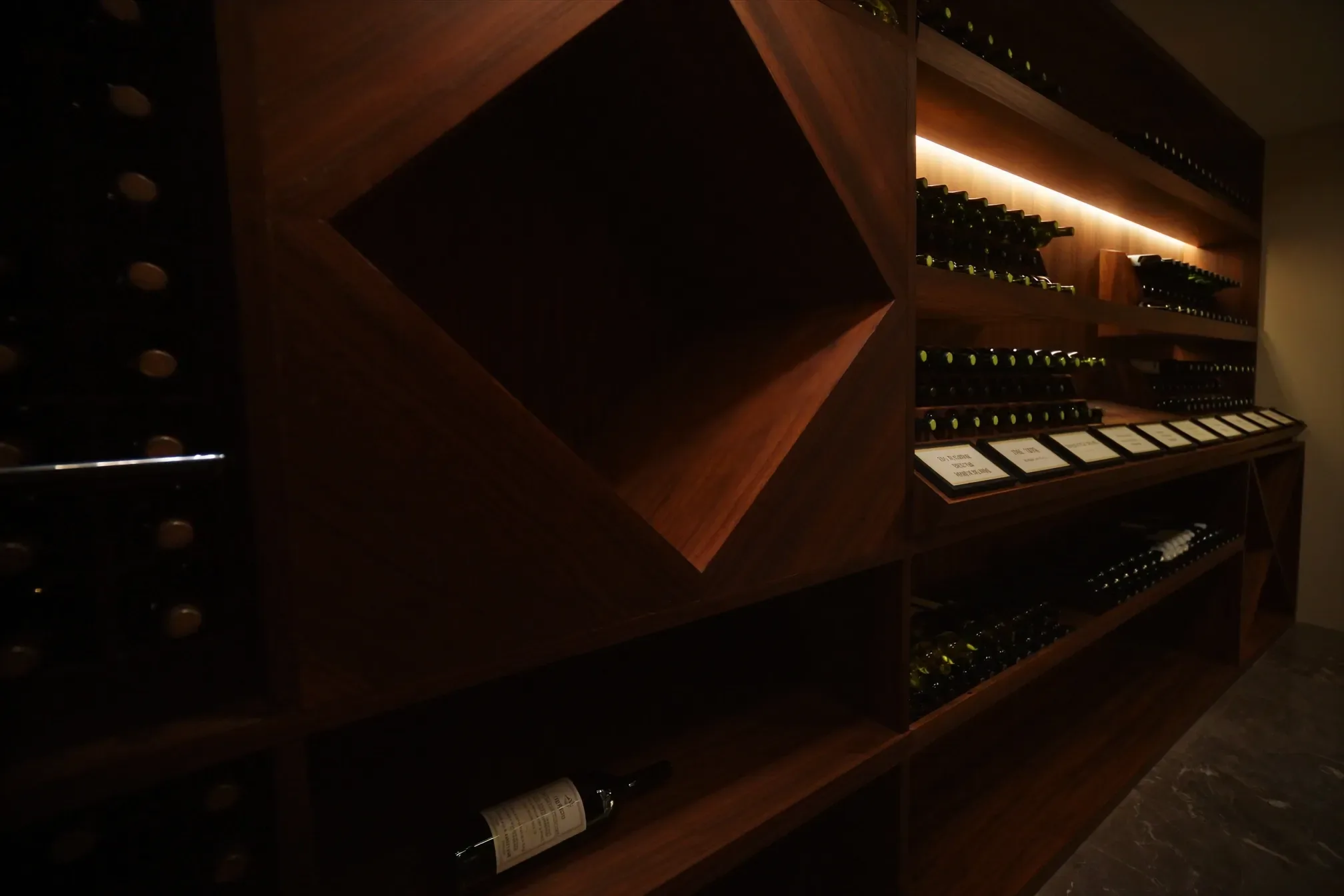
Racking is the part of a cellar people see, so it gets chosen for looks. It also decides how many bottles fit, whether you can find them, and whether the cooling unit can move air around the room. A rack that blocks the cooling grille, or slots too narrow for Champagne, will annoy you for as long as you own the cellar.
Here is how we choose wine cellar racks: materials, storage styles, capacity, the structural and airflow details, and the mistakes we keep seeing.
Start with the collection, not the catalog
Before you look at a single rack, answer three questions:
- How many bottles do you own, and how fast is that growing?
- What shapes are they? Burgundy, Champagne, and magnums need different slots than Bordeaux bottles.
- How do you buy? Case buyers need case storage or bins. Single-bottle buyers need individual slots and a way to find them.
The answers set the mix of storage styles. The material comes after.
Wood racking
Wood is still the default for traditional cellars. It is easy to fit to a room and forgiving of bottles that are not quite standard. The species matters more than the stain.
- Redwood. The classic cellar wood. Heart redwood is naturally resistant to rot and mildew and has very little odor, which suits a sealed, humid room. It is usually left unfinished or given a clear finish.
- Mahogany. Dense, stable, and takes stain evenly, so it is the usual choice for darker, furniture-grade racking. Ask which species you are getting, because several different woods are sold as "mahogany."
- Pine. Cheap and common in kits. In a dry, stable cellar it is fine. In a cellar held near 60 to 70% relative humidity, unfinished pine absorbs moisture and is more prone to mold than redwood or mahogany. If you use pine in a humid room, seal it, or spend the difference on a more resistant species.
Why the finish matters
A cellar is a small, sealed room with the air recirculating through the cooling unit. Whatever the racking gives off stays in there. Solvent-based stains and lacquers can smell for weeks in that environment, and nobody wants a cellar that smells of finish.
We use unfinished wood or water-based, low-VOC finishes, and we let any finish cure fully, with the room ventilated, before wine goes in. Whether odors can pass through a cork and affect wine is debated. It is not worth finding out with your collection.
Metal racking
Metal racking is the backbone of most modern cellars. It takes up less visual space than wood and puts the label in front of you.
- Label-forward peg and rod systems. Pegs or rods mounted to the wall or to posts, holding bottles horizontally with the label facing out. Many systems hold bottles one, two, or three deep on each peg, which changes capacity a lot.
- Cable systems. Tensioned stainless cables run floor to ceiling, with bottle holders clamped along them. They look light and architectural, but they hold fewer bottles per square foot than almost anything else. Use them for a feature wall, not for the bulk of a collection.
Specify powder-coated or stainless finishes. Raw or painted steel can rust in a room held at cellar humidity, and rust stains labels. For how metal racks fit a glass-forward room, see designing a modern wine cellar.
Acrylic racking
Clear acrylic rods or panels make bottles look like they float. It is a display material for a feature wall or small showcase, not main storage. It scratches more easily than metal, and lower grades can yellow over time, so ask the maker which grade they use.
Mixed racking
Most of the cellars we build mix materials: a wood or metal structure for bulk storage, with a band of label-forward metal at eye level for the bottles you want to see. That gives you capacity where nobody looks and display where everybody does.
Storage styles and how many bottles they hold
Each storage style trades capacity against access. The figures below are per square foot of rack face for single-deep racking, and they are rough. Real numbers depend on the exact slot size, depth, and the bottles you put in.
| Storage style | Approx. bottles per sq ft of face | Access | Best for |
|---|---|---|---|
| Individual slots | About 9 to 10 | Every bottle reachable on its own | Most collections, single-bottle buyers |
| Diamond bins and bulk bins | Often more than individual slots, especially in deeper bins | Poor: bottles stack, labels hidden | Multiples of the same wine |
| Label-forward, one deep | Roughly 3 to 5 | Excellent: every label visible | Display, the bottles you reach for |
| Label-forward, two or three deep | Roughly 6 to 12 | Good for the front row only | Display with some depth |
| Case storage | Depends on case size, often comparable to slots | Poor until the case is open | Case buyers, wine you are holding |
| Display rows (angled or tabletop) | Low | Excellent | A few featured bottles, open bottles |
| Magnum and large-format slots | Low | Good | Magnums and larger |
A few notes on each:
- Individual slots are the workhorse: you can pull any bottle without moving others. Number the columns or use one of the wine cellar inventory apps so you can find things.
- Diamond bins and rectangular bulk bins stack bottles on each other. Dense and cheap, but you dig for the bottom bottle and labels rub. Keep them for wine you own in sixes and twelves.
- Label-forward display is the most attractive and the least dense. Limit it to a band, usually at eye level.
- Case storage is open shelving sized for full cases. Cardboard in a humid cellar can mold, so wooden cases or unpacked bottles last better.
- Magnum and large-format slots need wider, deeper cells. Draw them in from the start, because adding them later usually costs a whole column.
Planning capacity
For individual single-deep racking at about 9 to 10 bottles per square foot of face, a full-height wall section around 7 feet (2.1 m) tall holds roughly 55 to 70 bottles per linear foot of wall. A 10-foot wall of individual slots is therefore somewhere around 550 to 700 bottles. Display rows, bins, corners, and the door swing all pull that number down.
To plan a room:
- Measure each wall you can rack, then subtract the door swing, the cooling unit's clear zone, and any outlets or switches.
- Decide which bands are individual slots, which are display, and where bins and large-format cells go.
- Add up the capacity of each band.
- Leave 20 to 30% growth room above what you own today. Collections grow, and a cellar that is full on day one forces bottles back into the kitchen.
Planning the layout in 3D before you buy helps more than people expect, especially for checking the door swing and the cooling grille.
Bottle sizes: the Champagne problem
A standard Bordeaux bottle is about 3 inches (76 mm) across. Burgundy bottles are wider, and Champagne bottles wider again, commonly around 3.5 inches (89 mm) and sometimes more. Many standard racks have individual slots around 3.5 inches wide. Bordeaux slides in easily. Burgundy usually fits. Some Champagne and heavier sparkling bottles are tight or will not fit at all.
What we do:
- Ask for the clear opening of the slot, not the column spacing.
- Specify a band of oversize slots, around 3.75 to 4 inches (95 to 100 mm) wide, if you hold much Burgundy, Rhône, or sparkling wine.
- Plan magnum cells at roughly 4.5 inches (115 mm) wide or more, with extra depth, since magnums are also longer.
- Measure your own bottles. Producers vary, and the outliers are usually the bottles you care about most.
Anchoring, loads, and seismic considerations
Wine is heavy. A full 750 ml bottle weighs about 3 lb (1.4 kg). A 3-foot section of individual racking 7 feet tall holds around 200 bottles, which is about 600 lb (270 kg) of wine before you count the rack itself.
- Anchor every tall unit to the wall. Fasten into studs or solid blocking, not drywall alone. Racking that is only leaning on a wall can tip forward as it fills unevenly, or when someone pulls on a column.
- Check the floor. A slab handles a full wall of wine without difficulty. A framed floor is different: a long, fully loaded wall concentrates far more weight on a narrow strip than typical residential floor design assumes. On a framed floor, have someone qualified check before you install floor-to-ceiling racking.
- Shim to level. Basement slabs are rarely flat. A rack that is out of level loads unevenly and looks wrong.
- In seismic regions, tie racks to the structure at the top as well as the base, bolt freestanding islands to the floor, and consider retaining lips or bars on bins and display rows so bottles cannot walk out in a shake. Follow local code and the rack maker's seismic details.
Airflow behind and around the racks
The cooling unit has to move air through the whole room. Racking is the biggest thing in its way.
- Leave a gap behind the racks. Mount racks off the wall by about an inch (25 mm) or so, using cleats or spacers, so air can move behind them. This also keeps the back of the rack away from any wall surface that runs warmer or damper than the room.
- Keep the cooling unit's grilles clear. Manufacturers specify clear space in front of the supply and return. The figures we see in manuals range from about 8 to 12 inches up to 3 feet, depending on the model. Check the manual for your unit before you draw the racks around it.
- Do not box the unit into a rack niche that is tighter than the manual allows. Cold air blown straight into a wall of bottles comes back to the return, and the unit short cycles.
If you have not chosen the unit yet, our overview of wine cellar cooling units explains the types, and the BTU calculator sizes one for the room. The racks do not change the load much. Glass, insulation, and how often the door opens do.
Lighting the racks
Lighting belongs in the rack plan, because the wiring has to run through it.
- LED only. Halogen and incandescent fixtures add heat that the cooling unit has to remove.
- Put drivers and transformers outside the cellar, or at least somewhere they can be reached and do not sit against bottles.
- Light the labels. Strips under each display shelf or along the rack uprights read better than ceiling fixtures.
- Warm white, high CRI. We use 2700K to 3000K with a CRI above 90.
- Keep it off when nobody is in the room. A door switch or occupancy sensor helps, since the ideal cellar is dark most of the day.
- Plan the wiring first, so channels and cable exits are cut in the shop, not drilled on site.
Kit vs custom racking
Modular kits come in standard widths and heights, in pine, redwood, or metal. They are the cheapest route, often a few dollars per bottle for basic wood or metal, and they go together in a weekend. The trade-off is the room: standard modules rarely fit a wall exactly, so you end up with gaps at the ends, awkward corners, and a soffit or slope left empty.
Custom racking is built to the room's measurements. It fills corners, follows a stair slope, wraps around the cooling unit, and sets display rows exactly where you want them. It costs several times more per bottle once design, finishing, and installation are included, and lead times run to weeks.
A middle path works well: kit modules for the long, plain walls, and custom pieces for corners, display bands, and anything irregular. In awkward spaces such as a cellar under the stairs, custom almost always earns its cost.
Common mistakes
- Racking before the room is finished. Insulation, vapor control, and cooling come first. Our guide on how to build a wine cellar covers the order.
- Ignoring the door swing. An in-swinging door takes a quarter circle of wall you cannot rack. See wine cellar doors.
- Blocking the cooling unit. Racks right up against the grille are the most common airflow problem we see.
- Slots too narrow for the collection. One band of oversize slots costs little at design time and a lot later.
- No anchoring. Every tall unit gets fastened to the structure.
- Too much display. Label-forward rows across every wall look great and hold a fraction of what slots hold.
- No room to grow. Plan 20 to 30% beyond what you own.
- Pine in a humid room, unsealed. It is the rack most likely to mold.
If you would like a second opinion on a layout before you order racking, contact our experts. For how bottles should sit once they are in the racks, see how to store wine.
FAQ
Frequently asked questions
- How many bottles fit per square foot of wine rack?
- Single-deep individual racking holds roughly 9 to 10 bottles per square foot of rack face. A full-height wall section about 7 feet tall holds roughly 55 to 70 bottles per linear foot. Bins hold more, label-forward display holds much less.
- What is the best wood for wine cellar racks?
- Redwood and mahogany are the most common choices for cellars because they resist moisture and rot and stay stable. Pine is fine in a dry, stable room but more prone to mold in a humid cellar, so seal it or choose a more resistant species. Use unfinished wood or water-based, low-VOC finishes.
- Will Champagne bottles fit in a standard wine rack?
- Not always. Many standard individual slots are about 3.5 inches wide, and Champagne bottles are commonly around 3.5 inches across or more. Plan a band of oversize slots around 3.75 to 4 inches wide for Champagne, Burgundy, and other wide bottles, and separate cells for magnums.
- Do wine cellar racks need to be anchored?
- Yes. A 3-foot section of full-height racking can hold around 600 pounds of wine. Fasten every tall unit to the wall structure, and in seismic regions also tie racks at the top, bolt freestanding units to the floor, and add retaining lips where bottles could slide out.
- How much clearance does a wine cellar cooling unit need from racks?
- It depends on the model. Manuals we have seen call for anywhere from about 8 to 12 inches up to 3 feet of clear space in front of the supply and return grilles. Check your unit's installation manual before laying out the racks.
- Is a racking kit or custom racking better?
- Kits are cheaper and quick to install but come in fixed sizes, so they waste corners and odd spaces. Custom racking fits the room exactly and costs several times more per bottle. Many cellars use kits on straight walls and custom pieces for corners and display.