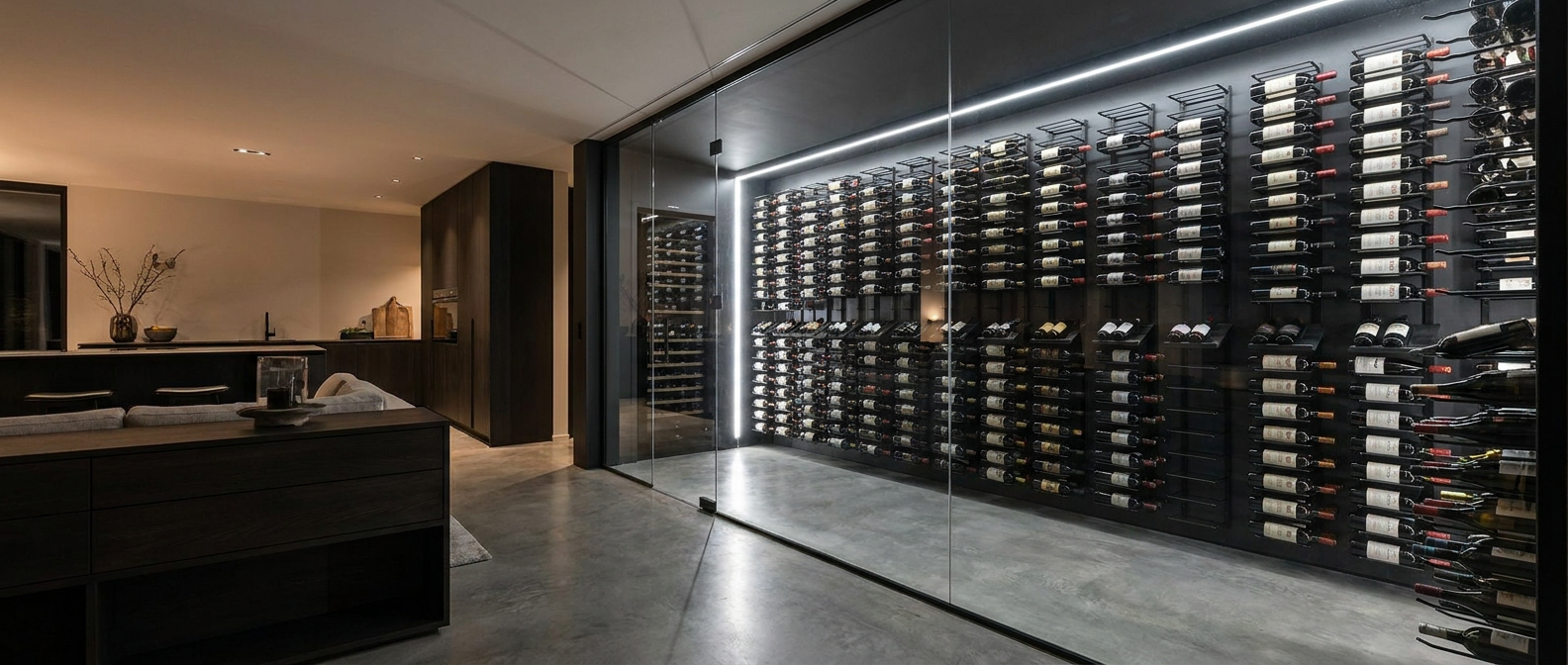
guide
Basement wine cellar: how to build one that works in every season
A builder's guide to the basement wine cellar: whether your basement is cool enough, where to put the room, how to insulate foundation walls and slab without trapping moisture, and when you need active cooling.
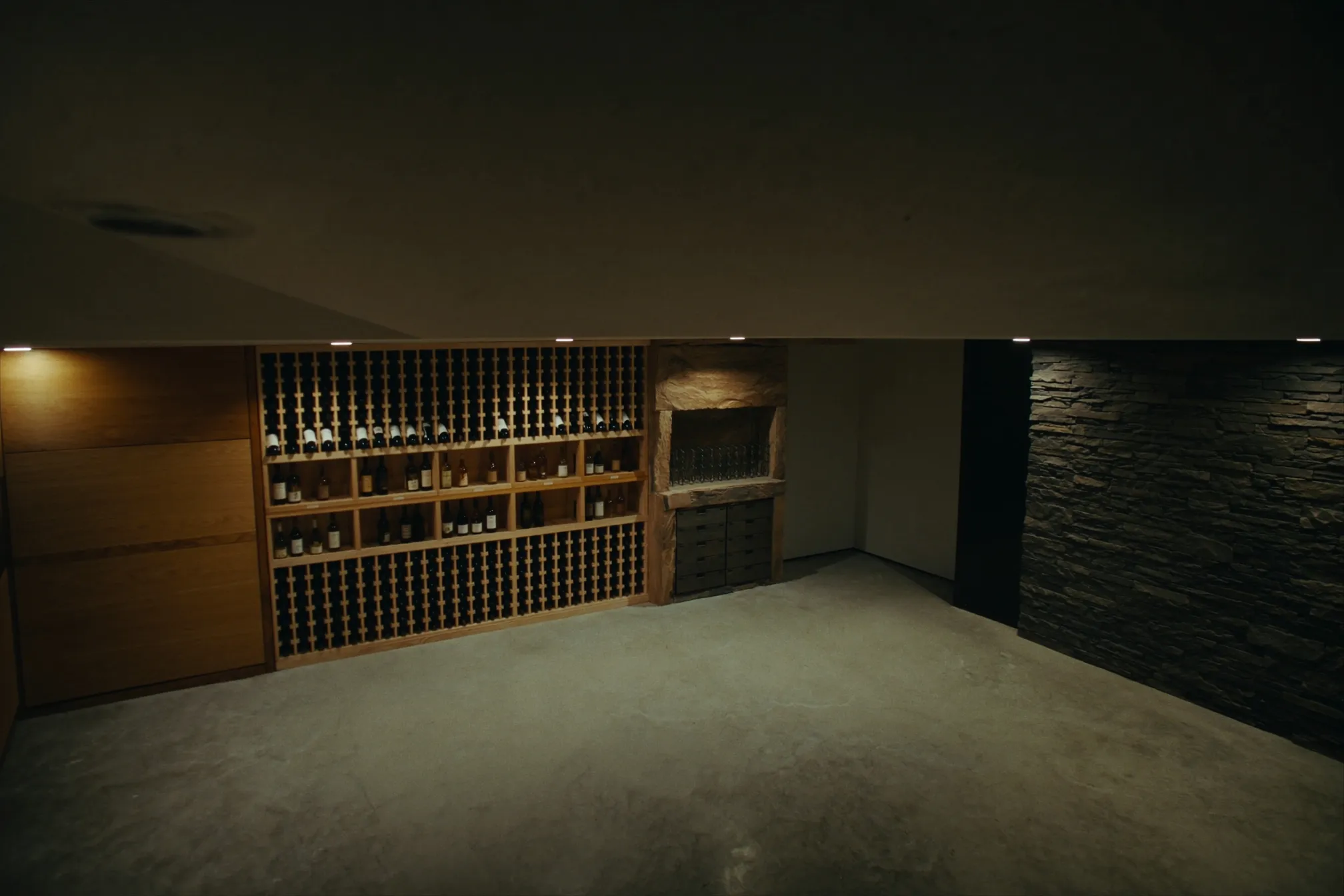
The basement is the most common place to build a wine cellar: below grade, out of the sun, and usually the coolest part of the house. It is also where we see the most cellars built the wrong way: poly stapled over damp concrete, or a cooling unit dumping heat next to the furnace.
We design and build cellars in Québec, where the ground is cold, the winters are dry, and the summers are humid. That climate punishes shortcuts. Here is how we approach a basement wine cellar, from "is it cool enough down there" to the checklist we run before framing.
Is your basement naturally cool enough?
Wine wants a steady temperature around 55°F (13°C) and humidity in the 50 to 70% range. Our guide to ideal cellar temperature and humidity covers why. The question is whether your basement holds that without help.
Usually it does not, at least not all year. "It's cold down there" is almost always a winter observation. In a heated house, a finished basement often sits at 60 to 65°F (16 to 18°C) in winter and climbs toward 68 to 72°F (20 to 22°C) by August.
Before you decide anything, measure. Leave a logging thermometer and hygrometer in the exact spot through at least one summer. What you want to know:
- The summer peak. If the spot stays under about 65°F (18°C) at the hottest point of the year and changes slowly, a passive cellar is realistic.
- The daily swing. Wine tolerates slow seasonal drift far better than daily cycling. A spot that moves 5°F in an afternoon is near a heat source.
- The humidity. Summer readings above 75 to 80% tell you the room needs moisture control before it needs anything else.
Choosing the location
In a basement, location does more than any piece of equipment. In order of preference:
- A north or east corner, below grade on two sides. Two foundation walls give you two faces coupled to cool ground.
- Away from heat sources. Keep the cellar off walls shared with the furnace room, water heater, laundry, and any room with a wood stove or gas fireplace.
- Away from sun-exposed exterior walls. A south or west wall with the top 2 or 3 feet above grade picks up real heat in summer.
- Clear of mechanical runs. Supply ducts and hot water lines in the ceiling are heaters inside your cellar. Reroute or insulate them.
- Near a place for the exhaust heat, if you will need active cooling.
A small wine cellar in the basement, say 4 by 6 feet, fits in a corner most people never use. The space under the stairs is another option, covered in building a wine cellar under the stairs.
Foundation walls and moisture
This is where basement cellars succeed or fail. Concrete is never fully dry: it wicks moisture from the soil into the room. Your job is to insulate it without creating a cold surface where moisture collects and gets trapped.
Fix the water first. Efflorescence, leaks, or a wall that is wet every spring means a grading, gutter, or drainage problem. No insulation detail survives bulk water.
Do not put polyethylene against the concrete. This is the classic basement mistake. Poly stapled to a framed wall, with fiberglass batts between it and the concrete, creates a cavity where humid air reaches the cold concrete, condenses, and cannot dry in either direction. Poly laid directly on the concrete traps moisture behind it the same way. Either version can mean mold in the wall within a few seasons.
Insulate the concrete with foam that bonds to it. The approach most building scientists recommend for basement walls is rigid foam board (XPS, EPS, or foil-faced polyiso) glued or fastened tight to the concrete with taped seams, or closed-cell spray foam sprayed directly onto it. With no air gap, there is no cold surface for room air to reach. At typical thicknesses, around 2 inches, closed-cell spray foam and foil-faced board act as a vapor retarder in their own right, and XPS comes close.
Then frame inside the foam. A stud wall in front of the foam carries more insulation, wiring, and racking. We use unfaced batts or mineral wool there, and we avoid a second sheet of poly on the cellar face. Two vapor barriers with insulation between them is a moisture trap.
Two code notes. Vapor barrier rules for below-grade walls vary by jurisdiction; in Canada the default is a warm-side vapor barrier and some inspectors expect one on basement walls, so talk to your building department before you frame. And exposed foam almost always needs a thermal barrier, typically 1/2-inch drywall, for fire safety.
The slab floor
A slab sits close to ground temperature, often 45 to 55°F (7 to 13°C) several feet down in a cold climate. That cool mass is an asset:
- For a passive cellar, we often leave the slab uninsulated, or insulate only a perimeter strip, so the room stays coupled to the ground.
- For an actively cooled cellar in a warm basement, rigid foam under a floating subfloor cuts the load. The trade-off is lost ceiling height, often 2 inches or more.
Flooring has to tolerate steady 60 to 70% humidity. Sealed concrete, tile, stone, and brick are the safe choices. Avoid carpet, and avoid solid hardwood laid directly on a slab.
Interior walls and ceiling
Walls facing the rest of the basement are ordinary framed walls built to a higher standard. Aim for at least R-19 in the walls and R-30 in the ceiling, the same targets we use for any cellar in our guide to choosing a through-the-wall cooling unit. On these walls, the heated basement is the warm side, and the vapor retarder goes on that side of the insulation.
The ceiling is the part most people get wrong. Above it is heated living space, so the warm side is up, not down. A poly sheet stapled to the underside of the joists is on the cold side, exactly where it should not be. The practical answers are closed-cell spray foam in the joist bays, which handles insulation, air sealing, and vapor control in one layer, or rigid foam with every seam taped. Seal every penetration, and cap any HVAC register in the space.
Passive or active cooling?
| Passive | Active | |
|---|---|---|
| Works when | The spot stays under about 65°F year-round and changes slowly | The basement climbs into the high 60s or 70s in summer |
| Envelope | Often lighter insulation, slab coupled to the ground | Full insulation and vapor control on every face |
| Humidity | Needs monitoring, may need a dehumidifier in summer | Unit removes moisture when it runs; may need a humidifier in winter |
| Cost and noise | Low cost, silent | Equipment, power, and a place for the exhaust heat |
Passive basement cellars work well in cold climates. If your logged summer peak supports it, read our guide to designing a small passive cellar. If the numbers are borderline, build the envelope for active cooling anyway. Adding a unit later is easy. Adding insulation after the racks are in is not.
Cooling options, and where the heat goes
Every cooling unit moves heat out of the cellar and puts it somewhere else.
- Through-the-wall units exhaust into the room behind them. That room needs to be large enough to absorb the heat and stay within the unit's rated ambient range all year. A small closet will overheat.
- Ducted self-contained units duct both supply and exhaust, so the heat can go to a larger space.
- Split systems put the condenser outdoors and send the heat outside. In a cold climate, the outdoor unit may need a low-ambient kit to run in winter, which your installer should spec.
Basements add two details. Many have no floor drain where you want one, so plan a condensate pump. And a cold winter basement can drop below a unit's minimum operating temperature.
Size the unit with our BTU calculator and read how to size cellar cooling, then compare types in self-contained vs ducted split and our overview of wine cellar cooling units.
Humidity: dry winters, damp summers
Cold-climate basements live two lives. In summer, the air is humid and the cellar risks mold on labels and racks. In winter, heated indoor air drops to 20 to 30% relative humidity, and a cellar that leaks air to the house dries out with it.
A tight envelope is the first defense in both seasons. An active unit usually handles summer, since it dehumidifies as it runs. Winter is harder: the unit barely runs and the room can drift below 50%. Plan for a humidifier if your winter readings call for it.
The door
A standard interior door leaks on all four edges. Use an insulated exterior-grade door with full perimeter weatherstripping and a sealed threshold or door bottom. Our guide to wine cellar doors covers the options, and glass wine cellars covers what changes if you want to see in.
Checklist before framing
- Logged a full summer of temperature and humidity at the exact spot.
- Fixed any water on the foundation walls and slab.
- Chosen the corner away from the furnace, water heater, laundry, and sun-facing walls.
- Rerouted or insulated ceiling ducts and hot water lines.
- Confirmed vapor control with your building department for the foundation walls, partition walls, and ceiling.
- Decided passive or active, and if active, where the exhaust heat and condensate go.
- Tested for radon, since you are about to seal a basement room. Health Canada and the US EPA both recommend testing basements.
If you want a second set of eyes on the plan, contact our experts. For layout and finishes beyond the basement specifics, see designing a modern wine cellar.
FAQ
Frequently asked questions
- Is a basement a good place for a wine cellar?
- Usually, yes. A basement is below grade, out of the sun, and coupled to cool ground, so it needs less cooling than other rooms. Most basements still warm up in summer, so measure the actual spot through a full summer before choosing passive or active cooling.
- Is my basement cold enough to store wine without a cooling unit?
- Only if the exact spot stays under about 65°F at the hottest point of the year and changes slowly. Many basements feel cold in winter but reach 68 to 72°F by late summer, especially near the furnace or water heater.
- Should I put a vapor barrier on basement walls for a wine cellar?
- Not as polyethylene against the concrete. The common approach is rigid foam or closed-cell spray foam bonded directly to the foundation wall, which acts as the vapor control, followed by a framed wall without a second sheet of poly. Rules for below-grade walls vary by jurisdiction, so confirm the detail with your local building department.
- How do you insulate a basement wine cellar ceiling?
- Treat the heated room above as the warm side. Closed-cell spray foam in the joist bays is the simplest option because it insulates, air seals, and controls vapor in one layer. Rigid foam with taped seams also works. Avoid stapling poly to the underside of the joists, which puts the barrier on the cold side.
- Where does the heat go from a basement wine cellar cooling unit?
- A through-the-wall unit exhausts into the room behind it, which must be large enough and stay within the unit's rated temperature range. Ducted units can send the heat to a larger space, and split systems send it outdoors through a condenser.